






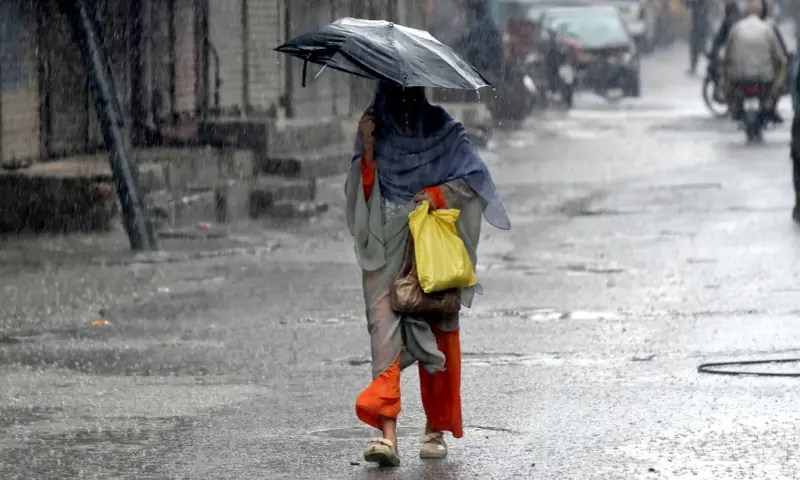
As monsoon rains continued to impact parts of the country, the National Disaster Management Authority (NDMA) reported seven additional fatalities in Punjab and three in Khyber Pakhtunkhwa (KP), elevating the national death toll since June 26 to over 100.
According to the NDMA’s 24-hour situation report up to 1pm, districts in Punjab such as Gujrat and Okara each recorded two deaths, while single fatalities were reported in Sargodha, Narowal, and Sialkot. In KP, Hangu and Shangla accounted for two and one death respectively, with confirmed causes including house collapses, electrocutions, and drowning incidents.
Accompanying these losses, at least 47 individuals were injured in Punjab, alongside three more in Hangu, KP, during the reported period.
NDMA data confirms the country has suffered a total of 107 monsoon-related deaths since June 26, with KP alone accounting for 55 fatalities—the highest among all regions. Punjab followed with 36 deaths, while AJK, Balochistan, Sindh, and Gilgit-Baltistan reported 7, 6, 2, and 1 fatalities respectively.
A New Wave of Rainfall Expected to Begin on July 29 in Upper Regions
The Pakistan Meteorological Department (PMD) forecasts a new wet spell likely to commence from July 29 in the upper catchments of major rivers, Iranabad, and regions in AJK, KP, and Gilgit-Baltistan.
However, no flood-triggering rainfall is anticipated until July 28 (Tuesday).
For the 24 hours leading up to Monday noon, the PMD predicts scattered rain-wind/thunderstorms over upper river catchments, along with Islamabad, AJK, and GB.
Here is the provincial forecast for the period leading up to Monday noon:
Khyber Pakhtunkhwa:
Abbottabad, Batagram, Buner, Chitral, Haripur, Kohat, Kohistan, Mansehra, Mardan, Nowshera, Shangla, Swabi, Swat, Tor Ghar, and Dir.
Punjab:
Attock, Bahawalnagar, Bahawalpur, Chakwal, Chiniot, Dera Ghazi Khan, Faisalabad, Gujranwala, Gujrat, Hafizabad, Jhang, Jhelum, Kasur, Khanewal, Khushab, Lahore, Lodhran, Mandi Bahauddin, Multan, Muzaffargarh, Nankana Sahib, Narowal, Okara, Pakpattan, Rawalpindi, Sahiwal, Sargodha, Sheikhupura, Sialkot, Toba Tek Singh, and Vehari.
Sindh:
Badin, Hyderabad, Matiari, Mirpurkhas, Sanghar, Tando Allahyar, Tando Muhammad Khan, Tharparkar, and Umerkot.
Karachi is forecast to experience cloudy, humid weather with light rain/drizzle and possible thunderstorms/rain at its outskirts on Sunday. From Monday to Tuesday, the city will remain cloudy with isolated drizzle.
Balochistan:
Barkhan, Duki, Kalat, Khuzdar, Kohlu, Loralai, and Musakhel.
As of 6pm, the PMD Flood Forecasting Division (FFD) reported that major rivers were at normal or low flood levels. River Ravi, however, showed medium-level flooding with rising flows at Sidhnai headworks. Jassar and Shahdara remained at normal levels, while Balloki was in low flood. River Indus was at normal levels at three barrages and low in four others. Jhelum and Sutlej maintained normal levels.
River Chenab and Ravi were deemed high-risk by the Met Office. The PMD’s 11:30am update confirmed that Indus at Kalabagh, Chashma, Taunsa, and Guddu would stay in low flood for 48 hours.
Punjab’s Provincial Disaster Management Authority (PDMA) noted stable river flows over the past 24 hours despite ongoing monsoon flooding. Medium floods persist in Narowal’s Basantar Nullah, whereas Wazirabad’s Phalko Nullah maintains high-level flooding at 5,000 cusecs.
The PDMA has directed citizens in flood-prone areas to evacuate immediately, assuring that basic services and medicines will be available in relief camps. “Heavy rain may damage mudbrick structures and trigger landslides in areas like Murree,” the authority warned.
Rainfall data shows Noorpur Thal received 115mm, Gujranwala 107mm, Gujrat 94mm, Narowal 68mm, Mandi Bahauddin 65mm, Sialkot Airport 52mm, Okara 46mm, Jauharabad 40mm, and Sargodha 38mm in the last 24 hours. Lahore recorded 37mm, Mangla 37mm, Jhelum 32mm, Sheikhupura 28mm, Hafizabad and Kasur 27mm, Chakwal 20mm, Bahawalnagar 18mm, and Khanewal 16mm.
“A total of 450mm of rain fell in Lahore over five days,” the PDMA statement added, noting significant rainfall in Rawalpindi, Faisalabad, Multan, Attock, Murree, and Bahawalpur.”


