The Montreal Canadiens face a unique set of challenges. Granted, these are highly desirable problems, given that their projected lineup for the 2026-27 season is overflowing with elite NHL talent—a testament to their impressive third-round playoff finish last spring.
On the flip side, there is minimal room for prospects and farmhands to win spots through training camp, especially as the organization officially opens its championship window. This competitive scarcity highlights the sheer absurdity of their situation, particularly as the Canadiens prepare to field one of the youngest projected rosters in the NHL, if not the absolute youngest.
However, a few potential exceptions are bound to emerge, depending on how key training camp battles shake out across different positions:
Owen Beck vs. Florian Xhekaj at Forward
This season represents a true make-or-break moment for 22-year-old center Owen Beck. Although he has logged significant playing time with Montreal over recent seasons, he has struggled to secure a permanent role. This difficulty stems largely from the team’s exceptional depth down the middle of the ice, coupled with his projected ceiling as a bottom-six center. Furthermore, the organization’s acquisition of Phillip Danault last season, alongside the re-signing of Jake Evans prior to their successful playoff run, has limited the opportunities available for the young prospect to prove his worth.
For context, Beck was selected 33rd overall in the 2022 NHL Entry Draft, a draft class that also saw the Canadiens select star winger Juraj Slafkovsky first overall and dynamic forward Lane Hutson at 62nd overall. Consequently, Beck’s struggle to carve out a consistent role is not reflective of a slow-paced prospect development philosophy. Rather, it is a matter of pure performance; he simply has not convinced management to entrust him with a permanent roster spot over seasoned veterans like Danault and Evans.
Even if a starting job appears to be open up front, Beck will likely face an uphill battle to secure a spot out of training camp. With twelve established NHL regulars poised to reclaim their spots, sophomore center Oliver Kapanen—who scored 22 goals as the team’s second-line center last season—is arguably the most vulnerable incumbent. This competitive reality speaks volumes about Beck’s chances of securing a roster spot.
While Montreal might slot Beck into a 13th-forward role, they will likely also evaluate winger Florian Xhekaj. Xhekaj has posted comparable offensive numbers but has demonstrated stronger goal-scoring prowess with the Laval Rocket over the past few seasons. The decision comes down to roster construction: does the team prioritize offensive punch at the bottom of the lineup, or the positional versatility of a forward who can reliably play center? Given that Danault—one of the franchise’s premier two-way centers of the last decade—has just one year remaining on his contract before unrestricted free agency, failing to promote Beck now could represent a missed opportunity to facilitate a seamless transition between the two.
Taking all these factors into account, Beck has a strong chance of finally sticking with the big club.
Adam Engstrom vs. David Reinbacher on Defense
While Arber Xhekaj, the older brother of Florian, remains an unsigned restricted free agent, he continues to hold significant value as a physically intimidating deterrent on the blue line. Canadiens fans should anticipate his eventual return as one of seven incumbent defensemen. Assuming the team opts for a standard roster configuration of eight defensemen (alongside thirteen forwards and two goalies), the final spot on the blue line is poised to come down to a battle between David Reinbacher and Adam Engstrom.

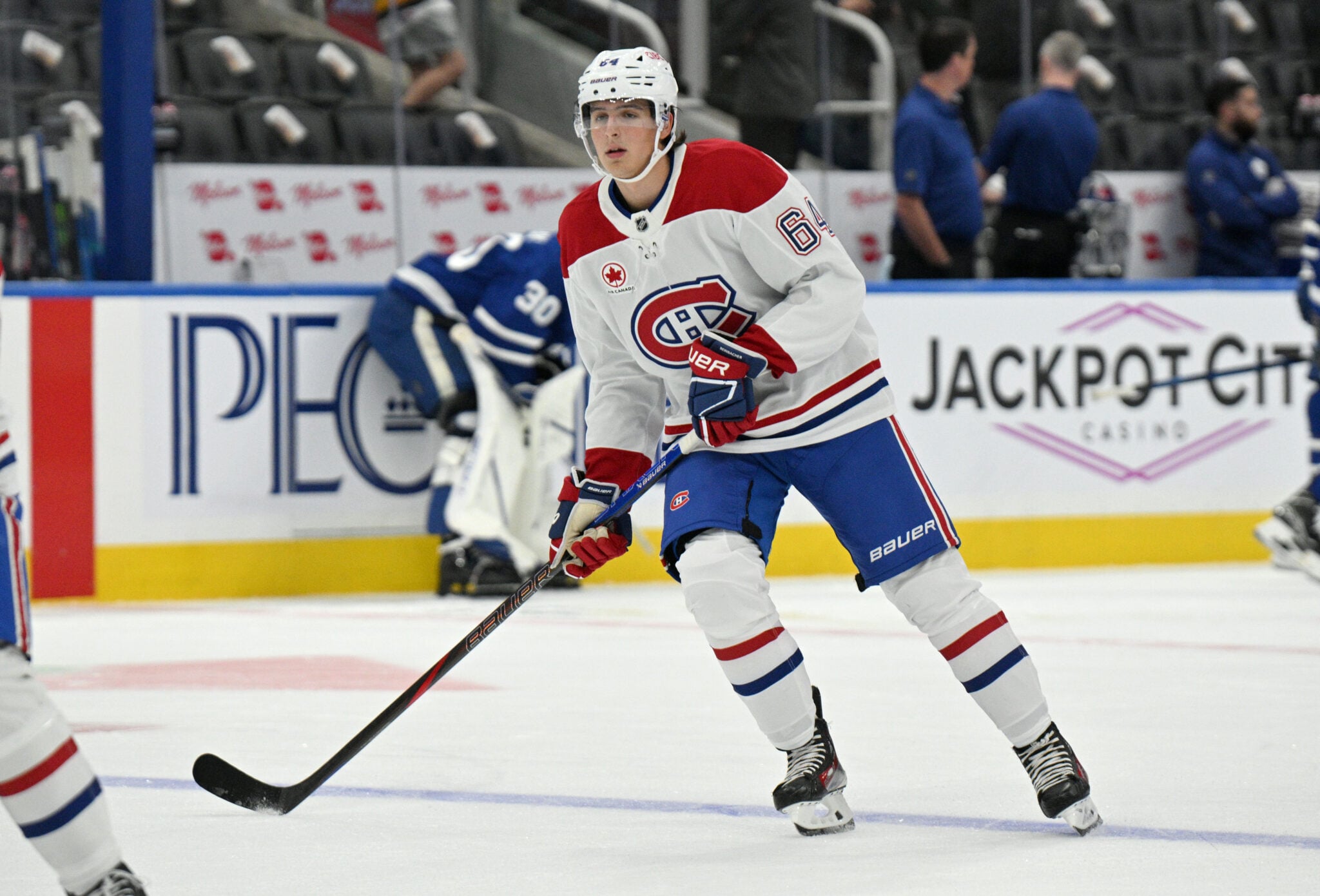
Much like the forward position, versatility plays a crucial role in this defensive battle. The left-handed Adam Engstrom, drafted in 2022, possesses the flexibility to play on either side of the ice. His steady progression, which included playing in fifteen NHL games last season, suggests he deserves serious consideration. And yet, the organization still highly values David Reinbacher. The pure right-handed defenseman was selected fifth overall in 2023 due to his immense upside, regardless of whether that draft choice ultimately proves correct.
With only Noah Dobson and pending unrestricted free agent Alexandre Carrier currently projected to handle right-side duties, Montreal theoretically has an opening for a right-handed defenseman. The team has had to rely on rotating left-handed players in and out of that role. It was under these circumstances that the defensively sound Reinbacher was drafted, envisioned as part of a formidable pairing alongside Lane Hutson. While Reinbacher has yet to live up to his draft status, his development has been heavily hindered by unfortunate injury circumstances.
Despite these developmental hurdles, reports from TVA journalist Anthony Martineau suggest the Canadiens remain committed to Reinbacher, keeping the door wide open for him to earn a roster spot at training camp. Ultimately, whether he makes the cut is up to him to force the organization’s hand. If he fails to do so, Adam Engstrom stands as a highly viable alternative—perhaps even to the point where both players perform so well that Montreal is forced to make a difficult trade decision to keep them both.
Jacob Fowler vs. Sam Montembeault in Net
The goaltending situation for the Canadiens is layered with complexity that goes beyond surface-level observation. To be sure, Jakub Dobes enters camp as the incumbent, and his status should remain unchanged following a masterful late-season stretch and playoff performance that effectively cost Sam Montembeault his starting job—a position the latter had earned early in the previous season before struggling down the stretch.
After turning to top prospect Jacob Fowler as Dobes’ backup during the postseason—following Montembeault’s struggles during the regular season—logic would suggest an easy decision. Internally, Fowler is viewed as the superior goaltender and should have the clear advantage in competing for the backup role, mirroring how Dobes claimed the position in 2025. However, the situation is not as straightforward as it seems.
Fowler remains exempt from the waiver wire. If Montreal were to cut Montembeault, they would risk losing him to another team on waivers. From an asset-management perspective, they might want to do the opposite. However, given that the future in net is widely expected to belong to Fowler and/or Dobes, and with Montembeault unlikely to re-sign after his contract expires in 2027, the Canadiens should not sacrifice crucial points in the standings just to retain a declining asset for one additional year. Put plainly, risking valuable games for a soon-to-be departed goalie makes little sense.
If a three-goalie rotation is ruled out, as it should be, the Canadiens showed their willingness to rely on a Dobes-Fowler tandem during the playoffs. This move signals that they trust these two netminders the most. If the organization trusts Fowler to win games at the NHL level—which he did consistently, posting a 9-6-2 record, a 2.43 goals-against average, and a .908 save percentage in 2025-26—there is very little left for him to achieve developmentally in the American Hockey League.
Fowler must be the chosen goaltender for this roster. While he may eventually claim the undisputed top spot over Dobes in the future, the Canadiens will never find out if they continue to delay his promotion. Selecting a departing goalie over Fowler is in no way a reasonable or justifiable solution. While the ultimate decision between Dobes and Fowler will present its challenges down the line, this particular choice should be a straightforward one.