






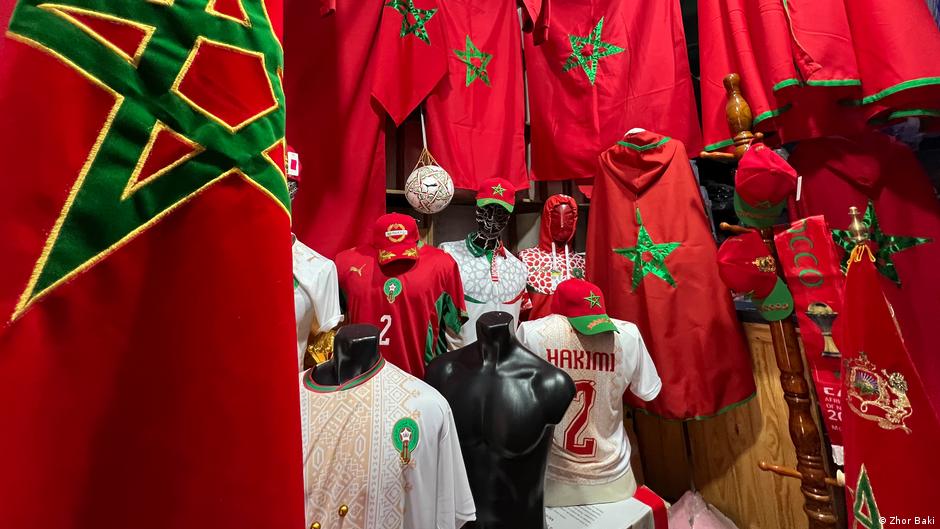
Moroccan supporters see the national team’s 1-1 draw with Brazil in its opening 2026 World Cup fixture as more than a single result. After Morocco’s remarkable run to the semifinals in 2022, expectations are higher than ever. Yet even as attention turns to this month’s tournament, the kingdom is already preparing for 2030, when it will co-host the World Cup with Spain and Portugal.
For Morocco, staging the tournament is not simply a matter of welcoming a global sports event. After five unsuccessful bids, FIFA awarded the hosting rights in December 2024, marking a major diplomatic and strategic achievement for the North African country.
Analysts say the tournament has become one of King Mohammed VI’s flagship prestige initiatives and part of a broader modernization agenda. Central to that vision is Morocco’s increasingly successful national football team.
“The World Cup is acting as a catalyst for Morocco’s economic transformation,” Steven Hoefner, director of the Rabat office of Germany’s Konrad Adenauer Foundation, told DW. He said the country is undergoing deep structural change: agriculture is becoming less dominant amid climate change and drought, while industry, services and tourism are gaining ground.
Isabelle Werenfels of the Berlin-based German Institute for International and Security Affairs (SWP) also sees the tournament as more than a sporting event. “The World Cup has multiple dimensions,” she told DW, adding that the government is using it “to advance its modernization policy and legitimize major domestic investments.”
Morocco’s “soft power” strategy
Morocco is investing billions in stadiums, airports, railways and roads. A study by Spain’s Real Instituto Elcano described the 2030 World Cup as a tool of Moroccan “soft power,” designed to improve the country’s global image, attract investment and strengthen its position in Africa. Its authors said the aim is to project an image of Morocco as an open, tolerant and rising economy capable of delivering complex projects at the highest level.
Hoefner said international visibility is “a central objective of the Moroccan leadership.” Without major oil or gas reserves, Morocco is increasingly relying on political and cultural influence. The World Cup, he said, is meant to present the kingdom as a modern economic and investment hub.
Protests by Gen Z
Those investments have also sparked debate. Last year, thousands of young Moroccans, many from the generation born around the turn of the millennium, protested against the World Cup plans. Werenfels said the demonstrations focused on large-scale infrastructure projects, with critics arguing that funds for stadiums and prestige developments could be better spent on education and health care.
Hoefner said the protests were not necessarily aimed at the World Cup itself, but at the question of whether stadium construction should take priority over social services. He said public acceptance over the long term will depend on whether ordinary Moroccans see tangible benefits from the investments.
That debate reflects one of Morocco’s central challenges. According to an analysis by the Carnegie Endowment for International Peace, Morocco has made significant progress over the past 25 years: life expectancy, income and educational attainment have risen; infrastructure investment has expanded; and the country has become Africa’s largest automotive exporter. At the same time, the report highlighted high youth unemployment, regional inequality and weaknesses in the education system. “Morocco’s successes to date are undeniable, but the road ahead will be fraught with obstacles,” the study stated.
Sustainability concerns
Public opinion remains divided. “Many people complain about the rising cost of living, but are also proud of the visible changes in their cities,” Werenfels said. New transport links, sports facilities and public amenities are widely welcomed, but construction projects have also brought social costs, including resettlements and demolitions.
The question now is whether the World Cup will leave behind sustainable development or costly prestige projects. “When it comes to infrastructure for sports alone, there are certainly questions about its long-term use,” Hoefner said. He pointed to the planned Hassan II Stadium near Casablanca, which is expected to hold about 115,000 spectators and become the world’s largest soccer stadium. Its long-term viability, he said, will have to be proven.
Environmental concerns
Environmental questions are also part of the debate. “Morocco is facing significant water problems,” Werenfels noted, raising concerns about how much tourism growth is sustainable and whether some developments could come at the expense of other sectors, particularly agriculture.
Even so, many Moroccans hope the World Cup will help trigger a broader development boom. The Real Instituto Elcano drew a parallel with Spain’s 1992 Olympic Games, which helped reposition the country internationally, and suggested that the 2030 tournament could become a similar turning point for Morocco.
Whether those expectations are fulfilled will depend on more than new stadiums and strong performances on the pitch. The real test will be whether Morocco can link economic modernization, social progress and national prestige. The 2030 World Cup is therefore not only a major sporting event. It is a test of the country’s future development path and of the royal family’s political vision.
Sustainable biogas for rural Morocco
To view this video please enable JavaScript, and consider upgrading to a web browser that supports HTML5 video


