




The catastrophic 2025 earthquake in Myanmar may provide critical insights into how a future major earthquake—often referred to as the “Big One”—could unfold along California’s San Andreas Fault.
On March 28, 2025, a magnitude 7.7 earthquake struck near the city of Mandalay, sending shockwaves as far as Bangkok, 830 miles (1,330 kilometers) away, and resulting in a tragic loss of at least 3,700 lives. New research leveraging detailed satellite data and a rare, captured video of the ground rupture reveals that the fault responsible possessed a complex, nearly helical structure, which significantly influenced the resulting seismic shaking.
The fault that triggered the quake is the Sagaing Fault in Myanmar, which shares key characteristics with strike-slip faults worldwide that loom over major population centers. Alice-Agnes Gabriel, a geophysicist at the Scripps Institution of Oceanography at the University of California, San Diego, and co-author of the new research published on Oct. 14 in Nature Communications, explains that California’s San Andreas Fault is similarly tilted and has the potential to generate a 7.8 magnitude earthquake. Analyzing the ground rupture near Mandalay offers invaluable clues about what might occur along similarly structured faults in the future, Gabriel noted.
“While we cannot predict precisely when and where an earthquake will occur along a specific fault,” Gabriel explained, “we may be able to predict certain characteristics of the rupture and shaking.”
Gabriel utilizes advanced supercomputers to simulate earthquake scenarios, though the accuracy of these models depends heavily on the quality of input data. In this study, researchers had a unique opportunity to validate their models using a security camera recording that captured the ground cracking as the fault ruptured—a phenomenon of unprecedented visual documentation.
<figure class="van-image-figure inline-layout kiosq-b" data-bordeaux-image-check="" id="elk-6da6818c-ccbe-11f1-8fc4-5f33f3142115" aria-hidden="true"><p class="vanilla-image-block" style="padding-top:56.33%;"> 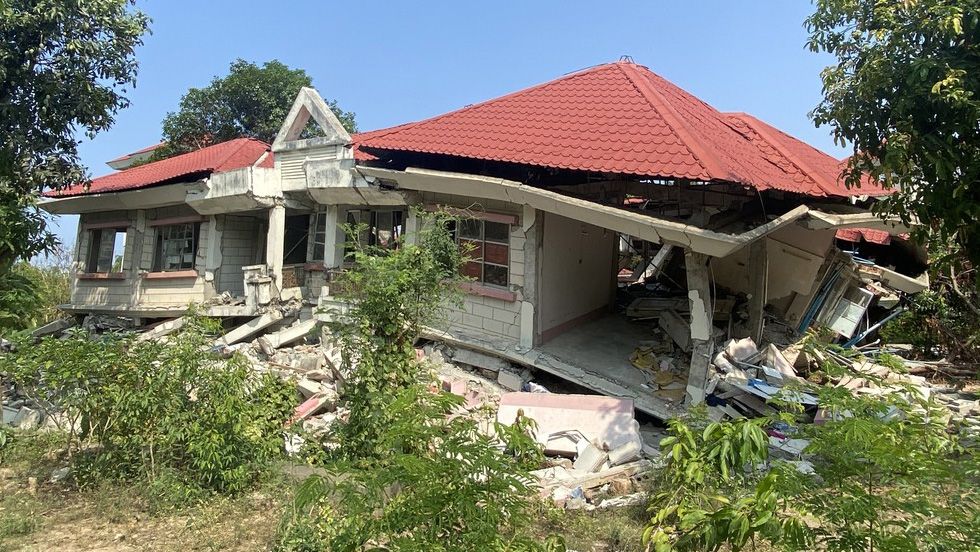
Damage from the magnitude 7.7 earthquake that hit on March 28, 2025, near the city of Mandalay.
(Image credit: Photo(s) taken by Dr. Tha Zin Htet Tin of East Yangon University)
The researchers’ sophisticated models revealed that the fault is not a simple vertical plane. Instead, the fault surface dips westward at its northern section, becomes nearly vertical in the middle, and then tilts eastward toward the southern end.
Generally, the direction in which a fault dips experiences more intense shaking. In the case of the San Andreas Fault, the dip angles inland toward California’s high desert—a region that is less populated than the coastal areas on the opposite side. Consequently, if a future “Big One” behaves similarly to the Myanmar event, the high desert side could experience significantly stronger shaking than the coastal side. Given that the San Andreas Fault has been accumulating strain for over a century, researchers believe it could behave in a manner analogous to the Sagaing Fault.
However, Gabriel emphasized that residents near any active fault must still prepare for severe shaking, as localized geological variations—such as the thickness of sediment overlying bedrock—can drastically alter ground movement. For instance, Los Angeles sits atop a sediment-filled basin that would experience intense, jelly-like amplification of seismic waves during a major quake.
The team also explored whether aspects of the Mandalay earthquake could have been predicted using pre-existing monitoring data. They knew that specific segments of the Sagaing Fault were “locked,” meaning that while the tectonic plates on either side were in motion, the rocks along the fault line were wedged tightly together. These locked segments had been accumulating stress for 186 years.
By analyzing pre-quake data, including the detailed three-dimensional geometry of the fault deep underground and the duration of locked segments, the researchers successfully predicted the path, geometry, and speed of the rupture on the Sagaing Fault. Similar predictive methodologies could be applied to the San Andreas Fault and other critical faults worldwide. Previous research has also highlighted how factors like fault simplicity and maturity can inform global seismic hazard assessments.
Scientists are currently updating their models to simulate a potential “Big One” on the San Andreas Fault. These updated projections will be released to assist the public in preparedness efforts, guide building code revisions, and educate emergency response managers.
“This really demonstrates how we can utilize long-term fault-monitoring data to understand the mechanics of major seismic events,” Gabriel concluded.
Reference:
Ulrich, T., Zou, X., Marchandon, M., Schliwa, N., Tan, F., Gabriel, A.-A., Fan, W., Shearer, P., Thant, M., Tin, T. Z. H., Lindsey, E. O., & Fialko, Y. (2026). On predictability of slip, rupture geometry, and speed of the 2025 m7.8 Mandalay, Myanmar, earthquake. Nature Communications, 17(1).