






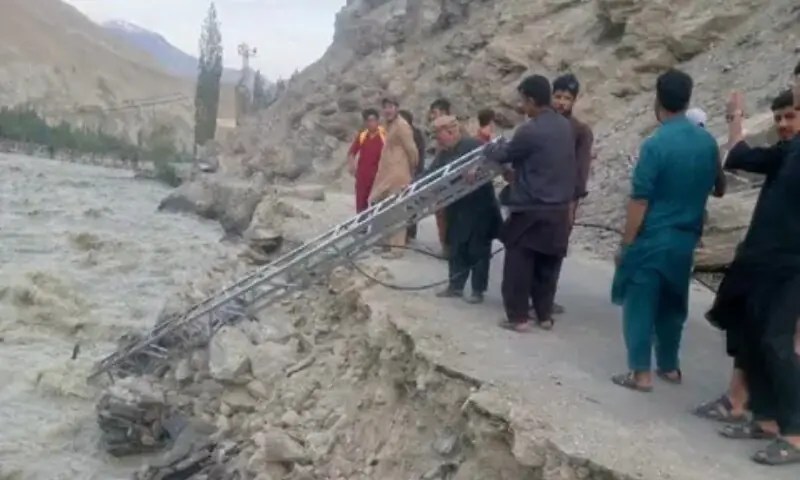
Gilgit: Rapid glacier melt has intensified the crisis in Gilgit‑Baltistan, as higher temperatures boost water discharge and mudflows in rivers and streams, resulting in extensive damage downstream.
The National Disaster Management Authority (NDMA) issued a Glacial Lake Outburst Flood (GLOF) alert on Wednesday for the Hoper and Hisper valleys in Nagar district.
Authorities noted that the ongoing heatwave across Gilgit‑Baltistan has accelerated glacier melt, causing rivers and streams to swell.
Floods and mudslides have damaged link roads, bridges, electricity infrastructure, agricultural land, and both public and private property in several remote areas.
According to district administration reports, rising water levels in streams and rivers in Ghanche district have damaged several link roads and bridges. A suspension bridge over the Hushe Nallah was submerged, cutting off access for local communities. Flooding also blocked the Siachen, Chorbat, and Ghowari roads, though the Siachen and Chorbat routes were temporarily reopened.
Deputy Commissioner Ghanche Waliullah Fallahi said the situation is under control and heavy machinery has been deployed to restore damaged roads and bridges.
A flash flood also blocked the Karakoram Highway (KKH) at the Ghoor Hill section near the Khunjerab Pass on the Pakistan‑China border, disrupting cross‑border traffic. Police reported that a large number of passengers, including domestic and foreign tourists and cargo vehicles, were stranded for several hours before traffic resumed.
In Ghizer district, flooding damaged homes, crops, and link roads in Matramdan village, located in the Ishkoman Valley, and disrupted electricity supply. Authorities expressed concern over rising water levels in an artificial lake created by last year’s floods, fearing potential inundation of nearby houses.
Residents in downstream areas fear further GLOF events and flash floods, as rising water levels and heavy mudflows continue to threaten lives and property.
Meanwhile, Rescue 1122 Gilgit‑Baltistan issued a public advisory warning that intense heat, together with a westerly weather system, has accelerated glacier melt, increasing the risk of GLOFs, flash floods, landslides, and damage to roads and bridges.
The advisory urged residents and tourists to avoid unnecessary travel during adverse weather, stay away from rivers, streams, glaciers, and fast‑flowing water, and refrain from bathing, fishing, taking selfies, or collecting wood near riverbanks. It also advised against attempting to cross flooded roads, drains, or streams, and urged parents not to allow children near rivers or other hazardous areas.
The advisory warned that floods and glacial lake outburst floods can occur without warning and emphasized that precaution is the best protection.
In its alert, the NDMA said hydrometeorological conditions indicated a significant increase in river discharge in the Hisper‑Hoper Nallah catchment due to rising temperatures and ongoing precipitation.
The authority warned that the area faces risks of rapid glacier and snowmelt, flash floods, debris flows, severe riverbank erosion, and damage to roads, bridges, irrigation channels, and other infrastructure, and cautioned that downstream communities could experience heightened risks with transport links potentially disrupted.
Local residents urged the government to take immediate measures to protect vulnerable communities living downstream from GLOFs and flooding.
Also Read
- Petition Seeks Transparency on Punjab CM Maryam Nawaz’s Publicity Spending
- US and Iran Agree to Continue Negotiations in Qatar Amid Maritime Disputes
- A Weremediated Update on Google Initiatives in Sindh
- Pentagon Creates Unified Command for Autonomous and Unmanned Systems Under New Deputy-Level Oversight


