






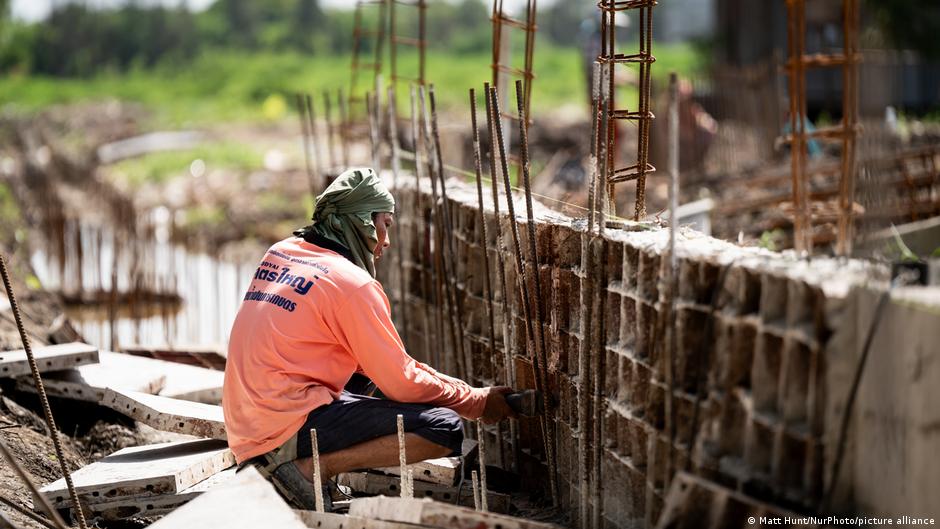
Among the tens of thousands of foreign laborers building Bangkok’s rapidly expanding skyline, Ray Boe could easily blend into the crowd.
What sets him apart is that, at 31, he came to the Thai capital from one of the country’s nine refugee camps, home to people who have fled decades of civil conflict in Myanmar.
Clustered along the Thai-Myanmar border, the camps house more than 100,000 people. Some have lived there since the 1980s, when the first refugees began arriving.
For decades, the Thai government prohibited refugees from leaving the camps to find work, leaving many dependent on foreign aid for basic needs.
That policy changed in October 2025, after reductions in foreign assistance, particularly from the United States, forced the camps to cut back on food distribution and healthcare.
New Thai labor scheme offers hope for Myanmar refugees
To view this video please enable JavaScript, and consider upgrading to a web browser that supports HTML5 video
Around the same time, fighting between Thailand and Cambodia over territorial disputes triggered the return of hundreds of thousands of Cambodian migrant workers, creating a significant labor shortage.
Myanmar refugees permitted to work outside the camps
To address both the funding shortfall and labor shortage, the government reversed its long-standing policy and began issuing permits that allow refugees to work outside the camps and support themselves.
Boe was among 6,800 refugees from the camps whom the government said had entered the Thai workforce during the program’s first year.
“After the cuts by USAID and other organizations, there is no more regular support for our daily needs, such as rice and other rations, and there is not enough healthcare in the camps anymore,” he said.
The funding reductions left him and his parents borrowing from neighbors and stretching their already modest meals.
Underpaid and overworked: Myanmar migrants in Thailand
To view this video please enable JavaScript, and consider upgrading to a web browser that supports HTML5 video
Since last month, he has earned 400 baht, or about $12, a day pouring concrete and erecting scaffolding for a 12-story apartment building in central Bangkok. He hopes to begin sending money home soon.
“It will help us pay for food and other basic needs, and for healthcare for my parents,” Boe said.
Compared with life in the camp, earning his own income and supporting his family rather than relying on others to meet their daily needs would be a significant change, he told DW.
Refugee employment program offers opportunities but faces early challenges
The program enables refugees to work in 43 of Thailand’s 76 provinces and in occupations that are not reserved by law for Thai citizens.
The Ministry of Foreign Affairs said the government has strengthened vocational training in the camps to better prepare refugees for employment outside them.
“We are hopeful that this policy would enhance opportunities and empower the [refugees] to realize their potential, as well as contribute to Thai socioeconomic development,” said Praporn Waenluang, a spokesman for the ministry’s information department.
Labor and refugee-rights groups have welcomed the initiative.
“I have met many camp refugees who have gone outside and worked. They are very happy to work and earn money, a lot more than they can earn in the camp,” said Siwawong Sooktawee, Thailand project coordinator for the International Detention Coalition.
“This is good because they feel they can help themselves, they can support themselves, not depend on aid anymore,” he added.
Myanmar workers in Thailand struggle to work legally
To view this video please enable JavaScript, and consider upgrading to a web browser that supports HTML5 video
Nevertheless, Siwawong and other observers said the program has had a slow start and still faces several problems that need to be addressed.
They said many participants have not received contracts from their employers and have instead encountered harsher conditions, heavier workloads or lower pay than promised before leaving the camps. The program also lacks a clear system for providing housing and resolving complaints, according to observers.
“Many refugees go, come back, go, come back so many times. Some refugees’ families have to raise funds or borrow money in the camps so that their father or another family member can return,” said K’nyaw Paw, general secretary of the Karen Women’s Organization, an NGO serving the camp’s ethnic Karen community.
Financial pressures weigh on Myanmar refugees
Siwawong and K’nyaw Paw said refugees are sometimes required to repay employers through wage deductions covering recruitment costs such as medical examinations, government permits and transportation to job sites. As a result, they can begin work already in debt, sometimes without advance warning.
Akwah, a father of two who goes by one name, left his camp with 20 other refugees in November 2025 for what was supposed to be a sugarcane-harvesting job on a farm across the country, paying 250 baht per day.
Upon arriving, however, he was told that the work involved cutting eucalyptus trees, a more difficult and potentially dangerous task, for only 200 baht per day. The workers had to sleep outdoors without electricity and use a nearby pond for water.
“We spoke to the boss, but the boss did not care. He said, ‘Just do the work because you are already here.’ But we said we could not do it,” Akwah said. They left after three months.
The Ministry of Foreign Affairs did not respond to DW’s request for comment on the program’s alleged problems. The ministries mainly responsible for overseeing the program, the Ministry of Labor and the Ministry of Interior, also did not respond to requests for interviews.
Rights groups call for further improvements
Siwawong and K’nyaw Paw said participating refugees should receive clear, detailed contracts, translated where necessary into Burmese, Karen or Karenni, the main languages spoken in the camps, and have an accessible system for filing and resolving complaints.
They also recommend expanding the program to more provinces and vetting job brokers who visit the camps as intermediaries to exclude unscrupulous recruiters.
They said their organizations and other groups are working with the government to implement some of these changes and expressed hope that the program will improve, enabling more refugees to participate.
Thailand-Myanmar border clinic helps people fleeing war
To view this video please enable JavaScript, and consider upgrading to a web browser that supports HTML5 video
Despite the program’s shortcomings, most refugees remain eager to apply, including those who have encountered problems.
“I had a bad experience, but I still want to go again, because food in the camp is a problem,” said Mu Dah Hsit, who fell ill at work and had to quit after her employer refused to cover the health insurance the program is supposed to provide.
“I have no mother, and I have a father who is sick and siblings I have to take care of,” she said. “So I have to go; otherwise, we cannot live.”
Also Read
- Republicans push back on Donald Trump’s wavering support for Ukraine
- Midday Market Movers: Key Gains and Declines Among Top Companies
- Two men rearrested in Britain over alleged Iran-linked plot against US-run air base
- Sudan Army Drone Strikes Kill Scores at Funeral and Fuel Market; Separate Attack Hits Khartoum Airport


