







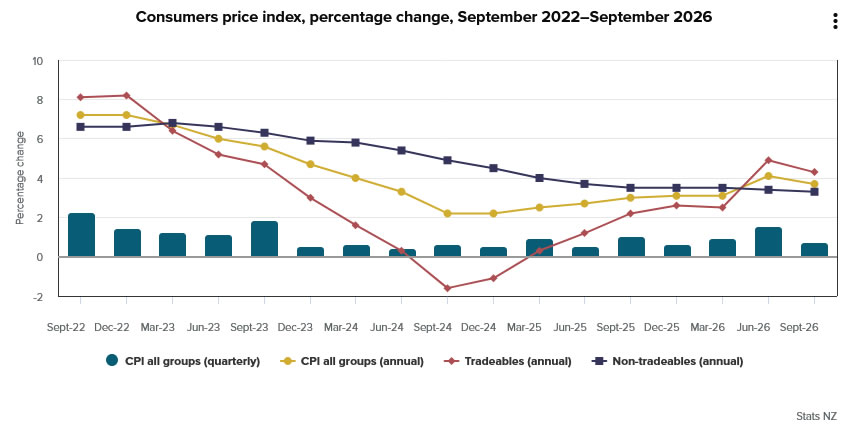
New Zealand’s consumer price index showed renewed moderation in the September quarter, with annual inflation easing from 4.1% to 3.7%, undershooting both market forecasts of 3.8% and the Reserve Bank of New Zealand’s (RBNZ) projection of 3.9%. Quarterly inflation declined sharply from 1.5% to 0.7%, also below the expected 0.8%. Despite this deceleration, annual price growth remains above the RBNZ’s mandated 1–3% target range, keeping monetary policy considerations highly relevant. Notably, underlying inflation trends painted a more complex picture, as key core measures strengthened even as headline numbers cooled.
Declining energy costs drove much of the quarterly pullback in inflation, with petrol prices dropping 6.5% following a 20.1% spike in the June quarter. Despite the recent decline, petrol prices stayed 19.1% higher compared to the previous year, maintaining their role as the single largest contributor to annual CPI growth. Stats NZ estimated that the CPI would have risen just 3.2% annually without the year-over-year increase in fuel costs. On the flip side, international airfares surged 14.3% during the quarter—the biggest upward force—with vegetable prices climbing 10.5% and local authority rates increasing by 6.2%. These divergent movements underscore how volatile individual price shifts can shape headline outcomes.
Core inflation indicators pointed to sustained domestic pricing pressures. The 30% trimmed mean rose from 2.6% to 3.0% year-over-year, while the weighted median moved up from 2.7% to 3.1%. In addition, CPI excluding fuel and food edged higher from 2.9% to 3.2%. Most significantly, the share of items in the CPI basket registering annual increases above 3% climbed substantially from 38.5% to 54.9%, reflecting a broadening base of elevated prices. At the same time, quarterly non-tradable inflation accelerated from 0.6% to 1.0%, though its annual rate slipped slightly from 3.4% to 3.3%. Contrastingly, quarterly tradable inflation plunged from 2.7% to 0.2%, largely due to the sharp reversal in fuel prices.
This latest data presents a mixed signal regarding the durability of disinflation. Lower energy costs delivered welcome relief to headline inflation, yet firmer core metrics and widening price dispersion indicate that underlying pressures persist. Such nuances are especially critical as the RBNZ prepares for its upcoming policy meeting on October 28. Market participants currently assign near-certain odds—around 98%—to another 25-basis-point rate hike. Furthermore, Westpac has advanced its forecast for rate tightening from December to October, pointing to resilient core inflation as justification. While the surprising drop in headline inflation offers some comfort, the depth of underlying price stability challenges leaves central bank officials with limited scope for declaring victory over inflationary risks.

Data Summary
New Zealand CPI — Q3 2026
| Indicator | Previous | Forecast | Current |
| CPI Q/Q | 1.5% | 0.8% | 0.7% |
| CPI Y/Y | 4.1% | 3.8% | 3.7% |
| Tradables Q/Q | 2.7% | — | 0.2% |
| Tradables Y/Y | 4.9% | — | 4.3% |
| Non-tradables Q/Q | 0.6% | — | 1.0% |
| Non-tradables Y/Y | 3.4% | — | 3.3% |
Underlying Inflation Measures — Y/Y
| Indicator | Previous | Current |
| CPI excluding fuel | 2.9% | 3.0% |
| CPI excluding fuel and food | 2.9% | 3.2% |
| CPI excluding fuel, food and household energy | 2.5% | 2.9% |
| 30% trimmed mean | 2.6% | 3.0% |
| Weighted median | 2.7% | 3.1% |
| CPI basket with annual price rises above 3% | 38.5% | 54.9% |
Selected Price Movements
| Component | Q3 Q/Q | Q3 Y/Y |
| Petrol | -6.5% | +19.1% |
| International airfares | +14.3% | +12.5% |
| Vegetables | +10.5% | -2.2% |
| Local authority rates and payments | +6.2% | +6.2% |
| New housing construction | — | +3.2% |
| Electricity | — | +9.3% |
Key Takeaways
- Inflation cools but stays above target: New Zealand CPI eased from 4.1% to 3.7% yoy in Q3, below consensus of 3.8% and RBNZ’s 3.9% forecast. Quarterly inflation dropped from 1.5% to 0.7%, undershooting expectations of 0.8%. Annual inflation continues to exceed the 1–3% target band.
- Fuel cost reductions ease quarterly pressure: Petrol prices fell 6.5% qoq after rising 20.1% in Q2, driving down quarterly tradables inflation from 2.7% to 0.2%. However, petrol remained 19.1% pricier than a year ago and continued to be the dominant factor behind annual CPI growth.
- Mixed component performance: Airfares climbed 14.3%, adding the most upward momentum to quarterly inflation. Vegetable prices rose 10.5%, and local authority rates increased 6.2%. These upward forces offset much of the benefit from cheaper fuel.
- Core measures suggest lingering inflation: The 30% trimmed mean rose from 2.6% to 3.0% yoy, while the weighted median increased from 2.7% to 3.1%. CPI excluding fuel and food also rose from 2.9% to 3.2%, indicating persistent underlying price trends.
- Widening inflation footprint: Over half of the CPI basket—54.9%—recorded annual increases above 3%, up sharply from 38.5%. Additionally, 85.5% of categories saw price gains, signaling increasingly broad-based inflation despite softer headline figures.
- Domestic pricing remains firm: Quarterly non-tradable inflation picked up from 0.6% to 1.0%, even as the annual pace eased from 3.4% to 3.3%. This trend contrasts with the steep fall in importable price pressures.
- Market braces for further rate hikes: Despite the surprise decline in headline inflation, expectations for tighter monetary policy remain intact. Around 98% of market participants anticipate a 25bps rate increase at the October 28 RBNZ meeting. Westpac has revised its rate hike timeline earlier to October, driven by resilient core inflation readings.
Also Read
- OCC Establishes Waiver Framework for Active Stablecoin Issuers Ahead of GENIUS Act Deadline
- Gold Extends Downtrend Amid Fading Recovery Hopes
- Decade-Old Bitcoin Fortune: Irregular Transfers from Irish Drug Lord’s Wallet Ignite Speculation
- Ringgit opens higher vs US dollar, major currencies – The Star


