




Some molecules exist as non-superimposable mirror images, and while one form can be therapeutic, its twin may be toxic.
Image credit:©iStock.com, filo
The biological impact of a drug or chemical compound depends critically on the spatial arrangement of its atoms. Many compounds possess a “dark twin” sharing the same molecular formula but a different three-dimensional structure—a distinction that can dramatically alter physiological effects.
The 2021 Nobel Prize in Chemistry recognized Benjamin List and David W.C. MacMillan for developing asymmetric organocatalysis, a precise chemical process that allows scientists to synthesize exclusively one of these mirror-image forms. This breakthrough empowered pharmaceutical chemists to produce only the beneficial version of a molecule—such as the isomer that aids the body while avoiding the one that causes harm.
The tragic history of thalidomide underscores the stakes. Marketed as a morning-sickness remedy, one isomer of thalidomide provided sedation, while the other is believed to disrupt embryonic development. Because the two forms interconvert inside the body, administering either version during pregnancy proved catastrophic, resulting in thousands of birth defects and miscarriages.
My research investigates a compound abundant in red grapes and peanuts: resveratrol. For years, clinical trials testing resveratrol for Alzheimer’s disease yielded contradictory results—some showing cognitive improvement, others showing accelerated decline. Leveraging the Nobel-winning chemistry of asymmetric synthesis, my team and I discovered that the inconsistency likely stems from the use of different isomeric forms: one may support cognition and memory, while the other may be neurotoxic.
Isomers and Amino Acids
Numerous drugs share identical atomic composition and bonding yet differ in their spatial arrangement. These are chiral compounds—molecules that exist as two non-superimposable mirror images, much like human hands. Despite apparent similarity, a left hand cannot fit into a right-handed glove; likewise, a “left-handed” drug cannot bind a biological target shaped for its “right-handed” counterpart.
These mirror-image versions, known as enantiomers, are defined by their optical activity: one rotates polarized light to the left (L-, levorotatory), the other to the right (D-, dextrorotatory). While they typically share physical properties, their biological interactions can diverge radically.
Amino acids, the building blocks of proteins, are chiral. Life on Earth predominantly uses L-configured amino acids for protein synthesis. The D-configuration, however, serves distinct biological roles: bacteria incorporate D-amino acids into cell walls, while mammals utilize them as signaling molecules in the nervous and endocrine systems.
Tyrosine represents a critical exception. Unlike other amino acids, both L- and D-tyrosine can be activated for protein synthesis by the enzyme tyrosyl-tRNA synthetase (TyrRS). Cellular quality-control enzymes normally discriminate between the two, ensuring only L-tyrosine is incorporated. When this discrimination fails, elevated tyrosine levels become neurotoxic.
Recent work from my laboratory offers a mechanistic explanation. Exposing rat neurons to increasing concentrations of L-tyrosine reduced TyrRS levels. Strikingly, D-tyrosine not only depleted TyrRS but also killed the neurons. Examining post-mortem brain tissue from Alzheimer’s patients—who exhibit elevated brain tyrosine—we found correspondingly depleted TyrRS. We hypothesize that rising tyrosine levels in the Alzheimer’s brain suppress TyrRS, disrupting the synthesis of proteins essential for cognition and memory.
Grapes, Peanuts, and Alzheimer’s
These findings reframe the resveratrol puzzle. A polyphenol in red wine, resveratrol has been studied extensively for neuroprotective potential. Yet clinical trials remain divided: some report cognitive benefits in Alzheimer’s patients, others report worsening pathology.
Resveratrol exists as two geometric isomers, cis– and trans-resveratrol, differing in the spatial orientation of their atoms. My colleagues and I found that these isomers bind TyrRS in opposing ways, driving opposite neuronal outcomes. In cultured rat neurons, cis-resveratrol elevated TyrRS levels, while high concentrations of trans-resveratrol depleted the enzyme and induced neural damage. Crucially, low concentrations of trans-resveratrol can isomerize into the cis form in the body, thereby increasing TyrRS and conferring benefit.
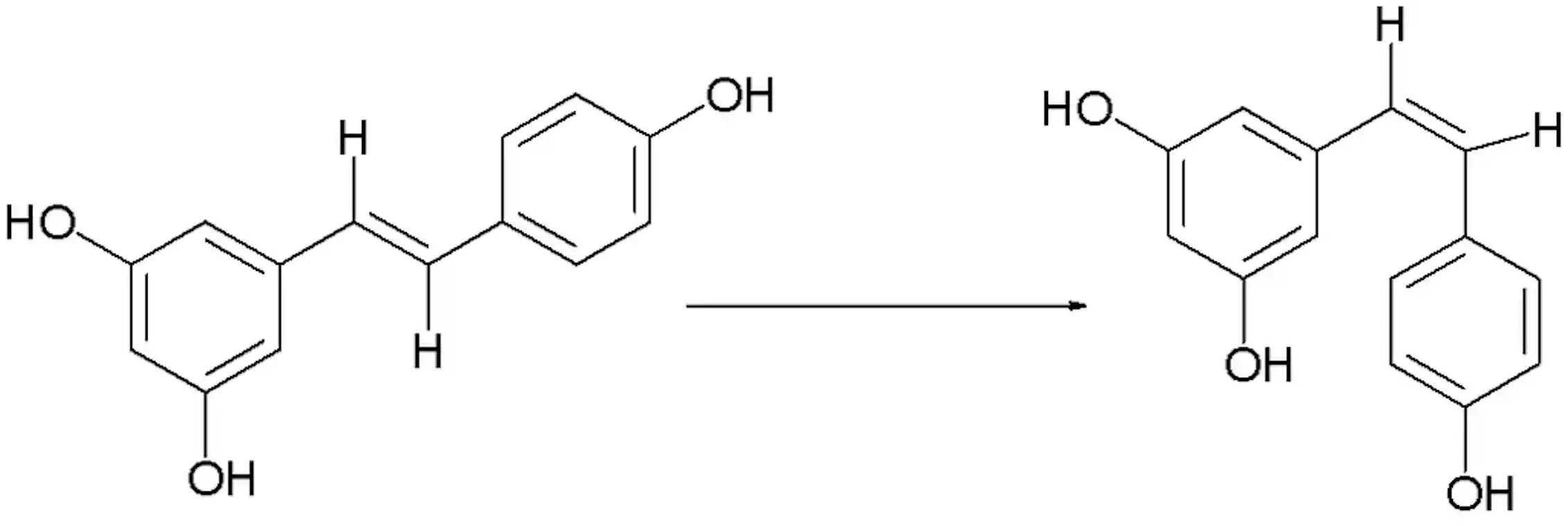
We hypothesize that past clinical trials failed because none tested pure cis-resveratrol. Trials using high-dose trans-resveratrol likely caused harm by depleting TyrRS, while those using low doses inadvertently allowed conversion to the beneficial cis isomer.
Beyond elemental composition, biology is exquisitely sensitive to molecular architecture. Accounting for the specific isomeric form of a drug candidate could resolve longstanding therapeutic ambiguities and yield more effective treatments.
This article is an updated version of a piece originally published on August 3, 2022.
Sajish Mathew, Associate Professor of Pharmaceutical Sciences, University of Maryland Eastern Shore
This article is republished from The Conversation under a Creative Commons license. Read the original article.
- Soai K, et al. Asymmetric autocatalysis: The Soai reaction. Catalysis Series. 2022;338.
- Jacques V, et al. Differentiation of antiinflammatory and antitumorigenic properties of stabilized enantiomers of thalidomide analogs. Proc Natl Acad Sci USA. 2015;112(12):E1471-E1479.
- Jhanji M, et al. Cis- and trans-resveratrol have opposite effects on histone serine-ADP-ribosylation and tyrosine induced neurodegeneration. Nat Commun. 2022;13:3244.
- Aliashkevich A, et al. New insights into the mechanisms and biological roles of D-amino acids in complex eco-systems. Front Microbiol. 2018;9:683.
- Chieffi Baccari G, et al. D-amino acids in mammalian endocrine tissues. Amino Acids. 2020;52:1263-1273.
- Calendar R, Berg P. d-Tyrosyl RNA: Formation, hydrolysis and utilization for protein synthesis. J Mol Biolog. 1967;26(1):39-54.
- Mitchell G, et al. Neurologic crises in hereditary tyrosinemia. N Engl J Med. 1990;322:432-437.
- Salehi B, et al. Resveratrol: A double-edged sword in health benefits. Biomedicines. 2018;6(3):91.
- Zhu CW, et al. A randomized, double-blind, placebo-controlled trial of resveratrol with glucose and malate (RGM) to slow the progression of Alzheimer’s disease: A pilot study. Alzheimer’s & Dementia: Translational Research & Clinical Interventions. 2018;4:609-616.
- Turner RS, et al. A randomized, double-blind, placebo-controlled trial of resveratrol for Alzheimer disease. Neurology. 2015;85(16):1383-1391.
- Jhanji M, et al. Towards resolving the enigma of the dichotomy of resveratrol: cis– and trans-resveratrol have opposite effects on TyrRS-regulated PARP1 activation. GeroScience. 2021;43:1171-1200.
- Sajish M, Schimmel P. A human tRNA synthetase is a potent PARP1-activating effector target for resveratrol. Nature. 2015;519:370-373.