The New Zealand dollar initially gained from the rate hike but the rally soon faded. The Reserve Bank of New Zealand implemented a widely expected 25‑basis‑point increase in the Official Cash Rate to 2.50%, though investors did not anticipate a more aggressive tightening path. Consequently, the market interpreted the decision as indicating that any subsequent move will face a significantly higher threshold.
The initial tone seemed hawkish, with the Committee noting that “further reduction in monetary stimulus is likely” and that “further OCR increases appear likely at upcoming meetings.” However, these assertions were counterbalanced by strong caveats. The RBNZ repeatedly highlighted uncertainty around medium‑term inflation and stressed that future decisions will hinge on new data, firms’ price‑setting behavior, and the pace of recovery, acknowledging that the timing of any further hikes remains “highly uncertain.”
This equilibrium was evident in the meeting record. All six members concurred on the OCR increase, yet their views on the inflation outlook diverged. Prasanna Gai and Hayley Gourley argued that upside risks persisted, whereas Governor Anna Breman, Chief Economist Paul Conway, Assistant Governor (Money) Karen Silk, and external member Carl Hansen regarded the risks as broadly balanced.
These distinctions matter because the balanced camp comprised the Governor and two of the Bank’s most senior policy officials. Breman argued that weak demand may continue to curb businesses’ ability to pass higher costs onto consumers. Conway questioned how quickly the recovery will diffuse beyond the stronger segments of the economy, even as firms may eventually restore margins. Silk highlighted two‑way risks, noting that a weaker exchange rate could increase imported inflation, while slower immigration could simultaneously dampen growth, housing activity and inflationary pressures.
Collectively, their remarks indicate the Committee is seeking clearer evidence that inflation is becoming persistently entrenched before pursuing further tightening.
This explains the Kiwi’s muted response. The RBNZ reaffirmed its inflation‑fighting credentials with another rate hike, yet deliberately refrained from signaling an automatic follow‑up. Investors appear to have concluded that policymakers are comfortable maintaining the OCR at 2.50% until data justify a further increase, rather than feeling compelled to continue tightening merely because the cycle has begun.
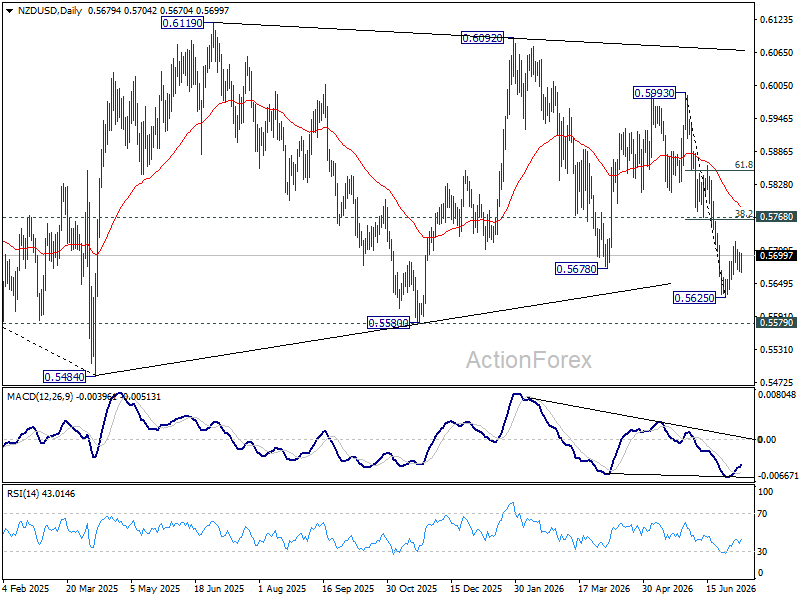
The charts tell a similar story. NZD/USD recovered after the decision but remained comfortably below last week’s peak of 0.5726, suggesting buyers have yet to regain full control. The rebound from 0.5625 may extend in the near term, but it continues to resemble a corrective recovery within a broader downtrend.
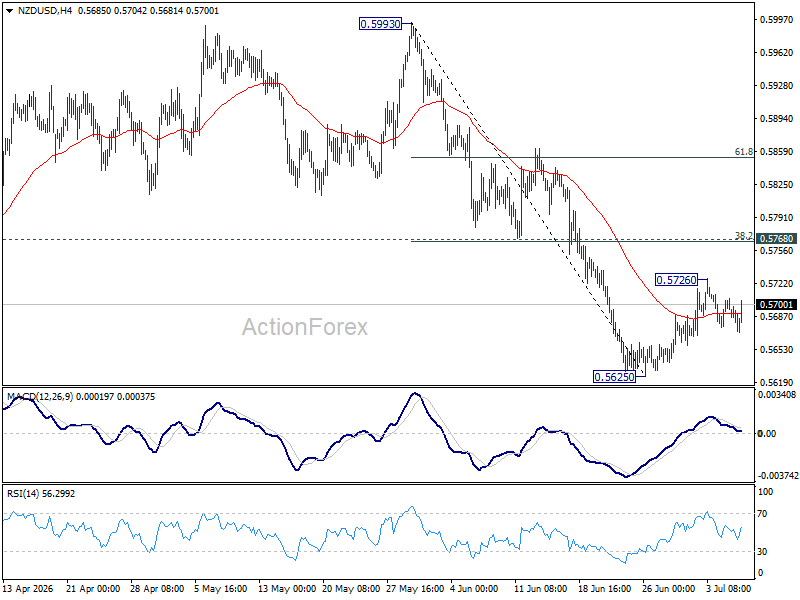
Even if another upward leg materializes, upside is likely capped by the 0.5768 resistance cluster, which encompasses the 38.2% retracement of the 0.5993‑to‑0.5625 decline at 0.5766. Once the corrective rebound runs its course, a drop below 0.5625 is expected to become the preferred scenario, with a subsequent move through 0.5580 drawing attention back to the 2025 low of 0.5484.