



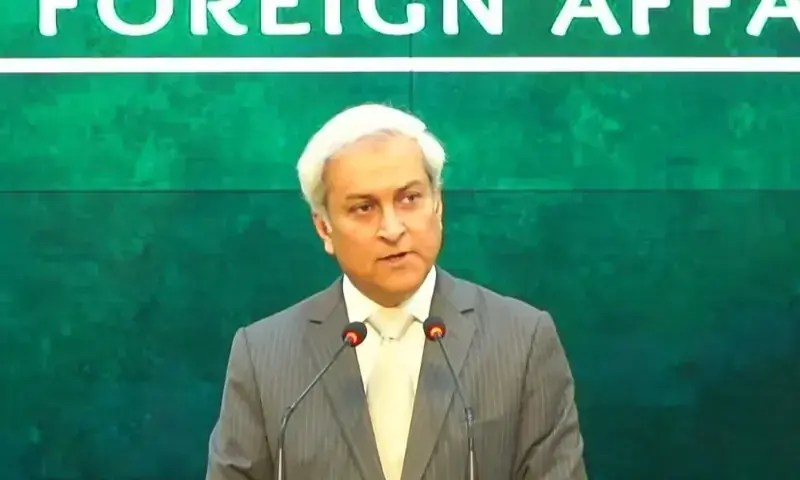
The Foreign Office has refuted claims that Deputy Prime Minister and Foreign Minister Ishaq Dar conveyed any information about Iran’s nuclear programme to U.S. Secretary of State Marco Rubio.
Dar met with Rubio on 29 May during a brief visit to Washington, where they discussed bilateral cooperation and regional security matters. Rubio acknowledged Pakistan’s role in promoting peace in the Middle East.
During a weekly press briefing on Thursday, FO spokesperson Tahir Andrabi stated that Pakistan rejected allegations of the deputy premier exchanging any information concerning Iran’s nuclear programme.
“No such information was shared,” he added.
The spokesperson’s comments followed remarks by former CIA analyst Larry Johnson, who cited an unidentified source claiming that Dar’s conversation with Rubio revealed Iran’s willingness to protect its sovereignty, a statement that allegedly alarmed Rubio.
Rubio addressed the allegation during a congressional hearing on Wednesday. Congressman Scott Perry inquired whether Dar had conveyed a message that Iran could demonstrate a nuclear weapon if escalation persisted.
“I have not seen that reporting and I am not aware of any such message,” Rubio responded.
Perry reiterated the claim, prompting Rubio to clarify that no such message had been delivered.
“I would be surprised if that message had been relayed. I would be aware of it if it had been,” he said.
India’s plans to divert Chenab water
Meanwhile, the FO condemned India’s plans to build a river‑linking project that would divert water from the Chenab River to the Beas River, describing the move as a serious breach of the Indus Waters Treaty and other international legal frameworks.
The Chenab River originates from the confluence of the Chandra and Bhaga rivers in Lahaul and Spiti, Himachal Pradesh. The 1960 Indus Waters Treaty, mediated by the World Bank, allocates the western rivers — Indus, Jhelum and Chenab — to Pakistan and the eastern rivers — Ravi, Beas and Sutlej — to India.
According to the Indian outlet CNBC TV18, India intends to commence work on the proposed “Link‑3 Project” in Himachal Pradesh on 1 August. The initiative aims to transfer surplus Chenab water to the Beas basin and is projected to cost approximately 26.2 billion Indian rupees, as reported by YEARS.
In response to a query, Andrabi said he had seen the report and the public tender issued by the Indian government inviting bids for the Chenab‑Beas Link Tunnel, which intends to divert 1.9 million acre‑feet of water annually from the Chenab into the Beas system.
He added that such an inter‑basin diversion would constitute a grave violation not only of the Indus Waters Treaty but also of treaty law principles, including the Vienna Convention on the Law of Treaties and broader international water law reflected in the 1977 UN Convention on the Law of Watercourses.
The FO spokesperson also referred to India’s planned “silt flushing” of the Salal Dam in the occupied Kashmir district of Reasi.
“This development is deeply concerning because it would grant water‑control capabilities that are not permissible under either the Indus Waters Treaty or the 1978 Salal agreement,” he pointed out.
Andrabi noted that India had not officially communicated or shared any notice of these projects and had not sought consultation.
“These projects demonstrate that India is attempting to weaponise water, with dangerous implications for Pakistan’s economy, regional stability, and global peace,” he stressed.
Emphasising Pakistan’s restraint and commitment to dialogue, Andrabi warned, “However, any illegal action or measure that endangers Pakistan’s water, food security, economic interests, or the well‑being of its 250 million citizens is unacceptable.”
He added that such measures amount to “further destabilisation of South Asia, with potentially grave consequences for the entire region.”
“Under the Indus Waters Treaty, Pakistan is entitled to unrestricted use of the western rivers’ waters, which compensates for the rights over the eastern rivers allocated to India,” Andrabi noted.
The FO spokesperson asserted that Pakistan “retains all options necessary for safeguarding its rights and interests under the treaty and protecting its vital national interests”.
“Let me emphasise, we retain all options in this regard,” he reiterated.
The FO urged the international community to call on India to “refrain from any form of water coercion, abandon projects that seek to stop, reduce, or divert water flow legally belonging to Pakistan, and fully respect the implementation of the Indus Waters Treaty”.
Also Read
- Asia’s Quest for a New Global Order Amid Western Disarray
- Border Volatility Escalates Between Ivory Coast and Burkina Faso Amid Militia Incursions
- Trump’s $300B Iran investment fund may be ‘close to impossible’ due to IRGC sanctions law, expert warns
- EU Summit Centers on Ukraine Accession and Seven‑Year Budget