






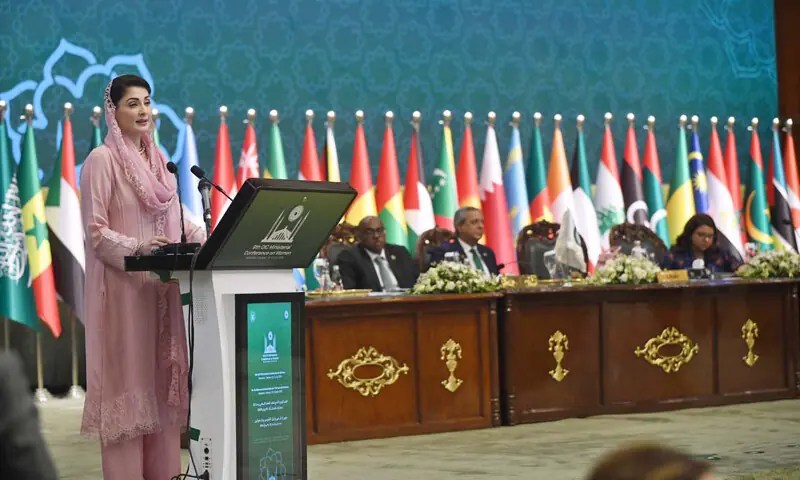
ISLAMABAD: Pakistan on Monday called on member states of the Organisation of Islamic Cooperation (OIC) to convert their commitments on women’s socioeconomic empowerment into tangible action, addressing the persistent challenges women face across the Muslim world.
Addressing the 9th Ministerial Conference on Women, Punjab Chief Minister Maryam Nawaz Sharif appealed for collective action to guarantee Muslim women equal access to education, economic opportunity, healthcare, and leadership roles. She described women’s empowerment as the cornerstone of sustainable development and stronger societies.
“If circumstances can empower one woman, opportunity can empower millions. Let us work together through the platform of the OIC to ensure that every girl in the Muslim world has access to education. Every girl across the Muslim world has access to opportunity,” she stated.
“Our commitment to women’s empowerment is deeply rooted in our faith and values. Islam honours women with dignity, rights, and respect. In empowering women, we are not departing from our traditions; we are returning to them,” the Chief Minister added.
She emphasised that the OIC embodies the collective aspirations and shared future of Muslim nations, stressing that women must not merely be beneficiaries of development but active architects of it as leaders, entrepreneurs, and decision-makers. Reflecting on her own political career, she noted that true empowerment is often forged through adversity.
The Punjab Chief Minister paid tribute to Mohtarma Fatima Jinnah, Begum Kulsoom Nawaz Sharif, and Shaheed Mohtarma Benazir Bhutto, crediting their courage and leadership for paving the way for future generations.
Speaking as chief guest, Senate Chairman Yousaf Raza Gilani echoed the call for the OIC to move beyond declarations and implement concrete measures. He reaffirmed Pakistan’s steadfast commitment to advancing women’s empowerment through education, entrepreneurship, digital inclusion, financial access, and employment opportunities.
Mr. Gilani highlighted the growing presence of women in Pakistan’s public life, serving with distinction as parliamentarians, judges, diplomats, civil servants, entrepreneurs, journalists, and academics. He urged OIC member states to set measurable targets for expanding girls’ education, increasing female leadership and workforce participation, strengthening protections against gender-based violence, and establishing robust accountability mechanisms.
Federal Minister for Law, Justice, and Human Rights Azam Nazeer Tarar, assuming the conference chairmanship, framed women’s empowerment as both a social imperative and an economic necessity, as well as a governance priority and a pillar of sustainable development.
He pledged that Pakistan would collaborate closely with the OIC General Secretariat, the Women’s Development Organisation (WDO), and member states to foster cooperation, share experiences, and transform shared aspirations into practical initiatives. He noted that Pakistan’s Constitution guarantees equality and dignity for women, and the government is pursuing legal and institutional reforms to bolster women’s leadership, entrepreneurship, financial inclusion, access to justice, and workplace safety. The minister also appealed for greater support for women affected by conflict, specifically in Palestine, Afghanistan, and Indian-administered Kashmir.
Advancing Women’s Causes
OIC Assistant Secretary General for Humanitarian, Cultural and Social Affairs Ambassador Dr. Tarig Ali Bakheet stated that the conference underscores the organisation’s enduring commitment to advancing women’s causes and sustaining empowerment efforts.
WDO Executive Director Sarah Al Shoura outlined the organisation’s work to strengthen inter-state cooperation and promote policies that expand women’s participation in education, economic development, and leadership.
Ambassador Naela Gabr, President of the Women’s Consultative Council of the 8th OIC Ministerial Conference on Women, reviewed progress since the previous session and stressed the need to maintain momentum through enhanced cooperation. She advocated for increased investment in women’s education, economic empowerment, and leadership, calling the advancement of women essential for inclusive development and long-term prosperity across the Muslim world.
Egypt’s National Council for Women President Amal Ammar declared women’s empowerment a strategic necessity for sustainable development and stability. She detailed Egypt’s approach, which includes constitutional, legislative, and institutional reforms under the National Strategy for Egyptian Women 2030.
She highlighted flagship initiatives such as the ‘Noura’ programme for girls, the ‘Noor’ programme for boys, the ‘Tahweesha’ initiative for women’s financial inclusion, and the Gender Equality Seal awarded to 31 companies promoting gender-responsive workplaces. She noted significant gains in leadership, with nearly 3,968 women serving as judges and prosecutors, alongside increased representation in parliament and senior public offices.
Ms. Ammar also drew attention to the plight of Palestinian women, encouraged states yet to join the Women’s Development Organisation to finalise accession, and congratulated Pakistan on assuming the conference chairmanship.
The opening session was attended by ministers, lawmakers, representatives of international bodies, diplomats, and delegates from OIC member states. A documentary showcasing women’s contributions across various sectors was also screened.
Published in Dawn, July 14th, 2026
Also Read
- India Blocks Acclaimed Film on Activist Who Exposed Punjab’s Secret Cremations
- Pakistan Backs Saudi Arabia at UN Security Council Over Houthi Missile Strikes
- 30 Lives Lost in Bangkok Music Bar Fire; Dozens Hospitalized
- JPMorgan Leads $1.6 Billion Basra Urea Plant Financing, Reinforcing Emerging-Market Project Finance Expertise


