



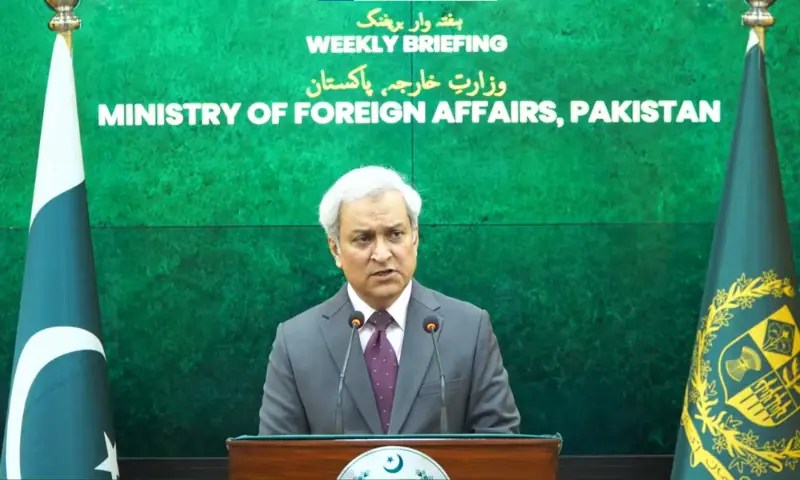
Pakistan voiced disappointment on Thursday over a recent European Union report that highlighted shortcomings in its compliance with the Generalised Scheme of Preferences Plus (GSP+) commitments.
Issued as part of the European Commission’s global review of the GSP for 2023‑2025, the report noted that Pakistan had regressed in several areas, with only limited positive progress observed.
During Thursday’s weekly press briefing, Foreign Office spokesperson Tahir Andrabi welcomed the report’s recognition of Pakistan’s legislative advances and noted the country’s continued adherence to the 27 international conventions required for GSP+ status.
He nevertheless expressed disappointment, saying the assessment’s overall narrative fails to provide a sufficiently balanced view of Pakistan’s performance.
He argued that the EU report understates the scope of reforms implemented since Pakistan joined GSP+ in 2014 and places undue emphasis on modest progress in a few sectors.
At the same time, the spokesperson affirmed that GSP+ remains central to Pakistan’s economic ties with the EU, supporting exports, jobs, women’s economic participation, poverty alleviation, and broader development.
He described the arrangement as mutually beneficial in this regard.
He said Pakistan will continue to engage constructively with the European Commission and other EU bodies, and remains committed to effectively implementing the international conventions that underpin the GSP framework.
He added that Pakistan’s cooperation with the EU goes beyond GSP+, encompassing development, migration, counter‑terrorism, regional stability, climate resilience, connectivity and numerous other sectors.
FO Completely Rejects Amnesty International’s Allegations on Kabul Strikes
The spokesperson also completely rejected an Amnesty International report released on July 21, which alleged that Pakistan struck the Omid Rehabilitation and Treatment Centre in Kabul on March 16, causing numerous civilian casualties.
Responding to a question, Andrabi stated, “We completely reject the allegations made by Amnesty International.”
He called it unfortunate that such serious allegations were presented without any credible evidence.
The spokesperson asserted that any Pakistani military strikes were carried out in exercise of its right to self‑defence, guided by necessity and as a last resort, and were directed solely against terrorists and their logistical bases in Afghanistan.
He maintained that the response was proportionate to the threat level while strictly observing the principles of distinction, precaution, and proportionality.
He said the scale and scope of the action demonstrated restraint, especially given the severity and frequency of terrorist attacks Pakistan faces, and rejected any suggestion to the contrary.
Both the government and the military have stated that Pakistani forces struck an ammunition and drone storage site during the March 16 nighttime airstrikes.
Andrabi urged Amnesty International and the broader international community to subject the Taliban regime’s ongoing support for terrorist groups to rigorous scrutiny and to address the root causes that the report overlooks.
He also urged the international community to hold the Afghan Taliban accountable for failing to meet its obligations under relevant UN Security Council resolutions and the Doha Agreement, which call for preventing Afghan territory from being used as a launchpad for terrorism.
Andrabi declared that Pakistan reserves the right to take all necessary measures to protect its sovereignty, territorial integrity, and the safety and security of its citizens.
He emphasized that no responsible state can remain passive when its civilians and security forces are repeatedly attacked.
The FO official said the Taliban regime continues to foster a permissive environment for various terrorist groups, including the Tehreek‑e‑Taliban Pakistan (TTP), the Baloch Liberation Army (BLA) and their affiliates.
He added that the freedom granted to these groups to operate, their access to bases and sanctuaries on Afghan soil, and their capacity to recruit, fund, and launch cross‑border attacks pose a serious threat to regional peace and security.
Noting that such attacks have killed and injured thousands of innocent Pakistani citizens, Andrabi asserted they were planned, financed, supported and executed from Afghan soil under the Taliban regime’s watch, patronage and active facilitation.
In recent years, Islamabad has repeatedly urged the Taliban administration in Kabul to dismantle terrorist sanctuaries on Afghan soil that are used to launch attacks into Pakistan; officials say those appeals have gone unheeded.