






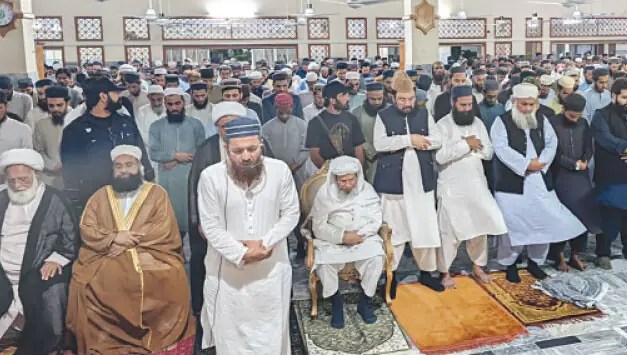
ISLAMABAD: In a notable effort to counter sectarian divisions, clerics representing Pakistan’s four primary Islamic schools of thought performed collective prayers at Jamiatur Rasheed in Karachi—a seminary previously known for its hardline stance.
Speaking to media on Monday, Hafiz Muhammad Tahir Ashrafi, chairman of the Pakistan Ulema Council, stated, “This joint prayer reflects rising tolerance within religious communities nationwide.”
Ashrafi, who also coordinates the Prime Minister’s National Paigham-i-Aman Committee (NPAC), explained the group includes senior clerics from Shia, Barelvi, Deobandi and Ahle Hadith traditions.
Under his leadership, the NPAC delegation recently visited Jamiatur Rasheed to participate in unified prayers.
Observers view this as a key advancement in Pakistan’s initiative against extremism, terrorism and sectarian conflict, as the clerics observed Maghrib prayers following the seminary’s appointed imam.
“This gathering represents an unprecedented display of religious harmony and national unity by the NPAC,” Ashrafi remarked, “bringing together distinguished religious scholars, seminary heads and interfaith leaders.”
He emphasized that this marked one of Pakistan’s first occasions where representatives of all Islamic scholarly traditions convened at a major religious institution for shared worship.
Participants included Allama Arif Wahidi, Allama Muhammad Hussain Akbar, Mufti Abdul Rahim, Allama Syed Ziaullah Shah Bukhari, Mufti Muhammad Karim Khan, Dr Asif Mir, Mufti Yousaf Kashmiri, Allama Tauqir Abbas, Allama Asad Zaidi, Hafiz Maqbool Ahmed, and delegates from various seminary federations.
Addressing reporters, Ashrafi affirmed that inherent unity exists among Pakistanis, attributing divisions to agitators and certain religious figures who exploit societal tensions.
“Respected religious scholars across Pakistan aspire to see Muslims pray collectively behind a single imam, as practiced in Islam’s holiest sites,” he added, noting the NPAC’s success in facilitating peaceful Muharram observances as a major achievement.
The committee remains dedicated to advancing the Paigham-i-Pakistan framework by opposing extremism, terrorism and sectarianism while nurturing unity, tolerance, mutual respect and national solidarity throughout the country.
The NPAC has organized engagements in multiple cities, extending visits to Muslim places of worship as well as Sikh, Hindu and Christian sites.
Founded in September 2024, the NPAC integrates Muslim clerics, non-Muslim religious leaders and government officials to combat extremism, hate speech, terrorism and sectarianism. It operates as a subsection of the National Committee on Narrative Building (NCNB), which incorporates provincial information ministers from Punjab, Sindh, Khyber Pakhtunkhwa and Balochistan, plus officials from Gilgit-Baltistan, Azad Jammu and Kashmir and the federal information minister.
The NCNB additionally encompasses military and intelligence agency representatives, foreign affairs and information technology ministry officials, and the Pakistan Telecommunication Authority chairman.
Per official mandate, the committee supervises the “formulation, distribution and assessment of the national counter-terrorism and anti-extremism narrative across media, communication and digital platforms” to support the Revised National Action Plan 2021’s execution.
Published in Dawn, July 21st, 2026


