



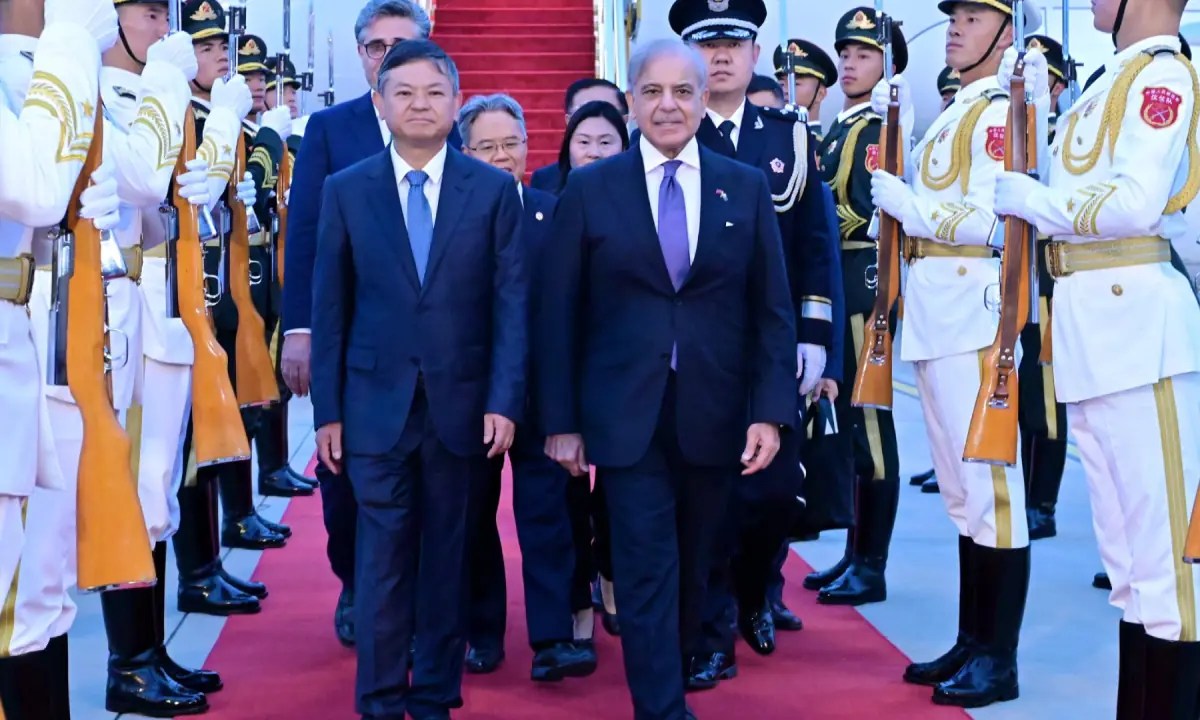
Prime Minister Shehbaz Sharif arrived in Beijing on Sunday for a series of high‑level engagements with Chinese leadership, including President Xi Jinping and Premier Li Qiang.
The prime minister touched down in Hangzhou on Saturday, commencing a four‑day official visit to China.
He opened the Pakistan‑China Business‑to‑Business Investment Conference in Hangzhou before traveling to Beijing, where he was welcomed by Chinese Minister of Environment and Ecology Huang Runqiu.
During his stay in Beijing, the prime minister will meet President Xi and Premier Li to deepen the all‑weather strategic partnership and advance Phase‑II of the China‑Pakistan Economic Corridor, focusing on trade, investment, industry, agriculture, science, technology, and people‑to‑people exchanges, the PM’s Office said.
In Hangzhou, Sharif presided over the opening ceremony of the third Pakistan‑China B2B Investment Conference, which highlighted charging infrastructure, battery energy storage, solar technologies, and pharmaceuticals.
More than $7 billion in agreements and MoUs were signed at the conference to promote cooperation and investment across multiple sectors.
The prime minister also met provincial leaders and Chinese enterprises such as StarCharge, CATL and Xiuzheng Pharmaceutical to explore practical investment and industrial cooperation.
Subsequent signing ceremonies recorded $1.22 billion in MoUs and cooperation agreements between Pakistani and Chinese companies.
Four priority areas for Pakistan‑China cooperation
Speaking at the Hangzhou conference, Sharif identified agriculture, information technology, special economic zones (SEZs), and mining as key sectors for collaboration.
He noted that 1,000 Pakistanis trained in China last year have returned and are contributing significantly to the agrarian economy.
Sharif urged both sides to improve crop yields, introduce high‑quality seeds, modern farming practices, and mechanisation to boost agricultural output.
He highlighted that $100 billion worth of agricultural products are imported by China each year, and Pakistan aims to increase its agricultural exports to China by $10 billion within the next five to seven years.
Regarding SEZs, Sharif pointed out that Karachi’s zone covers over 6,000 acres and will be equipped with full amenities to attract joint Chinese‑Pakistani investment, offering long‑term leases on attractive terms.
He invited Chinese investors to consider joint ventures in sectors where rising labour costs in China have reduced competitiveness, suggesting that products manufactured in Pakistan could be exported to third‑country markets.
Sharif also emphasized the potential of the IT and artificial intelligence sectors and urged Chinese investment in Pakistan’s mining and gemstone industries.
He concluded by stressing Pakistan’s desire for expertise, experience, and investment—not loans or aid.
Meetings with Chinese corporate executives
In Hangzhou, Sharif held discussions with senior executives from companies such as Sheng Huo Neng Yuan Ke Ji, CATL, StarCharge, and Xiuzheng Pharmaceutical, focusing on renewable energy, advanced batteries, electric‑vehicle charging infrastructure, and pharmaceutical manufacturing.
The meetings also covered expanding investment, establishing new manufacturing facilities, and scaling existing operations in Pakistan.
During a visit to Alibaba’s headquarters, Sharif and Alibaba Executive Chairman Joe Tsai signed several MoUs covering export, AI, fintech, healthcare, and human‑capital development.
Tsai outlined plans for Alibaba to help Pakistani small businesses and exporters leverage its platform, while Sharif reaffirmed Pakistan’s commitment to expanding cooperation with the tech giant.
Deputy Prime Minister Ishaq Dar chairs Pak‑China Political Parties Forum
Deputy Prime Minister and Foreign Minister Ishaq Dar, alongside Planning Minister Ahsan Iqbal, chaired the 2nd China‑Pakistan Political Parties Forum and the 4th CPEC Political Parties Joint Consultation Mechanism in Beijing.
Dar highlighted the forum as an opportunity for meaningful dialogue, reinforcing mutual trust, advancing CPEC 2.0, deepening economic cooperation, and enhancing people‑to‑people links.
Earlier, Dar addressed the Pakistan‑China B2B Investment Conference, noting the presence of over 500 companies and celebrating joint ventures such as the Servis Group‑Long March Tyres partnership, projected to become a billion‑dollar enterprise within five years.
On Saturday, Sharif signed an MoU establishing a sister‑province relationship between Zhejiang and Punjab and witnessed the signing of a cooperation agreement between Hangzhou Normal University and the Pakistani Embassy to create a joint technology research centre.
The visit coincides with the 75th anniversary of Pakistan‑China diplomatic relations, offering an occasion to reaffirm the strategic partnership and advance shared goals in CPEC development, trade, investment, industrial cooperation, agricultural modernisation, IT, science and technology, and cultural exchange.
Foreign Office spokesperson Tahir Andrabi indicated that the ongoing US‑Iran tensions in the Middle East were also on the agenda for discussion between Sharif and Chinese leaders, reflecting close coordination on regional peace efforts.
Also Read
- Death Toll Reaches 21 After Migrant Boat Capsizes Off Senegal
- Pope Closes Uruguay Visit, Advances to High-Stakes Argentina Leg of South American Tour
- Power Division Clarifies Rs25.30 Per Unit Rate Applies Only to Incremental Electricity Consumption
- Kurdish Divisions Deepen as Rival Governments Threaten Iraq’s Northern Region