






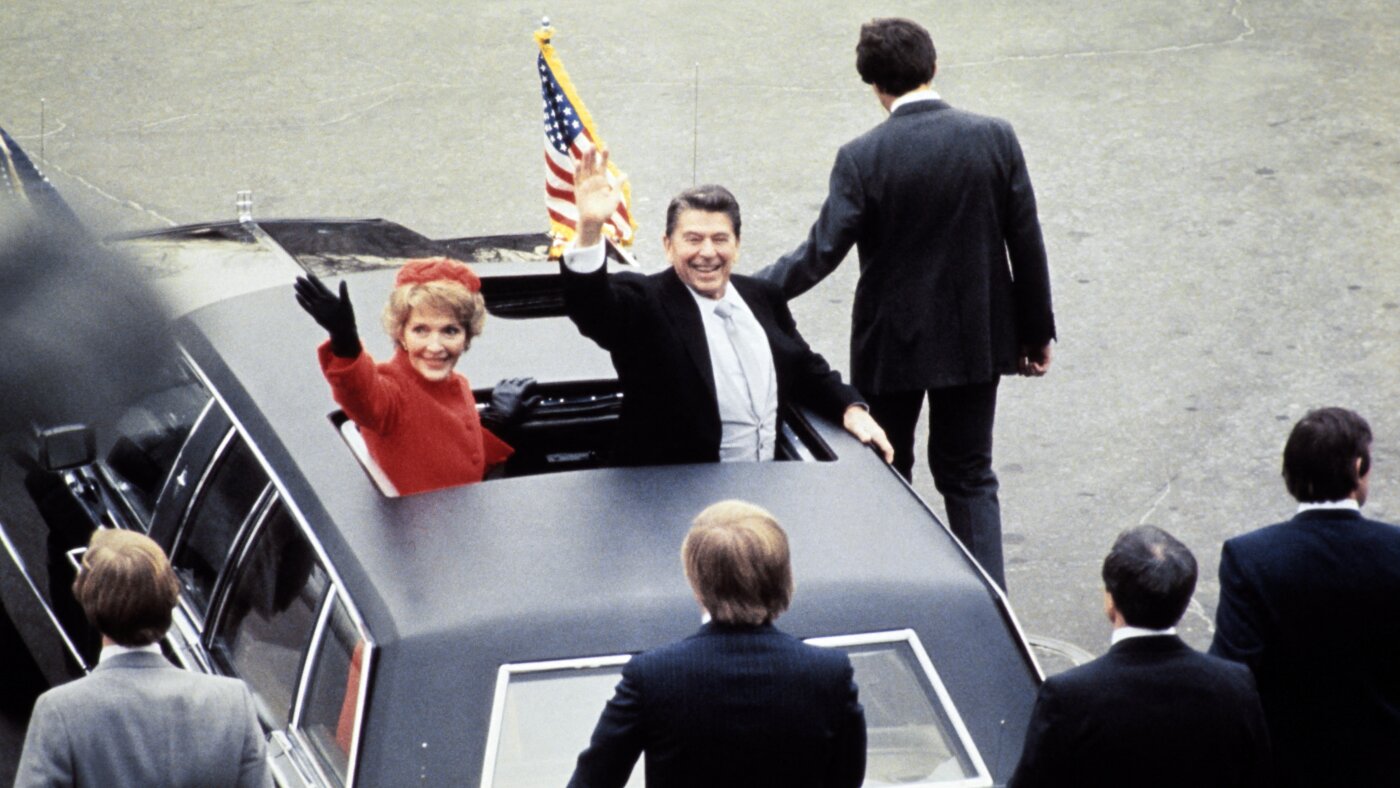

            Ronald Reagan is depicted saluting with his wife, Nancy, during his 1981 inaugural ceremony in Washington, D.C., and now heads a newly commissioned orchestral and video work that dramatizes pivotal moments of his career.
            <b class="credit" aria-label="Image credit">

                Consolidated News Pictures/AFP via Getty Images

            </b>
            <b class="hide-caption"><b>hide caption</b></b>
        </p>

        <b class="toggle-caption">

          <b>toggle caption</b>
        </b>


<span class="credit" aria-label="Image credit">


    Consolidated News Pictures/AFP via Getty Images

</span>
During a recent evening at the Reagan Presidential Library and Museum in Simi Valley, California, the late president’s voice resonated over a musical tribute that blends his cinematic legacy with a new orchestral composition.
A regional group, the New West Symphony collaborated on “The Ronald Reagan Overture,” a piece created for the nation’s 250th anniversary. It weaves together excerpts from the score of his 1942 film King’s Row, his 1987 appeal to Mikhail Gorbachev to dismantle the Berlin Wall, and archival images of the former actor greeting crowds.
Patriotic artworks such as this are increasingly prominent in 2024, yet beneath the celebratory music and flag‑adorned venues lies a subtle reorientation of federal cultural funding priorities across the United States.
“Stirring patriotism on America’s birthday is a resonant message,” Michael Christie, the ensemble’s music director, remarked in an interview with NPR. “I am proud of this work.”


            The New West Symphony unveiled "The Ronald Reagan Overture" as part of a larger celebration marking the nation's 250th anniversary last month.
            <b class="credit" aria-label="Image credit">

                The Ronald Reagan Presidential Foundation and Institute

            </b>
            <b class="hide-caption"><b>hide caption</b></b>
        </p>

        <b class="toggle-caption">

          <b>toggle caption</b>
        </b>


<span class="credit" aria-label="Image credit">


    The Ronald Reagan Presidential Foundation and Institute

</span>
Christie and the orchestra performed in a soaring atrium adorned with a massive American flag, where Reagan’s Air Force One was displayed overhead. Approximately 600 attendees, many dressed in red, white, and blue, witnessed the event.
“It reaches into the heart and resonates throughout,” audience member Theresa Brunasso observed. “It fills one with pride as an American.”
A policy shift
“The Ronald Reagan Overture” was made possible by a $25,000 grant from the National Endowment for the Arts, one of 50 awards the agency provided to support artistic projects honoring figures selected for the proposed National Garden of American Heroes.
Former President Donald Trump introduced the concept of a sculpture garden comprising 250 life‑size statues of celebrated Americans in 2020. Reagan is slated among the honorees, alongside personalities such as Muhammad Ali, Susan B. Anthony, and Elvis Presley. Construction remains in the proposal stage.
While the NEA historically supports a broad spectrum of artistic endeavors, this anniversary year it has intensified its focus on works that embody national pride.
The agency issued a statement describing the milestone as “an opportunity to celebrate our nation’s rich artistic heritage and cultural legacy” through “many artistic disciplines and perspectives.”
In 2025, the Trump administration withdrew $21 million in NEA funding, as reported by the advocacy group Americans for the Arts.


The money was reallocated away from initiatives deemed overly focused on diversity, equity, or inclusion. NPR reported that the NEA discontinued the “Challenge America” program, which previously targeted organizations serving historically underserved communities across geography, ethnicity, economics, and disability. The agency now gives priority to applications that emphasize patriotic themes, such as performances by military bands.
Artists lean into the spirit of American patriotism
The abrupt withdrawal of expected funding sent shockwaves through arts organizations nationwide. NPR previously reported that hundreds of groups received notifications that their grants had been abruptly terminated.

Earlier in the fall, several organizations declined new grants, citing the NEA’s revised eligibility requirements that obligate applicants to attest they will not sponsor programs promoting diversity, equity, or inclusion in line with a Trump administration executive order.
Conversely, ensembles like Sones de México embraced the prevailing patriotic tone.
In the previous year, the NEA withdrew a $20,000 grant that had been earmarked for a Chicago‑based Mexican folk ensemble to develop concerts and educational programs centered on a traditional ballad genre.
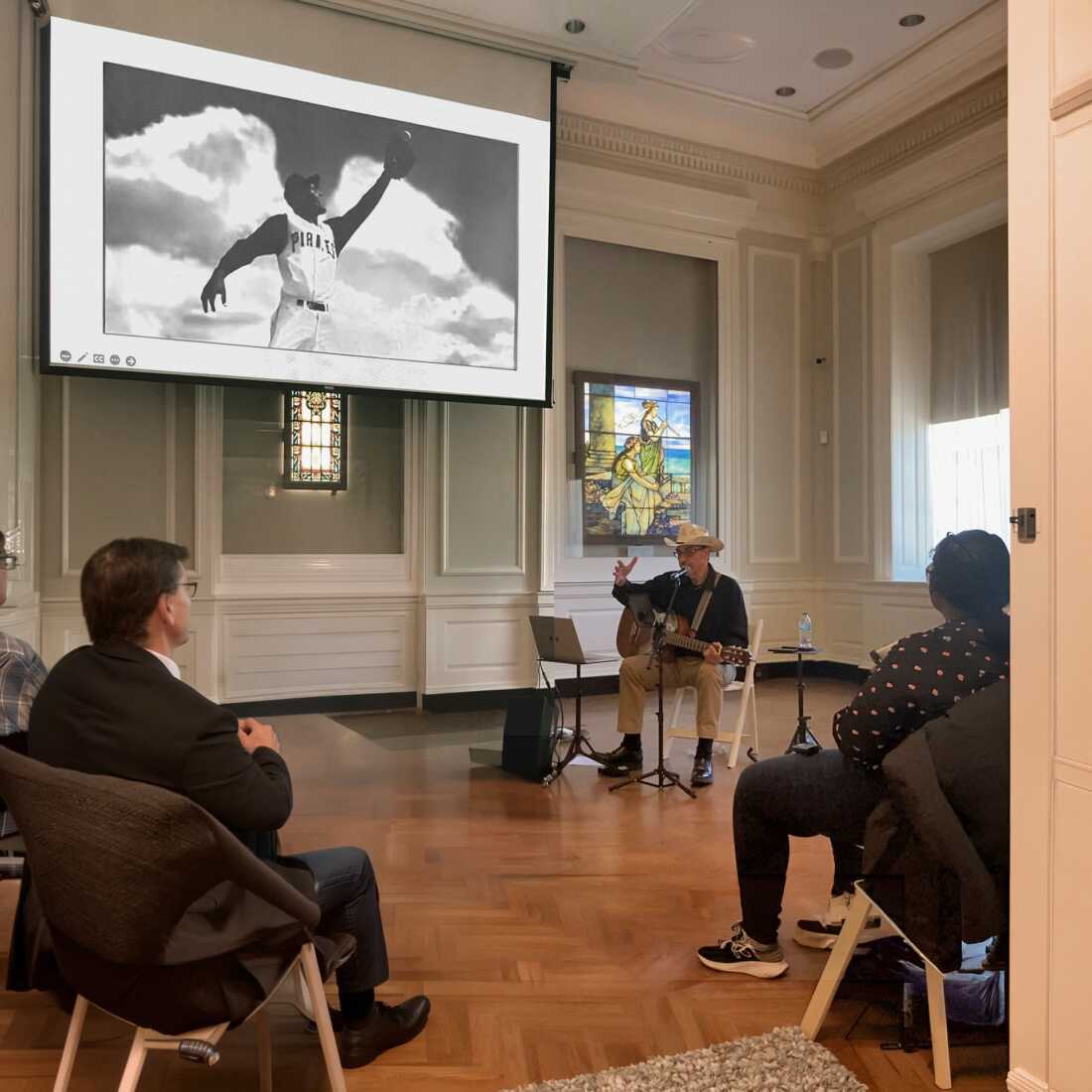
            Juan Díes performs a *corrido* honoring baseball legend Roberto Clemente.
            <b class="credit" aria-label="Image credit">

                Erika Erdely

            </b>
            <b class="hide-caption"><b>hide caption</b></b>
        </p>


<span class="credit" aria-label="Image credit">


    Erika Erdely

</span>
“The rationale was that it no longer aligned with the administration’s updated criteria,” explained the group’s co‑founder, Juan Díes.
When the latest NEA grant opportunities were announced, Díes examined the proposed list of statue subjects.
He re‑submitted the proposal, this time highlighting subjects such as aviator Amelia Earhart and baseball star Roberto Clemente that meet the administration’s criteria. The grant was ultimately awarded.
Díes’ new compositions adopt a celebratory tone while also addressing deeper narratives, such as the racism experienced by Clemente as a prominent Puerto Rican figure in the United States.
“He never bowed his head or condemned racism,” Díes sings in his corrido about Clemente. “Though he confronted considerable racism, he never lowered his head.”
“We are not compromising our goals,” Díes explained of adapting the grant proposal to align with Trump administration priorities. “By working within the framework, we can share our perspective on the lives of these American heroes.”
David Lubin, a retired Wake Forest University professor specializing in American art, politics, and cultural propaganda, identifies two strands of patriotism.
“One strand holds that ‘My country, right or wrong’—that the United States is the world’s premier nation,” Lubin explained. “The other is the aspirational patriotism of ‘We can do better, and it is our mission to uphold the nation’s founding ideals.'”
Lubin noted that patriotic art can serve governments by rallying public support for policies and ideologies. However, in a deeply divided nation like the United States, such art often exacerbates existing divisions.
“It reinforces preexisting convictions among a segment of the population,” Lubin added, “essentially preaching to the choir.”
At the Reagan Museum and Library, Reagan Foundation spokesperson Melissa Giller noted that the 40th president envisioned patriotism as compatible with a broad spectrum of viewpoints.
“He consistently championed bipartisanship and collaboration across party lines,” she affirmed.
Giller added that the foundation is now dedicated to disseminating the late president’s vision.

            The Reagan Foundation distributed complimentary Civility Handbooks, modeled on the former president's principles, to participants at last month's concert.
            <b class="credit" aria-label="Image credit">

                The Ronald Reagan Presidential Foundation and Institute

            </b>
            <b class="hide-caption"><b>hide caption</b></b>
        </p>


<span class="credit" aria-label="Image credit">


    The Ronald Reagan Presidential Foundation and Institute

</span>
“We have established a new Center on Civility and Democracy,” Giller explained. “Indeed, we were handing out free Civility Handbooks during the check‑in process.”
The publication is intended to foster respectful discourse in everyday interactions. During intermission, attendees flipped through the compact paperback, its cover adorned with stars and stripes, and later tucked it into their bags and pockets.
Jennifer Vanasco edited the broadcast and digital versions of this story. Chloee Weiner mixed the audio.


