






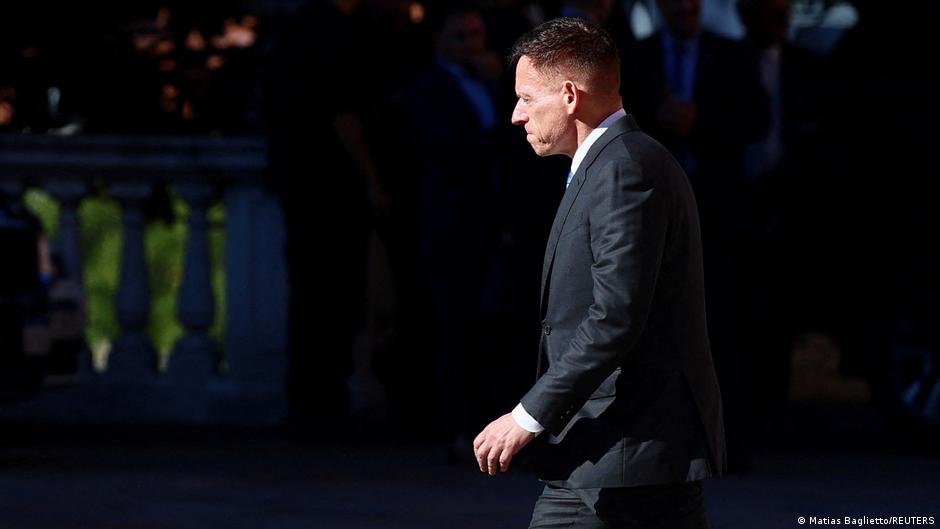
While figures like Donald Trump and Elon Musk often dominate the headlines, Peter Thiel asserts a compelling claim to being one of the world’s most influential and wealthiest individuals. Born in 1967 in Frankfurt am Main, West Germany, the Thiel family relocated to the United States when Peter was merely an infant. They also resided for six years in South African-occupied Namibia between 1971 and 1977.
Thiel’s ascent to prominence was driven by his technological enterprises and strategic investments. His initial major triumph was PayPal, a digital payment platform initially involving Musk. He subsequently became Facebook’s first external investor. Currently, he holds stakes in Musk’s SpaceX, as well as OpenAI and numerous other ventures. Forbes estimates his personal fortune at $35.7 billion (€31.1 billion).
However, Palantir may represent his most significant endeavor. This surveillance, AI, and data-analytics firm has secured billions of dollars in government contracts to develop software for the Pentagon and US Immigration and Customs Enforcement (ICE). In April, the company published a 22-point manifesto that critics argue reflects “techno-fascism.”
Yet, Thiel’s influence extends beyond the corporate sphere into the political arena, and this impact is not confined solely to the United States.
Palantir’s AI manifesto sparkes global debate on weapons
To view this video please enable JavaScript, and consider upgrading to a web browser that supports HTML5 video
Although several European nations, including the UK, the Netherlands, France, Germany, and Spain, are reconsidering or severing their governmental and military ties with Palantir due to security concerns, the company remains deeply entrenched in global security infrastructures.
Thiel himself has recently relocated to Argentina, where he has reportedly engaged in discussions with the nation’s right-wing president, Javier Milei. These talks coincide with proposed government regulations offering incentives for foreign businesses and targeting investments in AI data centers.
Early Trump Support Yields Dividends
Thiel was an early supporter and later advisor to Donald Trump, contributing $1.25 million to the 2016 presidential campaign and addressing the Republican National Convention that year, a period when Silicon Valley was predominantly aligned with the Democratic Party. Apart from a hiatus between 2023 and 2025, he has remained a prolific donor to Republican campaigns and figures, including Vice President JD Vance.
Thiel’s personal political convictions are difficult to categorize. He is often described as a libertarian nationalist and has consistently championed the idea that “technology is the alternative to politics.” He also exhibits a deep distrust of authorities, regulations, and liberal elites, partly stemming from his frustration with what he views as inefficient decision-making by elected officials and the electorate.
“It borders on fascism,” Max Chafkin, author of a 2021 biography of Thiel, told Time magazine. “He argues that companies are better governed than governments because they have a single decision-maker—a dictator, essentially. He is hostile to democratic principles. This is deeply unsettling given the pivotal role of the companies he has influenced.”
These beliefs began to surface during his time at Stanford University in California. Thiel vigorously opposed the prevailing liberal campus ideology and founded the Stanford Review, a publication dedicated to expressing his contrary views—a stance that foreshadowed his current disdain for ideologies labeled as “woke.”
Christianity, the Antichrist, and Artificial Intelligence
Raised in a devoutly Christian household, Thiel’s religion has undeniably shaped his life and career. He recently identified himself as a “small ‘o’ orthodox Christian,” a label that appears to influence his conservative politics. His homosexuality and marriage to American financier Matt Danzeisen seem to contradict this background, though paradox is nothing new for Thiel.
More recently, he has become fixated on the concept of the antichrist, touring globally with a series of lectures over the past few years. Unlike the biblical figure, Thiel views this entity or group as one that will bring about the apocalypse “by exploiting our fears of technology and seducing us into decadence with the antichrist’s slogan: Peace and safety.”
Those vaguely cast as soldiers of the antichrist include environmental activist Greta Thunberg, whom he dismisses as a “Luddite intent on halting all science,” and governments seeking to regulate AI. In July, he accused Pope Leo XIV of “working for the Chinese communists” after the pontiff warned about the “risk of dehumanization” posed by AI.
Despite his deep ties to the tech industry, Thiel also leverages his relationships with powerful figures, including Musk, Trump, and Vance.
“I’ve cultivated meaningful friendships over the years with my professional associates,” Thiel told the Washington Post in 2014. “And I believe this is a crucial factor that enables one to achieve long-term success in our society.”
Inside Peter Thiel’s secretive elite Dialog club
To view this video please enable JavaScript, and consider upgrading to a web browser that supports HTML5 video
Leveraging Vance to Future-Protect His Interests?
Many observers believe Thiel may be leveraging his relationship with Vance to safeguard his personal and business interests in the future, given that the vice president is considered the most likely Republican successor to Trump. The pair first met in 2011 when Thiel delivered a lecture at Yale Law School. Vance, whose religious and political beliefs have since evolved, wrote in the Christian magazine The Lamp that Thiel “defied the social template I had constructed — that dumb people were Christians and smart ones atheists.”
Thiel subsequently became a mentor to Vance, helping to smooth relations between Vance and Trump as Vance shifted from opposing the president to joining his 2024 ticket. Most notably, Thiel donated $15 million to Vance’s 2022 Senate campaign, the largest contribution ever given to a single US Senate candidate.
Recent calls by CEOs in similar positions to Thiel to slow the pace of AI development may eventually impact his business interests. However, his distinct character and extensive connections have thus far kept him one step ahead.


