







PropAmm Efficiency Premium Lifts Solana Swaps While Public AMM Returns Plummet
A trader can obtain a higher Solana (SOL) swap price from a professional operator-controlled pool—often called propAMMs—while passive pool depositors encounter investors exploiting stale quotes, and a recent study reveals divergent outcomes across exchange venues.
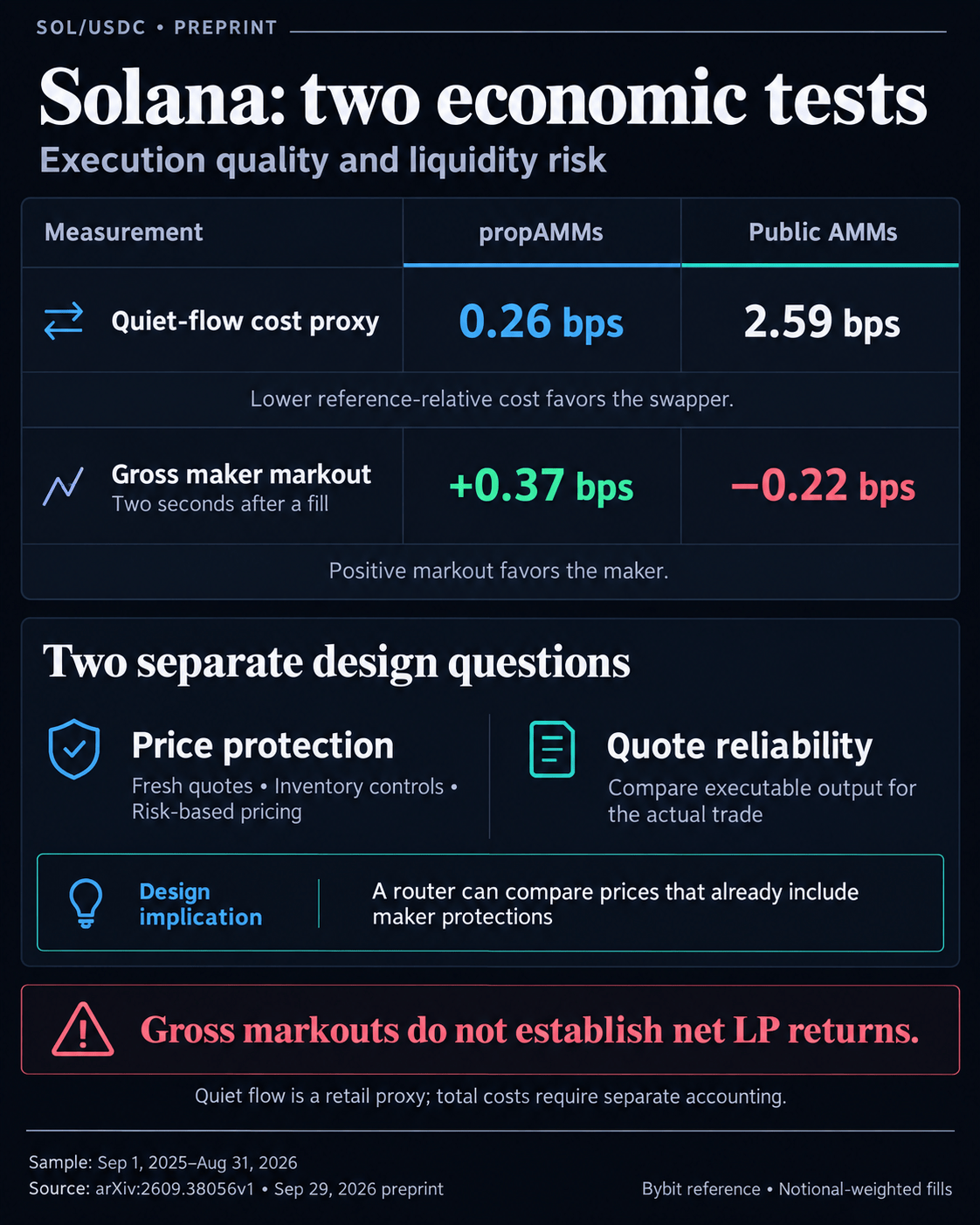
During quiet-market SOL/USDC fills, propAMMs demonstrate a reference‑relative execution cost proxy of 0.26 basis points compared with 2.59 basis points for public automated market makers (AMMs). The analysis spans September 1, 2025 through August 31, 2026, incorporating both full‑length and shorter Base and Monad samples. Fills were weighted by notional against Bybit’s size‑weighted top‑of‑book USDT microprice, which was then converted using its USDC/USDT midpoint. ETH Zurich and Category Labs contributed author affiliations.
Swap Prices and Depositor Returns on Solana
Across the Solana sample, the paper reports two‑second gross maker markups of +0.37 basis points for propAMMs and –0.22 basis points for public AMMs. A markup reflects the difference between a trade’s fill price and a subsequent reference price, with a positive number indicating a favorable outcome for merchants.
Quiet‑flow execution evaluates how much a trader sacrifices against a comparatively stable reference. The proxy assumes less than one basis‑point movement in the reference over a five‑second window preceding the fill. Maker markups further examine post‑acceptance trade values; mixing both measures conflates pricing evidence with potential adverse‑selection effects that the numbers themselves cannot substantiate.

>
A trader entering an outside market often finds a pool advertising an outdated price that will trade either too shallow or too deep. Arbitrageurs correct this imbalance, but profit comes from trading against existing pool inventory rather than the advertised level. Loss‑versus‑rebalancing frameworks treat such arb costs as part of LP economics, yet end‑of‑day returns also depend on asset exposure, earned fees, and operational overhead that span limited horizons.
Fees, inventory adjustments, hedging strategies, and running expenses all influence net outcomes. The brief reporting window prevents a complete accounting, and site‑average analyses cannot conclusively prove that professional pools systematically generated losses for passive participants.
Depositors require return assessments that encompass the full balance sheet—inventory, time horizon, and all associated inflows and outflows. Swappers can benefit from providing liquidity to operators who actively manage pricing risk. Jump Crypto’s BisonFi exemplifies such adaptations, dynamically adjusting prices and available liquidity based on inventory levels, quote freshness, and inbound flow quality—though implementation specifics vary.
A maker that accumulates excessive holdings of a single asset can deter additional add‑bases, while a stale price may justify reducing depth or broadening fee structures. Routing pathways that facilitate adverse‑selection flows might negotiate distinct terms from those viewed as less risky.
What’s Moving Crypto. Why It Matters.
Get CryptoSlate’s essential stories and what to watch next.
This analysis does not answer whether the lower execution cost of propAMms translates into superior longterm returns for passive investors; instead it underscores the complexity of evaluating matching supply and demand under varying risk profiles.


