Researchers at IBM and Oak Ridge National Laboratory (ORNL) have developed a pioneering approach combining quantum computing and artificial intelligence to model the physics inside a fusion reactor, marking a significant step toward realizing clean, abundant nuclear power.
The world-first experiment demonstrates the creation of tritium, a rare hydrogen isotope essential for the fusion process, using hybrid quantum computing and AI methods. While the findings, published on arXiv, have not yet undergone peer review, they represent the first instance where quantum and classical computing elements collaborate to define an effective tritium production method.
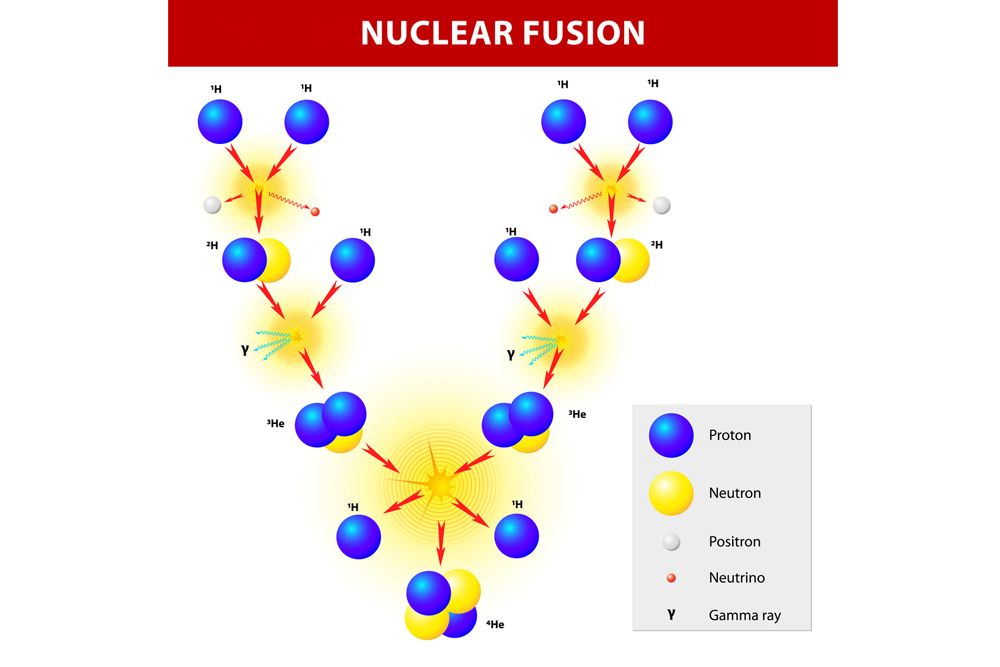
Nuclear fusion reactors generate energy by fusing atomic nuclei, producing no carbon byproducts or long-lived radioactive waste. A single fusion reactor could theoretically yield 4 million times more energy than a coal plant and four times that of a modern fission reactor.
Fusion requires deuterium, abundant in seawater, and tritium, a scarce radioactive isotope with a 12-year half-life. Currently, tritium is produced by bombarding lithium atoms with neutrons, a process that must be superheated and contained within a tokamak using magnetic fields.
The primary challenge lies in producing sufficient tritium for sustained fusion reactions. Classical supercomputers struggle to model the complex particle physics and chemical reactions involved in tritium synthesis within liquid fluoride salt mixtures like FLiBe.
In this study, scientists simulated nine molecular configurations of FLiBe, a leading candidate for tritium extraction in fusion reactors. The hybrid quantum-classical workflow used IBM Quantum Heron QPUs and ORNL’s Frontier supercomputer to tackle challenging chemical computations, particularly tritium binding processes beyond classical simulation capabilities.
The approach employs wave-function-based embedding, fragmenting calculations into smaller clusters solved classically and more complex sections handled by quantum computers. This method builds on prior research where quantum computers analyzed a 12,635-atom protein.
Accuracy was confirmed by matching results against known molecular configurations. The proof of concept could expedite scaling models to predict tritium production in fusion blankets, addressing a critical hurdle for commercial fusion energy.
Demystifying Complex Chemistry
<
A FLiBe “blanket of molten salt” surrounds the nuclear reaction in proposed fusion reactors, providing fuel and thermal shielding. Neutron bombardment continuously alters the salt’s chemistry, requiring materials that balance durability and efficient tritium release.
“If tritium binds with fluorine in the salt, it forms corrosive tritium fluoride, which is difficult to extract,” researchers explain. “Alternatively, it may form gas and bubble out. Predicting reaction paths demands high-precision modeling, a limitation of traditional methods.”
The workflow involved three stages: AI agents screening candidate salts from ORNL’s database, followed by density functional theory (DFT) simulations on supercomputers using AI-optimized models, and finally quantum computations to pinpoint tritium binding sites where DFT struggled.
Fusing Quantum and AI
<
Future steps include modeling larger molten-salt systems and testing scalable AI methods to accelerate material discovery. The broader goal is creating a computational framework to predict tritium breeding efficiency, recovery feasibility, and material performance in extreme fusion conditions.