






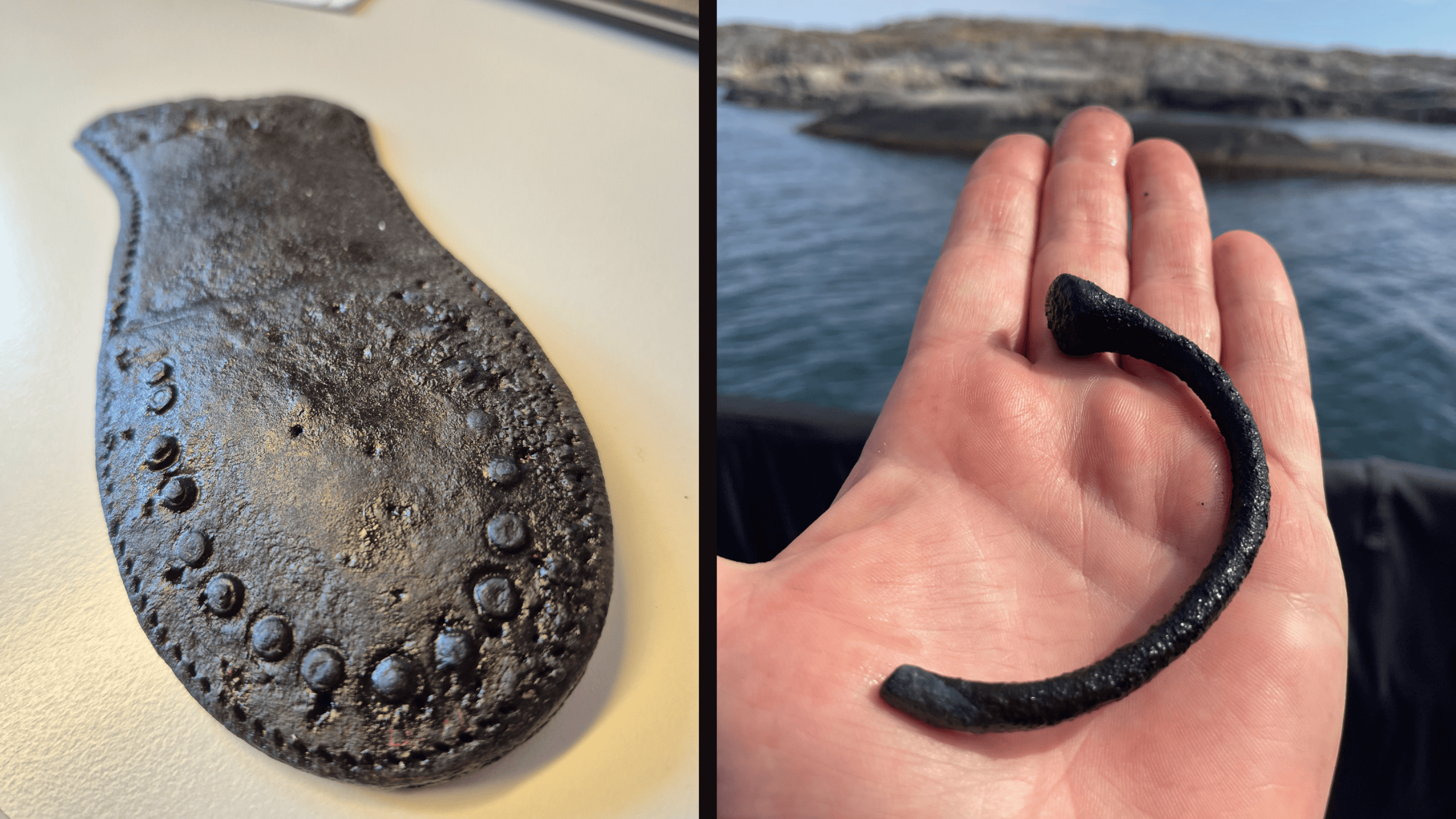
Maritime archaeologists exploring a 17th-century shipwreck off the coast of Sweden have recovered an elegant shoe and two metal rings once used as currency in the transatlantic slave trade. The objects went down with a ship lost during a mutiny in 1683, a revolt in which the first governor of the Danish West Indies was thrown overboard.
The Danish frigate Havmanden — meaning “Merman” — was sailing toward St. Thomas, a Caribbean island that today belongs to the U.S. Virgin Islands, carrying convicts and indentured servants bound for labor under the Danish West India Company. After delivering its new colonists, the Havmanden was meant to continue to West Africa to purchase enslaved Africans. Instead, facing dwindling food and water supplies, a group of crew members and convicts seized the vessel near the Azores in the North Atlantic and turned it back toward Copenhagen.
The mutineers shot the ship’s captain and cast other officers overboard, among them Jørgen Iversen Dyppel, the first governor of the Danish West Indies, whom they threw into the English Channel. Once the ship ran aground, the rebels were put on trial in Copenhagen and sentenced to death.
Described in a Nov. 11 statement from the National Museum of Denmark as one of the bloodiest mutinies in the nation’s history, the tale of the Havmanden is now being pieced together by underwater archaeologists studying the wreck, which rests on the seabed just east of Gothenburg, Sweden.
Among the finds is the rear portion of a man’s “unusually fine” shoe, according to the museum’s statement.
“I see a great many shoes from shipwrecks, but I have never before seen a shoe of such high quality,” said Vivi Lena Andersen, director of the Rudersdal Museums in Denmark.
Andersen noted that the sole reflects a high degree of craftsmanship, evident in the tiny holes perforating the shoe’s edge. Achieving such regular perforations would have demanded tools and skill possessed only by the era’s most accomplished shoemakers. The result, she said, was “undoubtedly an expensive and exclusive shoe that only the elite could afford to buy.”
Because the footwear was probably owned by someone of the upper class, researchers suspect it may have belonged to Iversen, the governor lost overboard.
“The shoe testifies not only to Jørgen Iversen Dyppel’s life and dramatic death, but also provides a personal point of entry into the larger story of the establishment of the Danish colonies in the West Indies and the widespread slave trade Denmark was a part of,” said Andreas Kallmeyer Bloch, a maritime archaeologist at the National Museum of Denmark’s Center for Maritime and Underwater Cultural Heritage.
Further evidence of the vessel’s role in the Danish slave trade included two manillas — ring-shaped pieces of metal used as currency in West Africa. European merchants cast manillas from copper, brass, or iron and exchanged them for enslaved people along the West African coast, particularly in what is now Nigeria. Such objects are rarely uncovered in Scandinavia, the statement noted.
“The manillas add another layer to Havmanden’s story and underscore the connection to the slave trade, which was a central part of Denmark’s colonial activities in both the West Indies and on the west coast of Africa,” Kallmeyer Bloch said.
Denmark remained involved in the transatlantic slave trade for more than a century after the Havmanden went down. Although King Christian VII of Denmark-Norway outlawed the trade in 1792, slavery persisted in the Danish West Indies until 1848, when hundreds of enslaved people rose up and were finally granted their freedom.
Also Read
- Nvidia CEO Investigation, Global Instagram Teen Accounts, and Cybertruck Production Phase-Out | Tech Today
- Amazon Web Services Launches Local Emulator for Cloud API Testing
- Who could replace Jensen Huang? A highly unscientific list of possible successors
- Curiosity Analyzes Unusual Rock Formations During Sols 5063–5069


