







TL;DR: The Australian dollar is the week’s weakest major currency despite the market assigning almost no chance to anything other than a September RBA increase to 4.60%. The decline reflects reduced long-AUD exposure ahead of an uncertain vote, statement tone, and policy guidance—not doubt that the rate will rise. AUD/USD is now testing support at 0.7006.
Aussie Weakness Goes Beyond Broad Dollar Strength
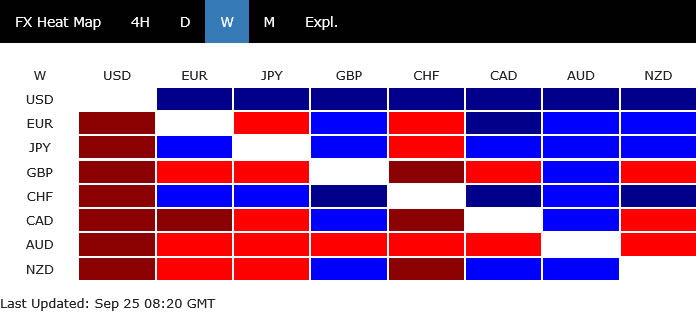
The Australian dollar is entering next Tuesday’s RBA meeting as the week’s underperforming major currency, down roughly 1.4% against the US dollar and lagging even NZD. Stronger USD and rising US yields explain part of the move, as every major currency has weakened against the dollar, with lower-beta currencies generally proving more resilient. AUD’s additional decline, however, points to Australia-specific positioning. With a 25bp increase to 4.60% almost completely priced in, traders have little potential upside tied to the headline decision while still facing uncertainty over the vote split, statement language, and guidance on subsequent moves.
The current sell-off is therefore best viewed as position trimming ahead of skewed event risk, rather than evidence that markets expect a divided or dovish board. That distinction is important. Investors can still believe the RBA will raise rates on Tuesday while reducing long-AUD exposure because the information accompanying the decision is much less predictable. A unanimous increase with firm language could simply confirm expectations already embedded in prices. A split vote or softer signal on further tightening, by contrast, could trigger a much sharper repricing.

The Decision Is Priced in; the Policy Signal Is Not
Uncertainty becomes clearer further along the rates curve. Although the September increase is priced at nearly 100%, the implied probability of another move falls to approximately 40.8% in November and 26.4% in December, before recovering only partially by February. Markets are therefore not anticipating a steady sequence of hikes. They are pricing one highly likely increase followed by a substantially less certain path.
Sell-side forecasts highlight the same divide. Commonwealth Bank expects a unanimous decision accompanied by hawkish language, while Westpac expects a split vote, even though both forecast a 4.60% cash rate. August’s hold was unanimous, but the minutes revealed differences in how board members assessed the risks. Some focused on the possibility that upside inflation pressures could materialize, while others placed more emphasis on offsetting downside risks.
RBA Monetary Policy Board member Iain Ross added another dimension this week when he said there was “no evidence of the emergence of a wage-price spiral” and that recent data made such an outcome unlikely. That reduces the case for viewing wages as an accelerating source of inflation, but it does not eliminate the broader argument for tighter policy. Underlying inflation remains above target, excess demand is a concern, and imported energy shocks could still generate second-round effects—all key considerations for policymakers favoring further increases.
Domestic Data Support Competing Policy Arguments
August’s labor-market figures illustrate why the board’s internal debate may remain challenging even if the rate decision itself is straightforward. Employment rebounded by 39.5k, but the entire net gain came from part-time roles, while full-time employment declined by about 6k and unemployment increased from 4.5% to 4.6%. The data do not indicate a collapse in labor demand; rather, they suggest that spare capacity is gradually expanding even as total employment continues to rise.
Wage growth points in a similar direction. The Q2 Wage Price Index remained at 3.2% year on year, down from 3.4% a year earlier, with private-sector wages growing at 3.1% and public-sector wages at 3.4%. Against headline CPI of 3.5% and trimmed-mean inflation of 3.6%, wage gains provide households with little protection in real terms. That supports Ross’s view that a wage-price spiral has not emerged and makes repeated tightening based solely on domestic wage pressure less persuasive.
Financial markets are also increasingly pricing in a weaker household outlook. Australian consumer-discretionary shares have fallen substantially over the past year, while housing prices have retreated from their April high. These indicators do not measure consumption directly, but they reflect growing concern about how higher interest rates could affect earnings and economic growth. HSBC’s Paul Bloxham has taken the view further, estimating a nearly 50% chance of a technical recession if both September and November increases occur—well above the roughly 20% market consensus. It remains a minority forecast, but it underscores how much more contentious the second hike is than the first.
The RBA Will Vote Before the Next CPI Release
Timing adds another complication. The RBA will announce Tuesday’s decision one day before Australia’s August CPI report, leaving policymakers without the latest inflation reading when they cast their votes.
This helps explain why the market can be nearly certain about September while assigning far lower probabilities to November. The board already has sufficient inflation evidence to justify another increase if it chooses, but guidance beyond Tuesday may need to remain conditional. The next CPI release could either strengthen the case for further tightening or weaken it.
The resulting asymmetry for AUD is clear. The expected 25bp increase contains limited new information. Investors will instead focus on whether the vote is unanimous, whether the statement preserves language signaling readiness to tighten further, and whether the board presents September as part of an ongoing sequence or as a more cautious policy step.
Technical Outlook: AUD/USD Tests the 0.7000 Pivot
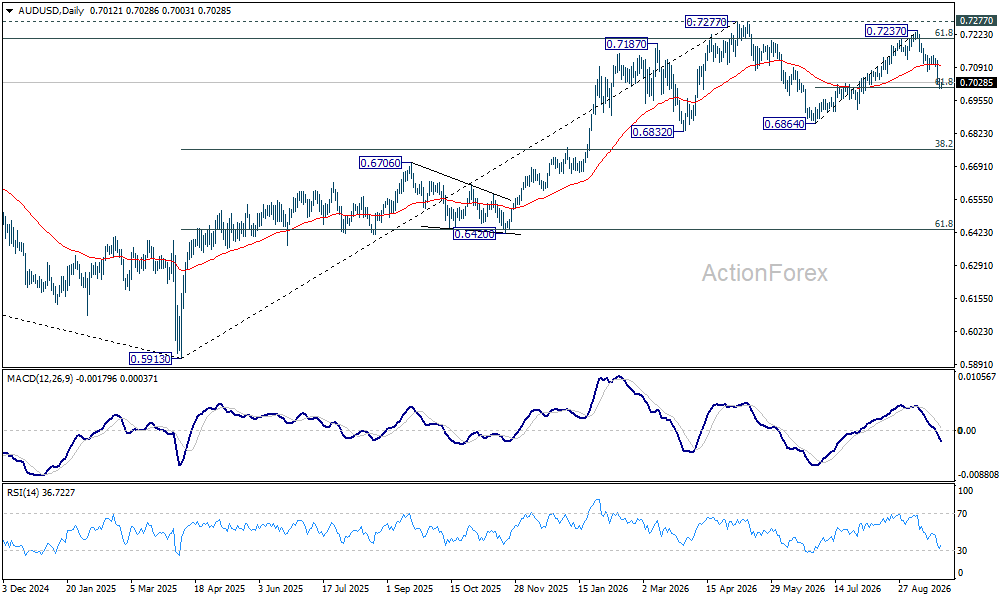
The positioning risk is already visible in AUD/USD. The pair has extended its decline from 0.7237, broken decisively below the daily 55-day EMA, and lost former 0.7074 support. It is now pressing 0.7006, the 61.8% retracement of the advance from 0.6864 to 0.7237.
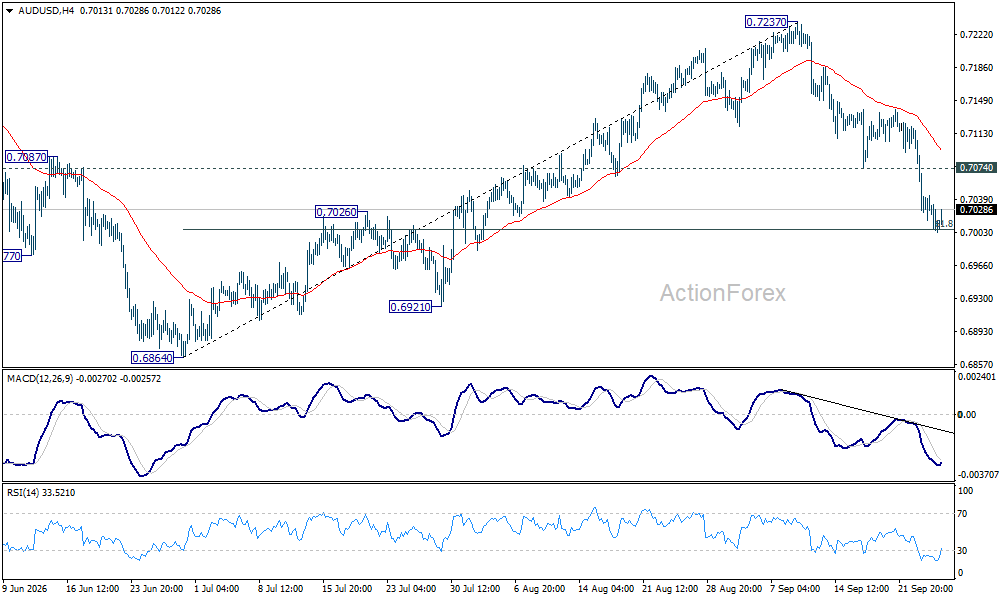

The decline is currently being interpreted as the third leg of the corrective pattern originating from the 0.7277 high. A sustained move below 0.7006 would expose 0.6864, followed by the more significant 0.6756 area—the 38.2% retracement of the rise from 0.5913 to 0.7277. Unless AUD/USD is entering a broader bearish trend reversal, stronger demand is likely to emerge near 0.6756.
On the upside, 0.7074 has emerged as the first meaningful resistance level. A recovery above it would indicate near-term stabilization, although a more credible rebound would require the pair to regain its declining short-term moving averages.
Tuesday’s Real Test Is the RBA’s Message
The central point is that AUD weakness does not necessarily signal an expectation that the RBA will disappoint. It is more consistent with investors reducing long exposure because the rate decision is predictable while the accompanying message remains uncertain.
A unanimous 25bp increase with clearly hawkish guidance could ease that uncertainty and support AUD. A split vote or softer wording on future tightening would represent the clearer downside surprise and could push AUD/USD below 0.7006.
The most telling scenario would be a clean, hawkish increase that fails to lift the currency. That would suggest broader USD strength, domestic growth concerns, and positioning are outweighing the rate differential. For now, markets are not seriously debating whether the RBA will raise rates on Tuesday. They are deciding how much AUD exposure to retain ahead of an announcement in which the tone may matter far more than the expected rate move.
Key Points
- AUD is the week’s weakest major currency, falling about 1.4% despite a September RBA hike being nearly certain, as traders reduce exposure before an uncertain vote and policy message.
- Sell-side forecasts diverge on the vote despite sharing a 4.60% rate target: CBA expects unanimity and hawkish language, while Westpac expects a split.
- Implied odds of a November increase stand at 40.8%, far below September’s near-certainty, indicating one expected hike followed by substantial uncertainty.
- Full-time employment fell by roughly 6k, while wages grew 3.2% year on year—below both headline and trimmed-mean inflation—and weaken the case for aggressive follow-through tightening.
- AUD/USD is testing 0.7006 support. A breakdown would open 0.6864 and then 0.6756, while recovery above 0.7074 would point to near-term stabilization.


