






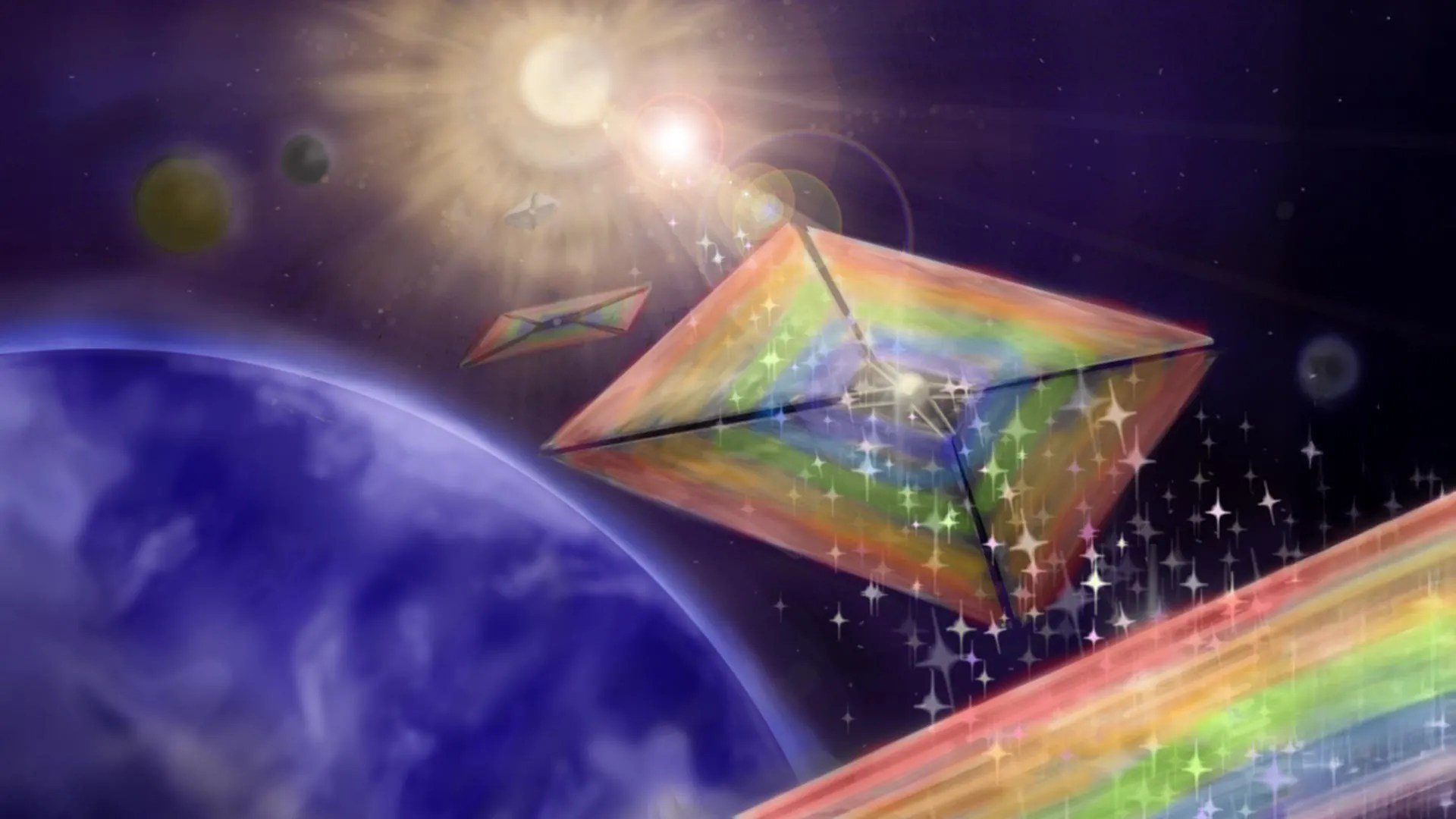
To reach another star within a practical timeframe, humanity must look beyond conventional chemical rockets. One of the most promising concepts is the solar sail—a vast, reflective structure designed to capture the momentum of light. By directing extremely powerful lasers at such a sail, scientists envision accelerating a spacecraft to speeds far exceeding those of traditional propulsion systems.
However, a new study suggests that traveling at a significant fraction of the speed of light could introduce an unexpected hurdle. According to a paper published on arXiv by Chao Shen and Jiaze Li of the Harbin Institute of Technology, the very light used to propel the sail might eventually end up generating a drag effect.
How Light Propels a Solar Sail
The researchers categorized the forces generated by photons striking a solar sail into three distinct components.
The primary force comes from incident light, which transfers raw momentum upon impact. The second strongest contribution is specular reflection, where photons bounce perfectly off the sail’s surface. The weakest of the three is diffuse scattering, which occurs when photons are absorbed by the material and subsequently re-emitted in random directions.
At lower velocities, all three of these effects work in concert to push the sail forward. However, the physics becomes significantly more complex once the spacecraft approaches relativistic speeds.
The Doppler Effect Diminishes Thrust
As the sail accelerates away from its laser source, the incoming light undergoes an increasingly pronounced Doppler shift. This shift lowers the frequency of the light, which in turn reduces the thrust generated by all three force components.
Consequently, continued acceleration becomes progressively less efficient. The faster the sail travels, the more difficult it becomes for the ground-based laser to further increase its velocity.
The physical dynamics shift even more dramatically once the lightsail reaches approximately 75% of the speed of light.
When Scattered Light Generates Drag
At this threshold, relativistic light aberration becomes a dominant factor. From the perspective of a stationary observer on Earth, diffusely scattered light begins to bend forward, aligning with the direction of the sail’s travel.
Due to Newton’s third law, this forward-directed radiation generates an equal and opposite reaction force pointing backward. Thus, diffuse scattering—historically the weakest of the three forces—begins to act as a form of drag once the sail exceeds roughly 75% of light speed.
While the laser continues to push the sail forward overall—meaning the net force remains positive—the overall efficiency of the propulsion system drops substantially.
Additional Hurdles for Real-World Solar Sails
The study focuses specifically on radiative dynamics, omitting non-radiative factors such as collisions with interstellar gas and dust.
It also overlooks the thermal limitations of actual sail materials. A physical sail exposed to an incredibly powerful laser could potentially overheat or even melt.
For simplicity, the researchers modeled the lightsail as an idealized mirror. Real-world spacecraft would likely utilize far more advanced materials.
Engineers are already exploring advanced metamaterials and photonic crystals tailored to specific laser wavelengths. In theory, these next-generation materials could exploit the aberration effects described in the study to help a lightsail automatically correct its orientation and stabilize its trajectory, keeping it centered within the laser beam.
The Long Road to Interstellar Flight
A fully operational interstellar solar sail remains a distant reality. Traveling across interstellar distances introduces numerous additional complications, including the curvature of spacetime, which the paper also simplifies out.
Even so, understanding these high-speed relativistic effects is a crucial step in determining how such spacecraft might eventually function. If humanity hopes to send a probe to another star someday, engineers will need a comprehensive understanding of every force that could influence its journey.
Also Read
- Decoding AI Authenticity: Max Spero on the Escalating Challenges of Detection
- Scientists Identify Ten-Sided Jet Stream at Saturn’s South Pole Using Hubble Observations
- When AI Interviews AI: The Emerging Reality of Bot-to-Bot Recruitment
- NASA’s Swift Observatory Reactivates Instruments for Final Science Mission Before Atmospheric Reentry


