






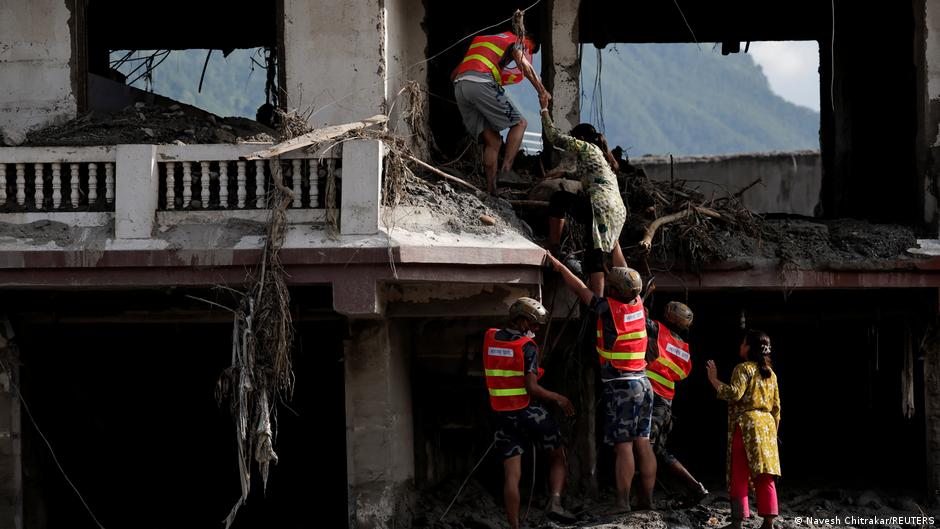
A lake created by a landslide along the Nepal‑China border began to overflow on Friday, endangering regions still recovering from recent flash floods and pausing rescue operations, officials reported.
“We have been notified that the lake has burst its banks,” said Narendra Pariyar, senior bureaucrat of the severely affected Rasuwa district, to DW. “We can observe that the river’s water level is rising.”
Residents of Nepal’s border district Rasuwa were observed moving uphill as they prepared for a surge in river levels, according to Reuters.
Concerned about a possible breach, Chinese rescue teams were ordered to move to a safe location, reported CCTV. Nepal’s authorities likewise suspended rescue activities for 90 minutes, an army spokesperson told Reuters.
Rescue personnel are urgently searching for hundreds of individuals still unaccounted for, two days after a catastrophic flash flood hit the Himalayan border region between Nepal and China.
Nepal police reported Friday morning that the death toll had risen to 469, up from 390 the previous day. China has not revised its earlier figure of three fatalities in Tibet. Both nations indicated that more than 1,000 people remain missing, among them up to 540 foreigners from over 30 countries.
Latest Update from China
Wednesday’s disaster, sparked by a glacial collapse that released rock and meltwater into rivers below, introduced a new hazard: a barrier lake formed upstream by debris dams.
China’s Ministry of Water Resources reported that the lake contained approximately 2 million cubic meters of water as of Thursday and was projected to receive an additional 3 million cubic meters — roughly the volume of 1,200 Olympic swimming pools — over the next three days, with peak flow anticipated around September 1.
CCTV reported that the lake’s barrier is situated more than 10 kilometers (6.2 miles) from Gyirong Port, the border crossing overwhelmed by the initial flood, and sits at an elevation of roughly 1,000 meters (3,280 feet) above that point.
Over 1,000 Presumed Missing After Nepal Flash Floods
To view this video please enable JavaScript, and consider upgrading to a web browser that supports HTML5 video
The government deployed an eight‑member engineering team to conduct aerial surveys and construct 3D models of the lake. Engineer Chen Hanxiao noted the challenging terrain: “Following the glacier collapse that formed the lake, numerous isolated and steep cliffs emerged along its perimeter,” he told CCTV.
He explained that the team’s overall plan is to excavate a drainage channel at a lower point of the dam, with the channel’s precise width and depth to be determined by water‑flow calculations and the rate at which the lake continues to fill.
The survey indicated the lake spans roughly 150 meters in length and reaches a depth of 40–50 meters. Ongoing rainfall, forecast to persist throughout the coming week, has further destabilized the surrounding soil and rock.
Nepal’s Position on Search and Rescue
Nepal’s Foreign Ministry stated on Friday that foreign assistance is not required for search‑and‑rescue operations, even though several nations have offered help for the missing nationals.
Spokesperson Lok Bahadur Chhetri added that Nepal’s security agencies are currently overseeing the response.
“The offer for assistance is understandable. Our security agencies are conducting the rescue operation, and we do not need additional help at this time,” he said.
South Korea has dispatched a response team and intends to send a dedicated disaster‑relief unit.
Seoul has pledged $1 million (approximately €860,000) in humanitarian aid via international organizations, following reports that nine of its nationals are missing and ten are stranded after a hydropower plant they were operating was struck by the flood.
Local media report that India, China, the United States, the United Kingdom, Japan, South Korea, Sri Lanka and Bangladesh have each requested permission from Nepal’s government to deploy their own search‑and‑rescue teams.
Also Read
- Canadians React with Ridicule to Trump’s ‘Lake America’ Renaming of Lake Ontario
- Business Park Development on Former Nazi Concentration Camp Site Sparks National Outcry in Austria
- MOD Industry Spending by Region and Sector: 2026-27 Data Overview
- fileAI expands in Japan with new backing from SMBC and Singtel Innov8


