






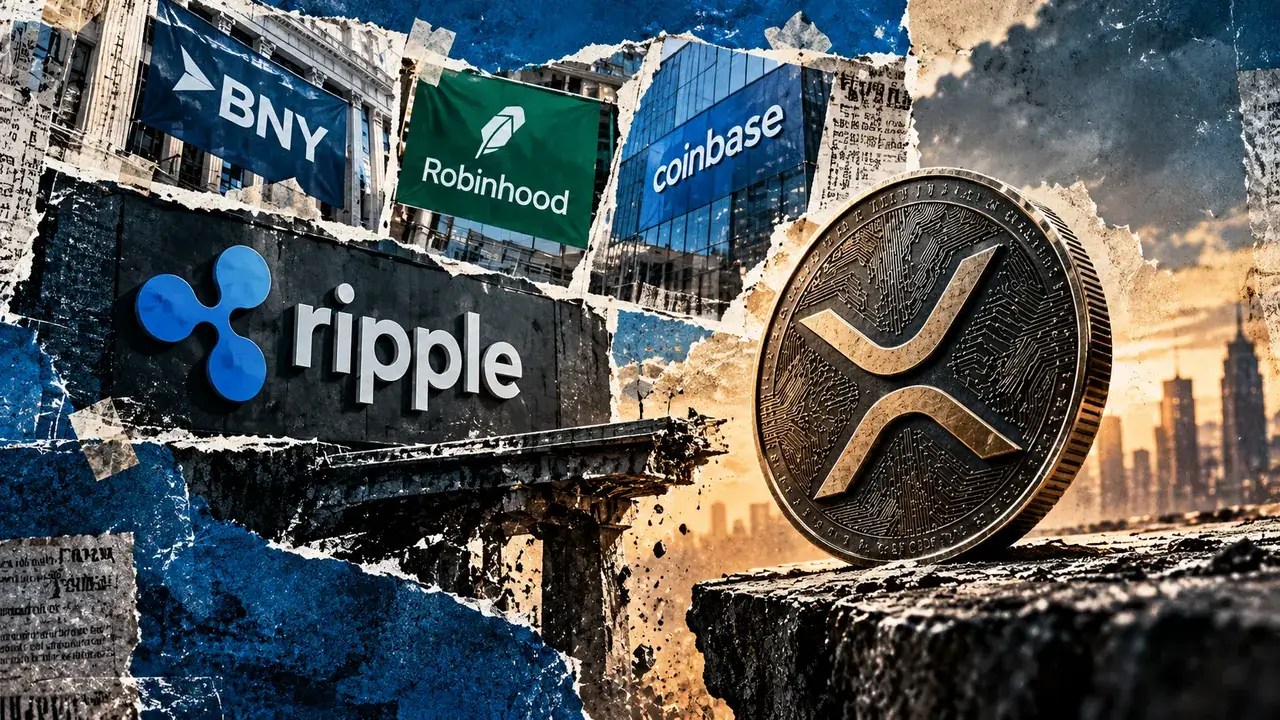
Purchasing XRP does not confer ownership in Ripple, despite the company’s expanding roster of ventures and financial partners creating an impression that their fortunes should align. Ripple can generate substantial revenue from these relationships without distributing any proceeds to token holders, who hold no claim on corporate profits.
XRP did appreciate during the latest announcement cycle, rising from $1.29 on October 25 to $1.32 on October 28—a modest 2.3% gain. Even so, the token remained approximately 11% below its September close, despite another week of recognizable names adopting Ripple’s services. Over the same September-to-October window, Bitcoin declined roughly 2.7%, while Ethereum fell approximately 12.2%, indicating XRP’s performance was not unusually weak relative to major cryptocurrencies.
XRP and Ethereum lost more than Bitcoin in October
Cumulative percentage returns from each asset’s Sept. 30, 2026 USD closing price. All three start at 0%. CryptoQuant All Exchanges spot prices; daily closes with UTC dates. Returns are rounded to two decimals.
Sep. 30, 2026 – Oct. 28, 2026


Price action alone does not reveal what holders and traders think about these announcements. The announcements themselves, however, signal what customers intend to use in the coming weeks and months. Some partnerships improve institutional access to XRP, while others center on a dollar-backed asset Ripple offers alongside it.
Ripple Has More Than One Product to Sell
Ripple sells financial software and services, while XRP is the native cryptocurrency of the XRP Ledger (XRPL), the public blockchain underpinning the ecosystem. XRP pays transaction costs on that network and can serve as an intermediary between different assets, but customers can utilize certain Ripple services without selecting XRP as the settlement asset.
Ripple’s RLUSD stablecoin is designed to maintain a one-to-one peg with the US dollar, backed by reserves including dollars and short-term US government securities. Businesses transacting in RLUSD choose a dollar-denominated asset rather than assuming the price exposure inherent in holding XRP.
Institutions can also pay Ripple for cash-management software or digital-asset custody without becoming XRP investors. Ripple’s $900 million revenue target reflects growth across all products, including acquired businesses, and refers to its projected annualized revenue pace at year-end rather than revenue already earned in 2026.
On October 26, the company announced it had received final approval for a national trust bank charter, with approved activities including managing RLUSD-related reserves and providing digital-asset custody. The charter expands Ripple’s institutional offerings without requiring those customers to purchase XRP.
What the Partners Are Actually Using
On October 27, BNY announced support for XRP and RLUSD on its digital-asset custody platform, enabling eligible institutional clients to hold and transfer both assets through a provider they may already use for other holdings. This removes a significant barrier for institutions seeking XRP exposure through an established custodian.
Robinhood’s agreement with Ripple focused primarily on RLUSD. The company plans to use the stablecoin on the XRPL for institutional settlement and integrate Ripple Treasury into its cash-management operations. RLUSD was already available on Robinhood Chain and Bitstamp at the time of the announcement, with availability in the Robinhood app expected later in the year.
Coinbase added RLUSD across its retail and institutional platforms on October 28, supporting transfers across multiple blockchains. Customers can now use Ripple’s stablecoin on other networks without creating a transaction on the XRP Ledger.
DriveWealth, a brokerage infrastructure provider, is integrating RLUSD on the XRPL for settlement in Europe, with a US expansion planned. C2FO’s planned Instant Pay service would settle payments in RLUSD using the XRP Ledger. A business sending $1 million in RLUSD would not need to purchase $1 million worth of XRP, though the network’s minimal transaction fee would still be paid in XRP.
Ripple explained this design choice in November 2024, stating XRP is not necessary as an intermediate asset when the currencies involved are already easily exchangeable. The company argues the token is more useful when a direct exchange is difficult to arrange, with a payment provider converting the sender’s currency into XRP before exchanging it for the recipient’s required currency.
A Million Transactions Can Burn Just 10 XRP
At the XRP Ledger’s documented minimum fee, one million standard transactions would consume only 10 XRP. Each transaction costs 10 drops (0.00001 XRP), and those fees are permanently destroyed rather than paid to Ripple or distributed to holders.
Consequently, a business can move large sums while spending minimal XRP on fees—beneficial for the business but limiting what holders can infer from rising transaction counts. The dollar value moving across the ledger does not determine the standard transaction fee.
Accounts also require XRP reserves, currently starting at 1 XRP per account, with an additional 0.2 XRP for many types of ledger entries an account maintains. These requirements create a reason to hold XRP, but they are not calculated as a percentage of transaction volume, and validators can adjust the settings.
When XRP functions as a bridge asset, a payment moves from the sender’s currency through XRP before conversion into the recipient’s currency. SBI Remit’s XRP-based service employs this mechanism, with XRP supplied in response to payment requests rather than requiring the recipient to hold it as an investment.
The tokens used for the transfer then become available for another transaction, so a provider processing a billion dollars annually does not necessarily need to hold a billion dollars’ worth of XRP throughout that year. The calculation depends partly on how quickly tokens can be reused and how much inventory the provider needs when payments arrive simultaneously.
Growing payment volumes could require larger XRP balances, particularly where trading markets are thin or replenishing inventory takes time. Providers must decide how much to keep on hand to meet those demands, including excess capacity for when normal trading conditions deteriorate.
Ripple states its products enabled more than $16 trillion in transactions during 2025, but that figure covers its broader business rather than just payments settled in XRP. Ripple Treasury, built on the GTreasury acquisition, reported facilitating $13 trillion in payment volume during 2025.
In April 2026, it introduced digital-asset capabilities allowing customers to manage those assets alongside conventional cash balances, extending a treasury-management business that already handled substantial payment activity. This provides an established customer base for newer products, including support for XRP and RLUSD balances. Customers can use the software for stablecoin payments and other operations in fiat currencies.
There Is XRP Ownership You Can Count
The Bitwise XRP ETF held approximately 131.2 million XRP at the end of December 2025 and about 413.8 million as of October 27—a 215% increase, with the fund holding more than three times its year-end token balance despite the weaker price.
However, those numbers measure tokens held. Bitwise’s filings record both purchases and XRP contributed in exchange for newly issued fund shares, so some tokens can enter the fund without being bought on the market as part of that transaction.
SBI Remit provides a more explicit example of commercial XRP use than an agreement merely mentioning Ripple. Its September 2023 expansion into Southeast Asian bank-account remittances named XRP as the bridge asset and SBI VC Trade as the supplier responding to payment requests, although that announcement does not establish current volumes or subsequent growth.
Stablecoin activity on the XRPL can also create opportunities to use XRP. The ledger’s exchange can route a trade between two tokens through XRP when that offers a better exchange rate than trading them directly, meaning the native token can participate even when neither party ultimately wants to hold it.
More assets trading on the network could make that intermediary role useful more often, provided XRP offers the superior route. The mechanism does not require every exchange to pass through the token, and traders can use a direct route when its pricing is more attractive.
XRP’s circulating supply is approximately 63.35 billion tokens against a maximum supply of 100 billion. The growth in one fund’s holdings occurs within that much larger market, where other holders can choose to sell.
Ripple’s disclosed holdings, dated June 30, report about 37.66 billion XRP held in total, including 32.6 billion in escrow. Escrow locks existing tokens until specified conditions are met. Ripple’s original arrangement also allowed unused tokens to return to escrow after a release, extending the schedule rather than putting the entire amount into immediate circulation.
On-chain tracker XRP Insights lists 1 billion XRP becoming releasable on November 1. Its October record shows 1 billion released and 700 million subsequently locked again, leaving a net 300 million outside escrow from that cycle without establishing how much was sold.
A release makes tokens available under the escrow terms, but tracking the amount sold requires following what happens afterward. The same restraint applies on the demand side: a custody service can make XRP easier to own without revealing how many customers have acquired it.
What XRP Holders Still Need to Know
The recent partnership announcements do not provide the XRP-routing and inventory figures needed to calculate their effect on token demand.
Robinhood names RLUSD as its institutional settlement asset, while BNY announces custody support without publishing the XRP balances clients have placed there.
If a payment provider reported how much activity passed through XRP, holders would have far better information to track than total company volume. Reporting the balance needed to support that activity would show whether a growing business requires more tokens on hand or can handle additional payments by reusing the same inventory.
Investors can buy XRP in anticipation of that growth, but they are judging future demand rather than receiving a contractual share of Ripple’s earnings. The token does not give them a claim on the revenue generated when a customer purchases another Ripple product.
The next partner could make the relationship much easier to assess by publishing how much XRP it needs to keep available for the service. When that business doubles, will it need a larger balance, or will the same tokens simply turn over faster?


