



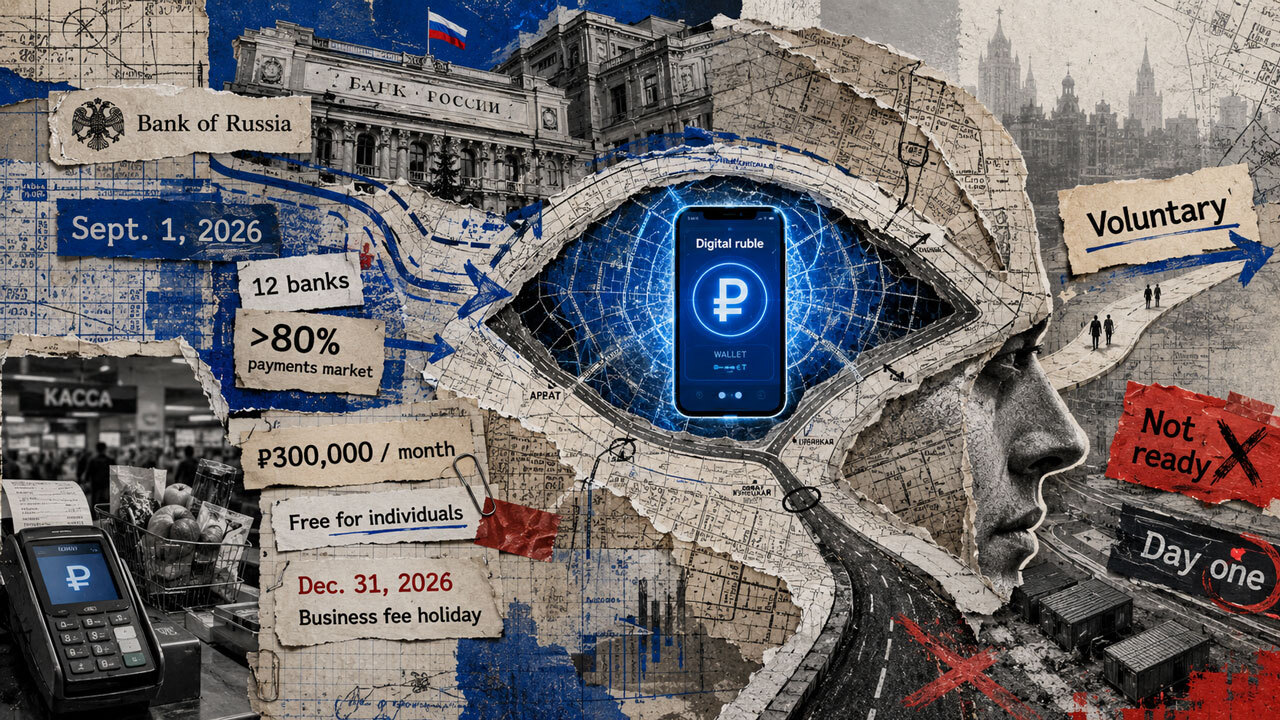
Russia is opening digital ruble access to customers of connected banks starting today, Sept. 1, moving its central bank digital currency beyond a restricted pilot phase as major banks and the first cohort of covered retailers activate the required payment infrastructure.
The Bank of Russia announced on Aug. 31 that individuals will be able to open a digital-ruble wallet through the mobile app of any participating bank. The wallet itself sits on the central bank’s platform, while commercial banks provide the access layer. Customers will need to confirm that their bank is connected before attempting to use the service.
Consumer participation remains strictly voluntary. A bank, employer, or other party cannot open a wallet automatically on behalf of an individual, even as covered banks and merchants face legal duties to provide the supporting infrastructure.
This split between mandated access and voluntary use defines the rollout. The law compels covered banks and merchants to build the necessary infrastructure, while customers decide whether or not to engage with it. There is no enrollment deadline for consumers, and banks cannot migrate customers into wallets automatically. A customer whose bank is not yet connected will not gain app access simply because the legal phase has commenced.
All 12 of Russia’s systemically significant banks are ready to offer digital-ruble accounts and transactions from Sept. 1, according to an Aug. 21 Bank of Russia interview. The regulator noted that those banks represent more than 80% of the country’s payments market.
The obligation also extends to nine banks designated as significant in the payments market. Most are ready, the Bank of Russia said, but three institutions that received the designation this year may need until the end of 2026 to complete their integration. As a result, the legal requirement and operational readiness do not align perfectly across every covered bank on day one.

The retailer mandate is narrower than a ₽120 million revenue threshold alone. According to Bank of Russia guidance, the Sept. 1 requirement applies to consumer-facing sellers whose prior-year revenue exceeded ₽120 million and who, as of Jan. 1, 2026, had an agreement to accept electronic payment instruments with a payment-services-significant bank. These covered sellers must accept digital rubles, while each customer remains free to disregard the option.
Individuals may add up to ₽300,000 per calendar month to a wallet from bank accounts or electronic money under an Aug. 28 central bank decision. The cap applies to top-ups only and does not restrict spending or transfers from funds already held within the wallet. Business top-ups remain uncapped.
Payments and transfers are free for individuals. Businesses are granted a fee holiday through Dec. 31, 2026, after which the published 2027 tariff schedule takes effect, although certain operations may retain zero rates. The immediate change is expanded access rather than compulsory consumer adoption.