




The remote South Atlantic island of St. Helena is home to an extraordinary international celebrity: Jonathan, the world’s oldest living land animal. At an astonishing 194 years old, the Aldabra giant tortoise (Aldabrachelys gigantea) has far exceeded the typical lifespan of his species by nearly a century. Now, scientific research has uncovered a series of unique genetic and epigenetic traits that may hold the key to his remarkable longevity.
The study focused closely on Jonathan’s genes, alongside the chemical tags on DNA molecules known as “epigenetic markers.” These markers play a crucial role in regulating which genes are activated and to what extent. The analysis revealed that Jonathan’s genes linked to mitochondrial function are in exceptionally good shape from an epigenetic perspective, indicating they have significantly contributed to his enduring success.
Mitochondrial function has long been associated with longevity, while its dysfunction is frequently linked to disease. Jonathan, however, offers fresh, invaluable insights into this relationship, according to study co-author Stephen Clark, chief scientist of the Kallel Foundation, a nonprofit in Nashville dedicated to researching drug targets for promoting human longevity.
Unraveling Jonathan’s Secrets to a Long Life
Nearly a decade ago, researchers enlisted the help of Joe Hollins, the veterinarian responsible for Jonathan’s care, to collect samples from the record-setting tortoise. However, island authorities prohibited drawing blood due to concerns over potential infection risks.
“I didn’t want to be the doctor that killed Jonathan,” Clark explained. Hollins instead collected samples using a cheek swab.
Upon arrival in the U.S., the researchers sequenced the samples, only to experience repeated computer crashes. They eventually discovered that the DNA had been isolated from bacteria in Jonathan’s mouth rather than the tortoise’s own cells.
Clark “had to go back and beg” for permission to collect more data. The vet subsequently sent cheek scrape samples, collected with a slightly different tool than the initial swabs. This time, the DNA was successfully obtained from Jonathan’s own cells.
The DNA extracted from the cheek tissue samples was more fragmented than typical blood samples, requiring researchers to fill in the gaps using an existing reference genome from a 36-year-old Aldabra tortoise named Tank. They also compared Jonathan’s DNA to that of a Galápagos tortoise (Chelonoidis abingdoni) named Lonesome George, who was over 100 years old when he died in 2012.
The team discovered that, compared to Tank and Lonesome George, Jonathan carried 287 unique gene variants previously linked to aging-related pathways. These included genes involved in DNA repair and the function of telomeres—the protective tips at the ends of chromosomes that typically shorten with age.
These pathways are also associated with aging processes in humans, highlighting a “broader signature of aging” across species, noted Greer Dolby, an assistant professor of biology at The University of Alabama at Birmingham, who was not involved in the study.
Researchers also examined epigenetic changes, including DNA methylation—a process where methyl group chemical tags bind to DNA. Certain methylation patterns can act as a “clock” reflecting an organism’s biological age, a method recently utilized in human aging studies. In this case, the team compared Jonathan’s genome-wide DNA methylation patterns to those of both young and old Aldabra tortoises.
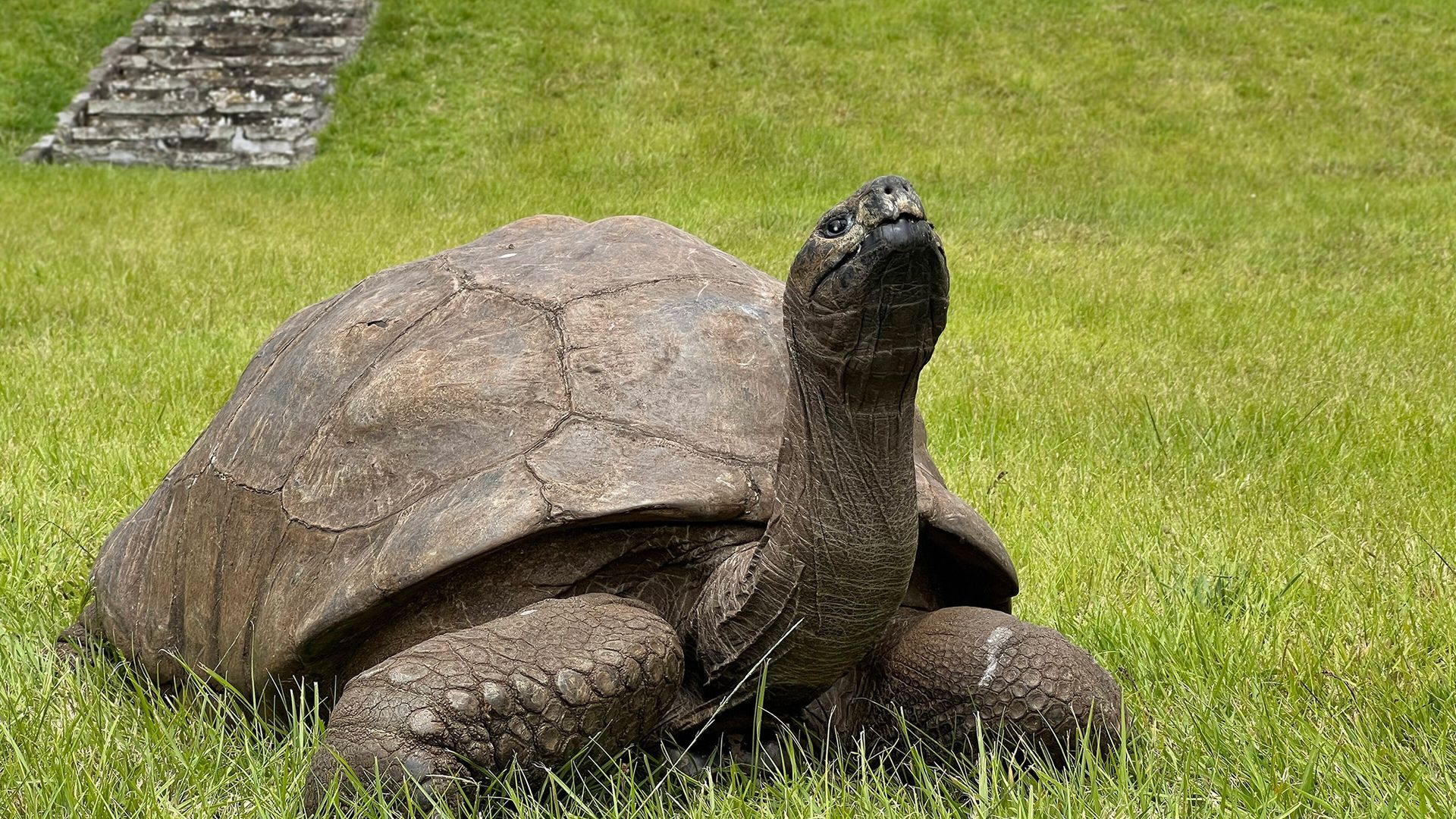
The researchers found that methylation patterns were more disordered in older tortoises, reflecting random changes accumulated over time—a phenomenon they call “methylation entropy.” While Jonathan’s methylation patterns were more disordered than those of young tortoises for most genes, he showed more organized patterns in a suite of genes tied to mitochondrial function, specifically the regions that switch these genes “on.” The researchers theorized that this organization may keep gene expression consistent over time.
Mitochondria produce the energy cells require to function, repair themselves, and minimize further DNA damage. “Keeping entropy low in these mitochondrial genes, or maintaining pristine mitochondria, is likely a key contributor to longevity,” Clark explained.
However, the authors could not establish a causal relationship, as they did not conduct tests to definitively prove that Jonathan’s low entropy in these genes explains his long life. Clark argued that further experiments on a blood sample from Jonathan could provide a more comprehensive view of his genome.
Jonathan’s full genetic profile will remain unknown until after the tortoise’s death, when researchers can collect DNA from a wider array of tissues, noted Vincent Lynch, a biology professor at the University at Buffalo who was not involved in the study.
“Some organs are more susceptible to age-related diseases than others due to the accumulation of mutations over time,” he explained. “We would ideally want to know what those mutations are in those specific tissues.”
Furthermore, Lynch questioned whether entropy is a useful characterization of age-related DNA methylation patterns, given that methylation can be unpredictable. Nevertheless, he agreed that the genes identified in the study provide valuable data for future longevity research.
Additional experiments are needed to determine whether these mitochondrial genes play a role in longevity across all Aldabra tortoises, or even other animals, or if Jonathan is simply a unique outlier.
“Maybe Jonathan is just really good at being old,” Lynch remarked.
Vasivil, B., Schmidt, D.P., Jones, A., Kapatral, V., Ford, J.M., Taylor, M.L., Colwell, M., Hollins, J., Pascucci, S., Weissenow, K., Rost, B., Notion, P., Gerlach, J., Terwilliger, T.C., Hung, L-W., Jensen, L.J., Reed, K., Robeck, T.R., Horvath, S., Faulk, C., Ma, Y., Clark, S.W. (2026). Epigenetic insights into extreme longevity in the world’s oldest terrestrial animal, Jonathan. Science Advances. 12.
Also Read
- Microsoft Unveils New AI‑Powered Windows PCs with Nvidia RTX Spark Chips and Updated Windows 11
- AI Giants Race for .agent and .agi Domains in ICANN’s New TLD Wave
- As AI Closed In on ‘Unique Games’ Proof, Researchers Raced to Beat the Machines
- Google’s Next Android XR Device Is Arriving Ahead of Meta’s VR Glasses, at a Similar Price