



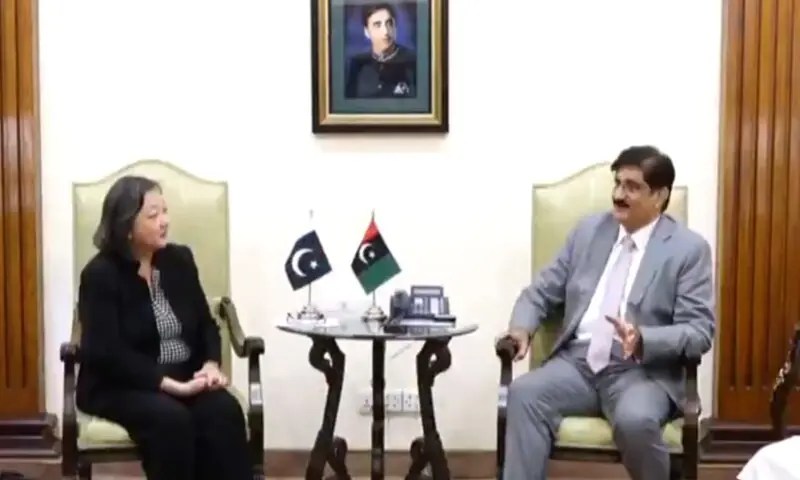
Sindh Chief Minister Murad Ali Shah met on Friday with World Bank Country Director Bolorma Amgaabazar to assess progress on Karachi’s water supply, infrastructure developments, and the K-IV augmentation scheme. In a press release from the Chief Minister’s office, Murad stated that the Sindh government, bolstered by World Bank collaboration, seeks to establish a modern and sustainable water supply system for Karachi. He further emphasized that the K-IV project is essential for meeting the city’s future water demands.
CM Murad instructed the relevant authorities to eliminate all technical and administrative obstacles hindering the K-IV project and to guarantee its timely completion. He underscored that effective water management and transparent governance are critical given Karachi’s rapidly expanding population. During the meeting, the chief minister and the World Bank country director also addressed water metering initiatives, urban enhancement projects in informal settlements, and ongoing reforms within the Karachi Water & Sewerage Corporation (KWSC). Provincial Ministers Nasir Shah and Jam Khan Shoro, Mayor Murtaza Wahab, senior government officials, and World Bank representatives attended the meeting. Previously, the chief minister had instructed authorities to accelerate project work while carefully managing construction activities in densely populated zones with existing utility infrastructure. He added that Karachi’s growing population necessitates a modern and efficient water supply system, and that all ongoing projects must be completed on schedule and to the highest quality standards.
Originally launched in the early 2000s to address Karachi’s chronic water shortage, the K-IV project has undergone multiple revisions, cost escalations, and bureaucratic delays. Although recent federal attention has renewed interest, concerns about funding and implementation timelines persist. The project, designed to deliver a sustainable supply of 650 million gallons per day (MGD) to Karachi in three phases, is being jointly executed by the Sindh and federal governments. The Water and Power Development Authority (Wapda) is currently implementing Phase I, which targets a supply of 260 MGD to the city. The project encountered another setback last year when the federal government allocated only Rs3.2 billion in the budget, far short of the required Rs40 billion for the scheme. In February, Planning Minister Ahsan Iqbal established December 2026 as the new completion deadline and directed authorities to expedite work.
Also Read
- Djibouti Football Federation Under Scrutiny Amid Allegations of Fund MisuseThe tiny Horn of Africa nation of Djibouti is embroiled in a football corruption row after a government audit accused its federation, largely funded by FIFA, of favoritism and inadequate competitive bidding.The recent success of Cape Verde – which reached the knockout stage of the 2026 FIFA World Cup – has shown that small African nations can succeed with the right organisation.Djibouti footballers are furious, however, at their federation over allegations it has misused money from world football governing body FIFA, which provides the vast majority of its funding.Funds provided by Saudi Arabia for a new headquarters for the Djibouti Football Federation are also said to have been misused.One local club manager, speaking on condition of anonymity, told the AFP news agency that his team would boycott this year’s league unless there was a change in leadership.“The (Djibouti federation’s) resources are not used for the development of football,” he alleged.“When I see what Cape Verde is capable of achieving… I tell myself there is a structural problem within our federation,” he added.Djibouti’s national football teamThe allegations stem from a 2024 government inspector’s report, recently obtained by AFP, that accuses the federation of “favouritism” in awarding the contract for the headquarters and overpricing for many elements of the contract.FIFA, which along with the Confederation of African Football (CAF) provides more than $1m a year to Djibouti’s federation, did not respond to queries from AFP.A member of Djibouti’s federation, Mohamed Elmi Farah, resigned from its executive committee on August 12 August, expressing “concerns regarding the management and use of the federation’s resources”.Souleiman Hassan Waberi, the longtime head of the Djibouti Football Federation, told AFP it had been cleared of all wrongdoing by FIFA.“FIFA has officially confirmed to us that, to date, its monitoring mechanisms have revealed no indication of wrongdoing regarding the funds it disbursed,” said Waberi, who also serves on the FIFA Council as a representative of CAF.Djibouti fans during the FIFA World Cup 2026 Africa qualifier against EgyptCAF is a major supporter of FIFA boss Gianni Infantino, who has recently courted controversy with plans to open the World Cup to private investors.Waberi acknowledged “shortcomings regarding competitive bidding” in “certain operations”, but blamed the limited availability of many items in Djibouti and said procedures had since improved.Djibouti, which has a population of just one million, has been ruled by President Ismael Omar Guelleh since 1999. It ranks 124th out of 182 countries on Transparency International’s corruption perception index.
- Wheat Futures Dip Ahead of Friday Session
- World No.1 Jannik Sinner Pulls Out of U.S. Open with Knee Injury
- Fishermen floating in cooler rescued after five days at sea off Mexican coast