






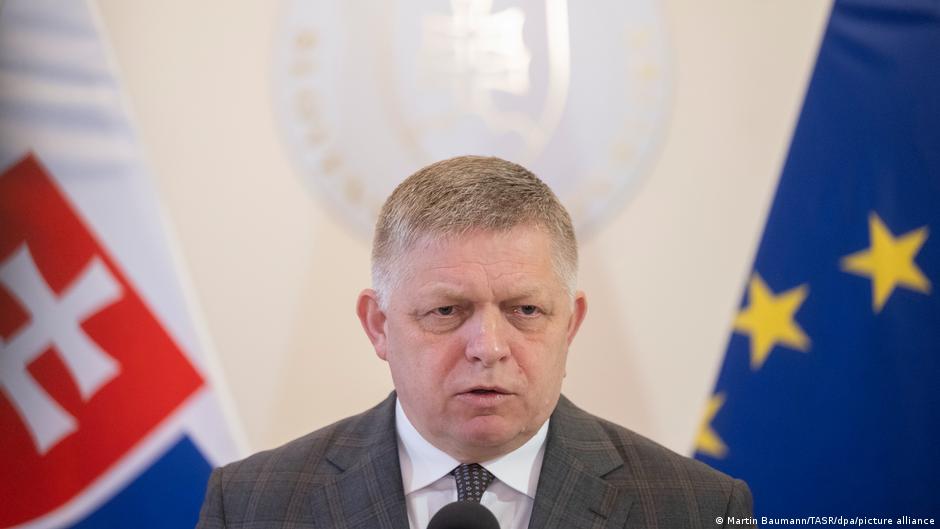
“I am afraid of war,” Slovak Prime Minister Robert Fico told medical students at a teaching hospital in Prešov last week.
“What is happening in Europe today, what we are hearing and seeing today, is that the military conflict in Ukraine has got out of control,” he continued, warning that Europe faced the possibility of a wider war.
He asked the students to imagine Slovakia being ordered to prepare “5,000 soldiers, 10,000 soldiers” to go somewhere to fight “without us even knowing whom they are fighting, or why, or what for.”
He then turned to Article 5 of NATO’s founding treaty, under which an armed attack on one member is considered an attack on all.
“I do not want Slovakia to be drawn into any military conflict because of some Article 5,” Fico stated.
“Yes, we are in NATO. We value that. Cooperation and fulfilling our obligations matter to us. But as prime minister, I will do everything to ensure that Slovakia is never drawn into a military conflict.”
The remarks prompted an uproar from the Slovak opposition and also triggered a spat with Petr Pavel, the president of neighboring Czechia and former chairman of NATO’s Military Committee.
“If anyone says they are glad to be a member of NATO but are unwilling to get involved if anyone else is attacked, then they have not understood the word solidarity,” Pavel remarked.
Fico countered that he understood Pavel, as a former NATO general, would like to fight, while he himself preferred peace.
The impact on Slovakia’s standing
The Slovak prime minister’s fear of a wider war is shared by many Europeans. However, critics at home dismissed his remarks.
“Isn’t he a prime minister? Isn’t he the leader of a country? Is he not supposed to lead people instead of expressing fears?” asked Miro Wlachovsky, a former Slovak foreign minister and now a distinguished fellow at the GLOBSEC think tank.
“My question for him as prime minister is: OK, even if the situation is as bad as you are saying, what I want to hear is how the country is prepared. What has been done for preparedness? Who will come to our aid in case we are attacked?” Wlachovsky told DW.
Asked whether Fico’s remarks could damage Slovakia’s standing among its allies, Wlachovsky replied: “It’s already done.”
Political background to Fico’s comments
Analysts see a clear political context to Fico’s remarks ahead of next year’s election.
The Slovak prime minister will face a difficult reelection fight next year. Some observers believe Fico is trying to attract votes from the extreme-right Republika party, which is viscerally hostile to NATO and the EU and opposes military support for Ukraine.
Wlachovsky compared Fico’s rhetoric to that of Hungary’s former Prime Minister Viktor Orbán and the current Czech Prime Minister Andrej Babiš, both of whom have presented themselves as candidates of peace.
Babiš was heavily criticized during his unsuccessful 2023 presidential campaign after questioning during a televised debate whether the Czech Republic should send troops to NATO ally Poland if it came under attack.
What is NATO’s Article 5?
Oana Lungescu, a distinguished fellow at the Royal United Services Institute and a former NATO spokesperson, told DW that Article 5 is “the most solemn pledge that a country can make to another.”
But its central purpose, she explained, is deterrence: convincing a potential aggressor that it would face the alliance together, rather than an isolated member.
“This is about solidarity, standing together, underpinning deterrence, and therefore avoiding war,” she said. “NATO is a defensive alliance. It is not an offensive alliance.”
Nor would invoking Article 5 automatically send every member’s troops into combat, she noted.
The North Atlantic Council, where every ally is represented, would assess an attack and decide by consensus whether it constituted an Article 5 situation — meaning Slovakia’s voice would be equal to that of its 31 partners in that room, she explained.
Once consensus is reached, each country would then assist the attacked ally by taking the action it deems necessary, which might — or might not — involve armed force.
Article 5 has been invoked only once in history, following the September 11, 2001 attacks on the United States.
Lungescu pointed to one of NATO’s initial responses: sending AWACS surveillance aircraft to patrol US skies and help prevent another attack.
She pointed out that Slovakia already benefits from the same solidarity Fico appeared to question. The country hosts a NATO multinational battlegroup established after Russia’s full-scale invasion of Ukraine, with personnel from several allies alongside Slovak troops.
Its purpose is to deter an attack on Slovakia.
‘Exactly what Putin wants’
For former Slovak Defense Minister Jaroslav Nad, the danger lies in allowing that fear to dictate policy toward Ukraine.
“This is exactly what Vladimir Putin wants,” said Nad, who served as defense minister from 2020 to 2023 and is now head of the non-parliamentary Democrats party.
“He wants citizens in the EU and NATO to believe that if EU and NATO countries continue to support Ukraine, this escalatory situation might lead to a Third World War or something like that,” Nad told DW.
Nad was in office when Slovakia decided to hand over its entire fleet of aging MiG-29 fighter jets to Ukraine. Fico’s government later sought a criminal investigation into the transfer; prosecutors closed the case, finding no crime.
“Even when I was defense minister, I heard this not only from ordinary people but also from some ministers around the table: that we shouldn’t help Ukraine with this or that equipment, capability, or ammunition, because it might create a difficult situation in terms of escalation toward Russia,” he continued.
“None of that happened.”
Edited by: Aingeal Flanagan
Could Slovakia replace Hungary as EU’s main disruptor?
To view this video please enable JavaScript, and consider upgrading to a web browser that supports HTML5 video
Also Read
- CFTC Chairman Urges US Markets to Prepare for Era of ‘Mass Tokenization’
- Live Cattle Futures Retreat as Cash Trade Stalls in Quiet Weekly Start
- Abuse Survivors Demand Pope Leo Accelerate Secret Church Trial Against Slovenian Priest
- Trump hosts China’s Xi for high-stakes summit ahead of US midterm elections


