






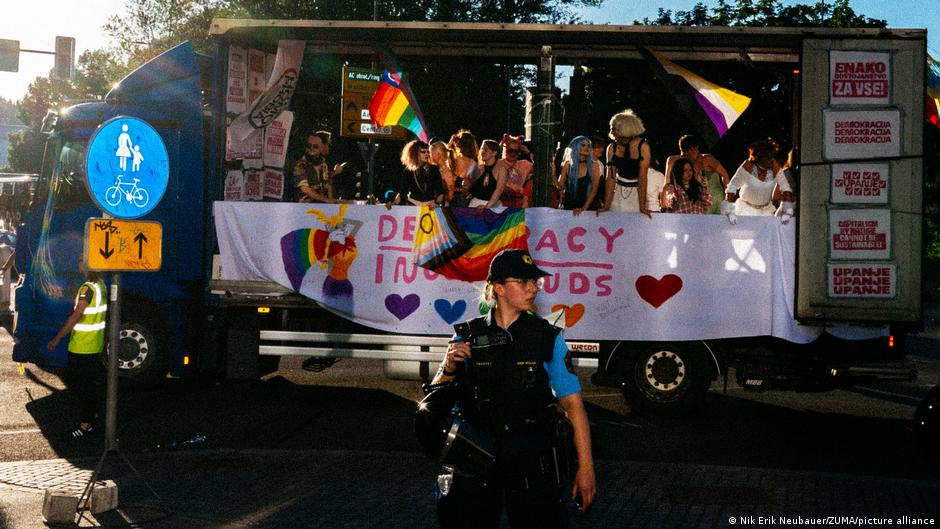
Slovenia’s LGBTQ+ Community Confronts Political Backlash as Government Removes Pride Flag]
Pride Month assumes greater significance for many whenvisibility throughout the year. In Slovenia, numerous LGBTQ+ individuals understand this reality all too well.
The picturesque capital of Ljubljana, along with smaller cities across the country, lacks distinct districts or neighborhoods specifically recognized as LGBTQ+ friendly spaces.
“In terms of physical locations explicitly designated as LGBT-friendly, there are simply not many,” explained Barbara Rajgelj, a lawyer who also co-manages a Ljubljana bar that hosts events for the gay community.
Rajgelj expresses concern that intolerance fueled by political leadership is increasingly impacting the nation. “Safe spaces are becoming more crucial, as violence originates from the top down—flowing from parliament, through digital media, and into physical spaces. I’m observing that people are growing more courageous in openly expressing their hostility,” she told DW.
Pride Month 2026 Marked by Heightened Tensions
Traditionally, Pride Month and associated events have provided some of these precious safe spaces, celebrating Slovenia’s vibrant LGBTQ+ community despite limited physical infrastructure.
This year’s Pride Month felt notably different amid Slovenia’s newly installed right-wing government.
The administration chose the period leading up to the June 13 Pride Parade in Ljubljana to remove the rainbow flag flying outside the Culture Ministry.
An official statement justified the decision by claiming the ministry “must represent all citizens and all cultural creators, regardless of their personal beliefs, identities or worldviews”—without clarifying how this position represented LGBTQ+ citizens or suggested that accommodating homophobic perspectives was now official policy.
Government’s Flag Removal Deemed Symbolic Gesture
Under the previous center-left government of Robert Golob, the rainbow flag flew throughout Pride Month, raised earlier in June before new Prime Minister Janez Jansa assumed office days later.
Removal of the rainbow flag represented one of Jansa’s administration’s earliest actions, sending a powerful signal to LGBTQ+ advocates and citizens.
“Even though we expected this, it was still extremely symbolic, sending a clear message within the LGBT community and broader society that things have changed,” said Simona Mursec, organizer of Ljubljana Pride.
Increased Participation Reflects Community Response
These political shifts are clearly being felt and responded to by LGBTQ+ individuals and their allies.
This year’s Pride Parade saw significantly higher turnout, with organizers reporting a four-figure increase compared to the previous two years—a direct response to the government’s stance.
Enhanced security measures aimed to prevent physical attacks, though verbal abuse and harassment outside the parade persisted.
“Organized groups of young men, displaying fascist and Nazi insignia, target LGBT people,” Mursec noted, adding that assailants threw eggs, pushed participants to the ground, and escalated their campaign by seizing and burning rainbow flags.
“These attackers didn’t suddenly appear. They exist because politicians have spent years creating, supporting, and encouraging them—and we’re now seeing the consequences, which will likely worsen,” she observed.
Progress Meets Backlash
This occurs just four years after Slovenia’s Constitutional Court established marriage equality for LGBTQ+ couples, followed two years later by guaranteed access to in vitro fertilization treatment.
Mursec and lawyer Rajgelj note that anti-LGBTQ+ rhetoric has intensified since these rights were legally enshrined.
Verbal and physical attacks have correspondingly increased, with advocates fearing further deterioration under the new government.
However, voices of cautious optimism also emerge. Miha Lobnik, founder of the LGBTQ+ campaign organization Legebitra in the late 1990s, now serves as Slovenia’s Advocate of the Principle of Equality, representing those who’ve faced discrimination.
Lobnik suggests the government’s actions may represent merely placating far-right supporters without causing serious harm to rights.
“I wouldn’t be too worried yet,” he said. “It might prove to be a few conciliatory gestures to calm extremely right-wing voters, which won’t result in significant damage to people’s rights.”
Fighting Mainstreaming of Anti-LGBTQ+ Rhetoric
Lobnik cautioned against allowing anti-LGBTQ+ messaging to become “dominant and mainstream,” risking the more accepting and tolerant society Slovenia has developed over three decades.
This warning gained urgency after National Assembly Speaker Zoran Stevanovic proposed banning flags “without legal basis.”
Stevanovic claimed displaying banners like the rainbow flag “deepens societal division and polarization.”
Though in office for less than a month, the government supporting Stevanovic’s far-right, populist Resnica party appears actively working to deepen divisions rather than bridge them.
To view this video please enable JavaScript, and consider upgrading to a web browser that supports HTML5 video
Also Read
- Financial Markets Authority Emphasizes Innovation Support in Latest Conduct Report
- Japan’s Innovative Startup SolaNika Unveils Laser-Based Drone Charging Solution
- Misinformation Surge: How Recycled Clips and AI Fakes are Distorting the Venezuela Earthquake Narrative
- Martinelli’s Late Strike Secures Brazil’s 2-1 Victory Over Japan, Advancing to World Cup Round of 16


