







Solana co-founder Anatoly Yakovenko has floated a provocative proposal to expand the network’s token supply, using newly minted SOL to acquire an existing company. The acquired business’s revenue would then be directed toward buying and burning SOL, creating a tokenomic cycle intended to enhance value for holders.
In a recent social media post, Yakovenko described this concept as more bullish than simply lowering inflation. He clarified that revenue generated by the acquired company would fund open-market purchases and subsequent burns of SOL, effectively returning value directly to stakers and holders.
As of mid-August, official merged-proposal directories did not contain any specific acquisition SGP or SIMD proposals to advance this idea. Implementing such a vision under Solana’s current governance framework would require a significant multi-step process.
Protocol Approval and Governance Challenges
Solana’s governance system allows a validator vote account with at least 100,000 SOL staked to submit a Solana Governance Proposal. Once support from 15% of active stake is secured, voting can begin, and approval requires a two-thirds majority of decisive stake. Individual delegators retain the ability to override their validator’s vote.


A completed protocol change would normally require one or more technical proposals, client implementation, and activation under the SIMD process. However, a fundamental disconnect remains: while the protocol can approve a directional mandate, it cannot legally buy a company.
The Solana Foundation describes itself as a Zug-based nonprofit, while Solana Labs operates as a separate entity. Neither is explicitly named in governance materials as the buyer, nor is either granted acquisition authority.

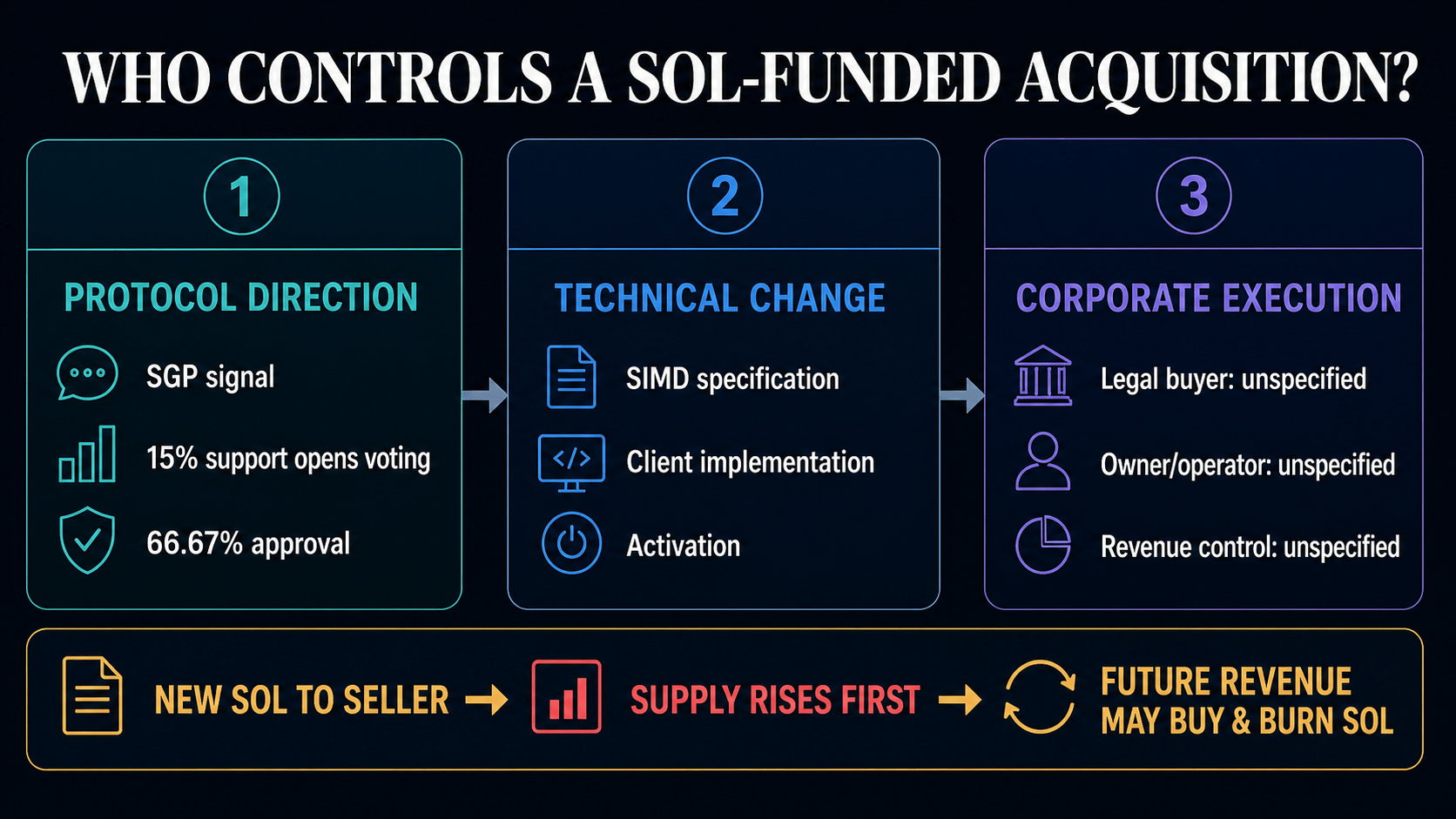
Mert Mumtaz, CEO of Helius, pointed out the practical hurdles, noting that validators would have to agree on actually running a company. A stake-weighted mandate does not identify a legal buyer, nor does it specify who could sign a purchase agreement, hold the assets, appoint management, or direct revenue.
The Mechanics of Supply and Burn
If newly issued SOL were transferred directly to a seller, the total supply would increase at the moment of issuance. Holders who do not receive any of these new tokens would see their share of the total supply diluted, unless subsequent burns—funded by the acquired company’s revenue—sufficiently offset the inflation.

To put the scale of this challenge in context, a separate draft fee-burn proposal, SIMD-0553, estimates that Solana currently burns approximately 648 SOL per day from signature fees alone at roughly 3,000 transactions per second. This stands in stark contrast to the roughly 60,000 SOL of daily inflation. While the proposal’s staged resource-fee burns illustrate the existing gap, it contains no acquisition mechanism and does not authorize Yakovenko’s idea.
Until a formal proposal defines both the governance and corporate tracks, control remains unresolved. Validators and delegators can signal a direction, but the SIMD process would still require technical specification, implementation, and activation. On the corporate side, critical questions remain unanswered: who selects the target, which legal entity buys and owns it, and who controls operations and revenue?
Also Read
- Study Suggests AI Agents Account for Minimal Share of Crypto Payments
- EU Mandates 24-Hour Reporting for Exploited Vulnerabilities in Connected Crypto Wallets
- AMC CEO Denounces Robinhood’s Tokenized Shares as Undermining Investor Protections
- Ringgit Forecast to Trade in Narrow Band Near RM4.06-RM4.08 Next Week


