






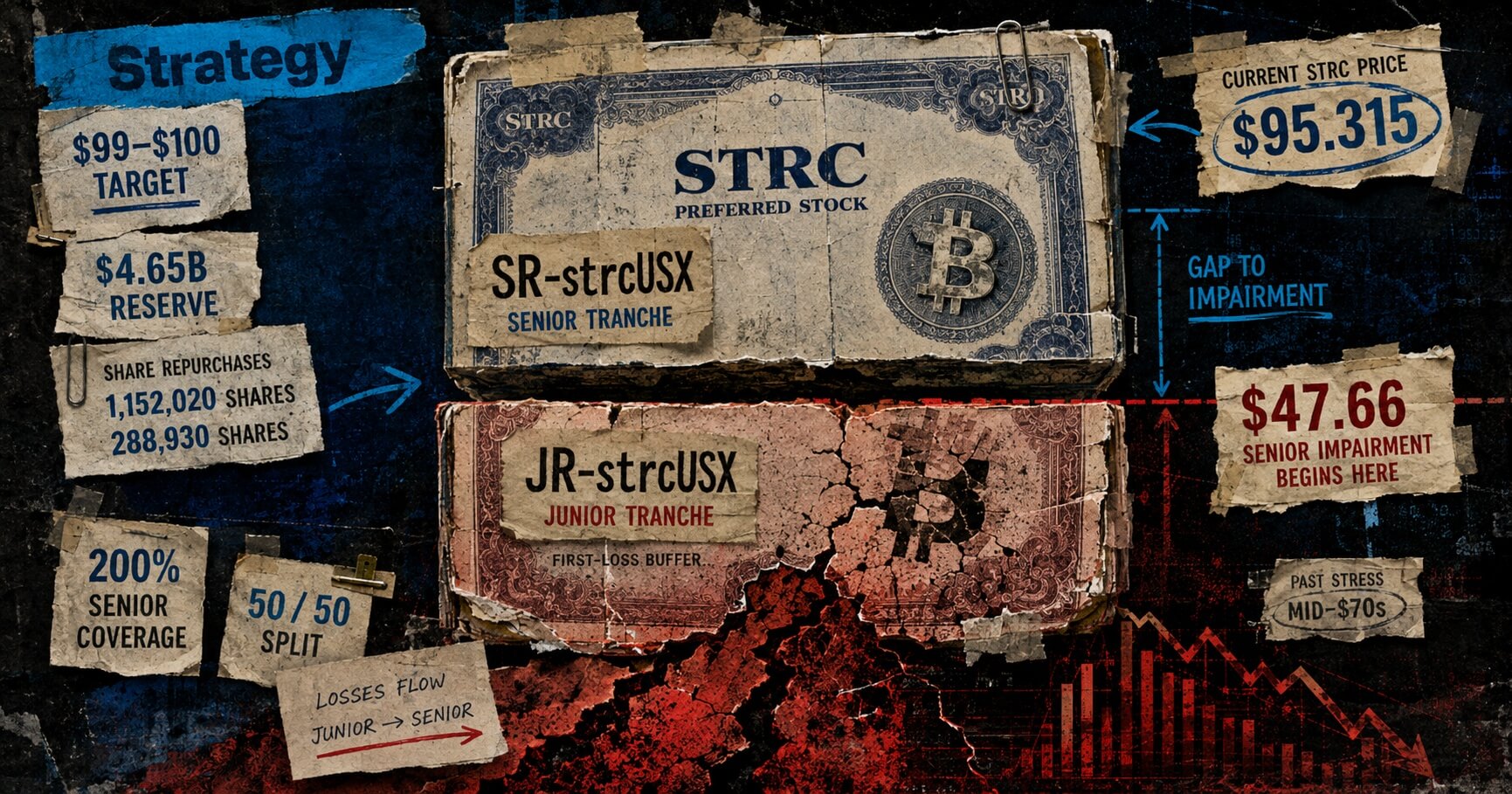
Solstice has introduced a tranched structured product built on Strategy’s Bitcoin-linked STRC preferred stock, featuring a senior tranche that only begins absorbing losses when STRC falls below $47.66.
At present, STRC trades around $95.315, meaning the impairment threshold is approximately 50% below the current market price and 52% below the security’s $100 par value.
According to Solstice COO David Plisek, the $47.66 level represents a modeled senior-impairment point under the protocol’s current risk framework, which remains subject to revision based on evolving assumptions.
Bitcoin as a Strategic Defense Mechanism
Strategy has spent the last six weeks actively managing STRC’s price through its Digital Credit Capital Framework, announced on June 29. This framework combines a dollar reserve policy, an updated dividend structure, and ongoing share repurchase authorizations—all aimed at maintaining STRC trading within the $99 to $100 range.
From July 20 to July 26, Strategy repurchased 288,930 STRC shares for roughly $25 million at an average price near $86.52.
In early August, the company sold $108.6 million worth of Bitcoin and used those proceeds to buy back 1,152,020 STRC shares. This followed the release of a $4.65 billion dollar-denominated reserve reported on August 9.
Solstice based its risk modeling on these known behaviors, listing any deviation from the framework as a key risk factor in its documentation.
Structure and Risk Allocation
The exposure is split across two distinct tokens: SR-strcUSX (senior) and JR-strcUSX (junior), representing $50 each per $100 of combined exposure. This 50/50 split creates a 200% senior coverage ratio.
The junior tranche absorbs losses first and targets a significantly higher yield than the senior tranche, which aims for approximately 7% APY. STRC’s nominal 12% annual dividend rate translates to close to 12.59% on its current trading price before Solstice applies its tranching mechanism and fee structure.
According to Plisek, this tranche design enables investors to capture a net asset value (NAV)-based return on STRC without bearing direct exposure to price volatility. It offers structured economic exposure rather than equity-like upside.
| For each $100 of combined exposure | Token Role in Waterfall | Target Return | Loss Position |
|---|---|---|---|
| $50 | SR-strcUSX | Paid first (~7% APY) | Impaired only after junior buffer is exhausted |
| $50 | JR-strcUSX | Takes residual yield | First-loss tranche |
Solstice retroactively modeled performance during STRC’s prior downturn to the mid-$70s range, where it bottomed near $73.62—still roughly 35% above the $47.66 impairment threshold.
Under that scenario, both senior and junior tranches remained unimpaired. Had senior holders chosen to redeem during the dip, junior would have faced a near 50% decline. Realized losses emerge only when redemptions require forced sales of the underlying STRC position.
Protective Mechanisms Built In
Solstice has programmed multiple stages before any senior loss occurs. Should STRC trade below a defined level, the protocol enters a restricted mode: junior redemptions and new senior minting are paused simultaneously.
These safeguards aim to prevent further erosion of the coverage ratio while restrictions are active. A deeper decline could trigger a liquidation phase, during which Solstice seeks to sell STRC collateral ahead of any senior impairment.
Plisek noted that market makers have committed to purchasing STRC outside regular Nasdaq hours, helping bridge the gap between a DeFi-native product and its less frequently traded underlying asset.
He emphasized that Solstice’s protocols operate independently; a STRC liquidation event would not impact other Solstice products like USX or eUSX, each governed by separate risk controls.
It’s important to note that Strategy has clarified that STRC dividends require board approval per period, and that the preferred securities do not carry a collateral claim on Bitcoin holdings—only a residual claim against remaining company assets.
Looking Ahead: Scenarios for STRC
The optimistic outlook sees STRC retracing to its targeted $99–$100 range as Strategy continues executing repurchases and deploying reserves. In such cases, junior risk declines and the senior tranche behaves more like a fixed-income instrument.
| Scenario | STRC Price Path | Senior Outcome | Junior Outcome | Key Variable |
|---|---|---|---|---|
| Bull Case | Moves toward $99–$100 | Earns target yield | Mark risk shrinks; residual yield attractive | Strategy support works |
| Base Case | Stays near current levels | Modeled unimpaired | No realized loss unless forced sales occur | Coverage remains intact |
| Stress Case A | Falls into mid-$70s | Modeled unimpaired | Modeled unimpaired | No forced realization |
| Stress Case B | Falls into mid-$70s with mass redemptions | Modeled unimpaired | ~50% modeled drawdown | Redemption pressure |
| Black Swan | Approaches or breaches $47.66 | Impairment begins if protections fail | Buffer exhausted | Liquidation execution |
As Plisek emphasized, junior outcomes hinge heavily on redemption behavior during downturns—the same dynamic identified in Solstice’s earlier stress tests.
By layering tranching, redemption controls, and liquidation procedures, Solstice aims to ensure that when risk materializes, the first to absorb it is the junior tier. For that protection to hold, every component of the system—from initial structuring to real-time execution—must perform under extreme market conditions.
Also Read
- Major Bitcoin Core update changes default wallet protocols, risking temporary disruption across popular apps
- Senate Block on Clarity Act Leaves Crypto Industry Navigating Regulatory Uncertainty
- AI Could Be Bitcoin’s Next Onboarding Engine, Nakamoto CEO Says
- 5 Best Solana Tools for Tracking Smart Money and Wallet Activity in 2026


