







Toss Bank’s Solana proof of concept would integrate stablecoin remittance infrastructure with a regulated banking app serving millions of users.
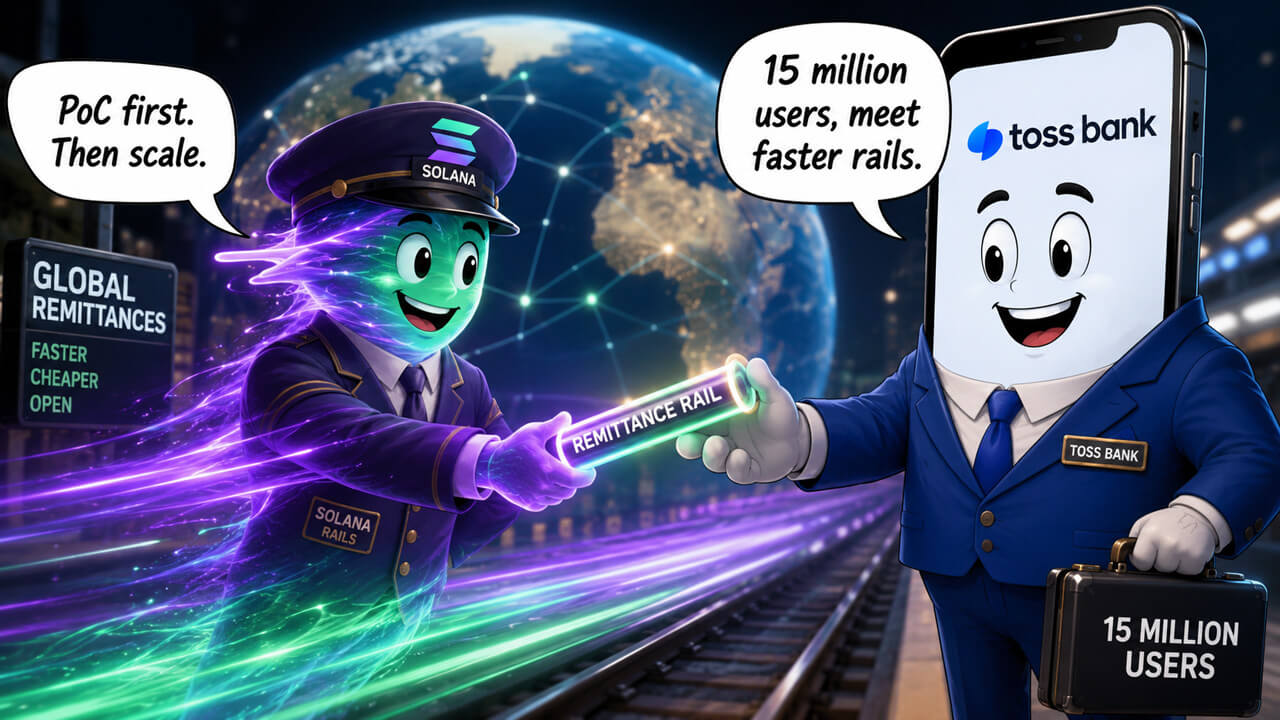
In a June 22 post, Solana announced South Korea’s Toss Bank plans to use its network for a global remittance and settlement proof of concept. Local media reported Toss signed a memorandum of understanding with the Solana Foundation to explore blockchain-based financial systems.
The initiative remains a technical feasibility test rather than an immediate consumer offering. Details about launch timelines, corridors, stablecoin issuers, tokens, custody models, or eligible users remain undisclosed.
The announcement has generated interest in crypto circles due to placing a public blockchain within a remittance experiment led by a traditional bank rather than a crypto-focused payments company. This tests whether blockchain settlement can enhance existing banking products while maintaining familiar customer experiences.
Toss Bank became the first South Korean internet-only bank partnering with the Solana organization, according to The Korea Herald.
The agreement covers a phased proof of concept for cross-border payments, evaluation of blockchain payment systems, and digital asset transmission studies using stablecoins.


Bank Maintains Customer Experience Control
The collaboration explores positioning blockchain settlement infrastructure alongside traditional financial applications. A bank-controlled model could retain users within existing apps while operating public-chain settlement behind the scenes.
For Toss Bank, this maintains authority over customer onboarding, compliance, support services, and product design. Advanced testing might enable faster or more cost-effective settlements while preserving the regulated banking relationship.


The South Korean bank powering Upbit is testing Ripple integration for cross-border payments
South Korea’s Kbank is piloting Ripple-powered remittances, testing whether bank-linked crypto rails can evolve into real payment infrastructure.
If testing concludes without deployment, remittance customers gain little immediate benefit.
Solana highlighted Toss Bank’s 15 million users as giving the test disproportionate scale compared to crypto-only remittance apps. This reach suggests distribution potential rather than current functionality.
Toss Bank’s existing service already supports real-time international transfers with seven currencies across 30 countries, according to The Korea Herald. This operational baseline serves as the standard for future blockchain enhancements.
The partnership requires blockchain infrastructure to demonstrably improve the existing service through reduced costs, expanded corridors, enhanced reliability, or new currency options before customer adoption expands.
Critical Hurdles Remain Before Implementation
Initial testing will verify technical feasibility of stablecoin transfers on Solana’s network, according to local reports. Subsequent phases require overseas partner integration and identity verification systems.
Compliance challenges include anti-money laundering protocols and know-your-customer requirements. These processes must align with banking regulations before expanded implementation.
While Solana’s network hosts significant stablecoin activity with substantial liquidity depth – including USDC and other assets cited in DeFiLlama data – practical remittance implementation demands cash-on/cash-off infrastructure, institutional partnerships, and regulatory clearance.
Successful implementation would require resolution of the following elements: designated stablecoin issuers, specific transfer corridors, partner banking relationships, custody solutions, and full compliance frameworks across target jurisdictions.
Wall Street Journal reporter Yonhap News noted these hurdles could determine whether the test evolves into actual remittance service. Toss Bank’s representative stated the partnership marks initial steps toward integrating blockchain infrastructure with established financial services.
Regulatory Path Forward
South Korea’s evolving stablecoin regulations create additional constraints. March Financial Services Commission briefings addressed digital asset legislation development while confirming stablecoin issuer details lack finalization. A January FSC statement indicated no definitive requirements for the second-phase law’s content.
This regulatory ambiguity frames the Toss-Solana MOU as exploratory infrastructure work. Any potential product launch would depend on resolution of stablecoin issuing rights, operational parameters, and compliance systems under Korea’s pending legislative framework.
The proof of concept must overcome three primary challenges: (1) Regulatory approval processes, (2) Overcoming the Stablecoin Issuer and Infrastructure Requirements, (3) Technical Nullification of the Settlement Goes Distributed on chain.


