







For years, the text‑to‑speech landscape forced product teams into a harsh compromise. If you wanted the most natural‑sounding voice, you had to pay enterprise‑level pricing. If you chose affordability, you settled for a robotic tone. And if speed mattered, you sacrificed both quality and cost. That paradigm just shifted.
The trade‑off every product team has been forced to make
Building a voice agent, a phone system, or a real‑time reader means auditioning multiple models. One option sounds great but costs more than your entire infrastructure budget. Another is cheap but sounds like a dated GPS. A third may be fast but limited to only a few languages. Teams end up picking the “least bad” solution and shipping it anyway—only to see the invoice arrive later.
What just changed on the leaderboards
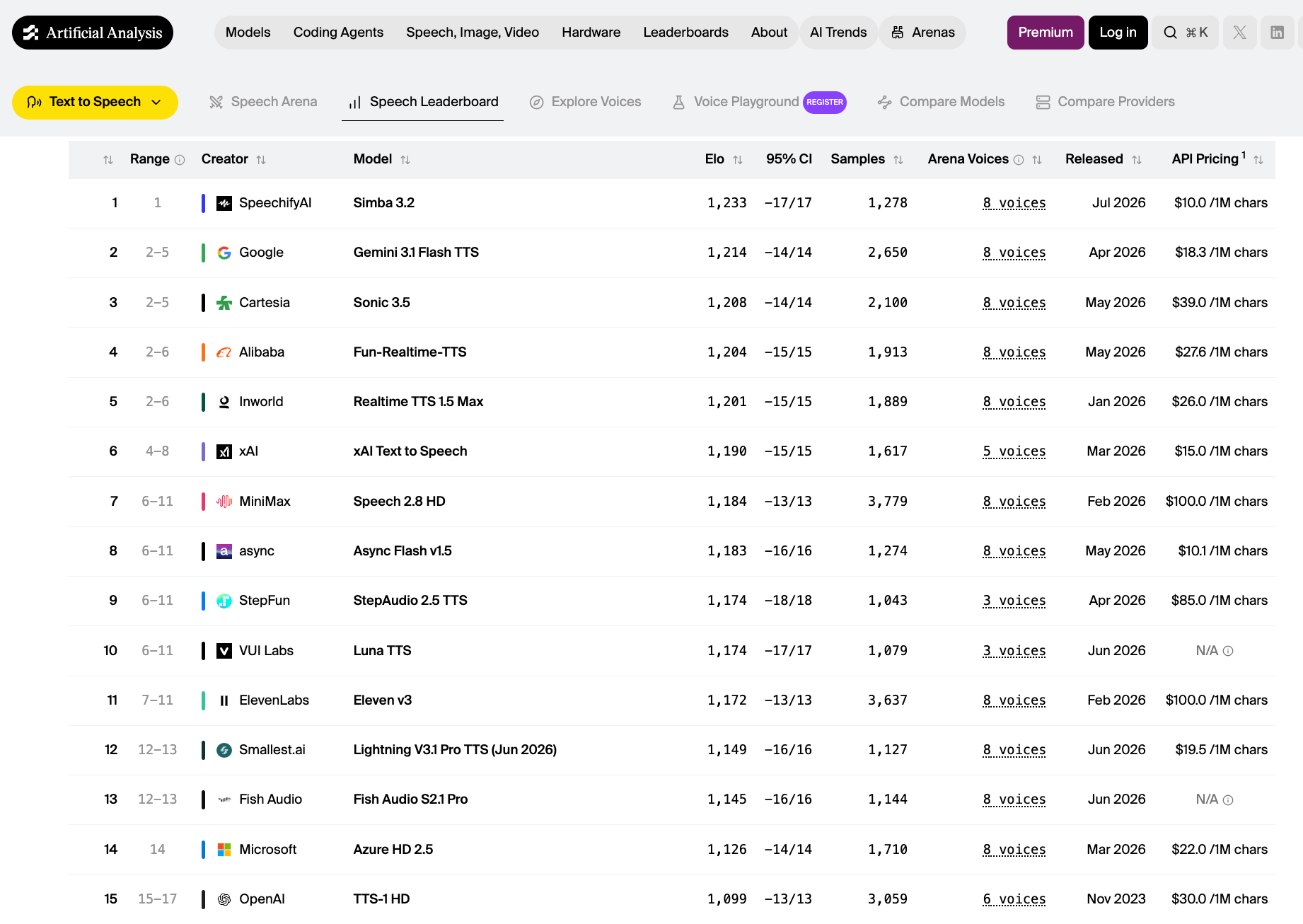
This week, Speechify’s Simba 3.2 captured the No. 1 spot on the Artificial Analysis text‑to‑speech leaderboard, overtaking ElevenLabs, Cartesia, OpenAI, and Google DeepMind. On Voice Arena—a blind‑listener benchmark modeled after Chatbot Arena—it now ranks highest among real‑time models at its price point.
Both leaderboards are independent, using blind listening tests where native speakers compare two clips without knowing the source. Simba 3.2 is now the highest‑rated real‑time voice model ready for production.
The three numbers that matter
For any voice‑enabled product, three metrics dominate: quality, latency, and cost. Historically, every model forced a compromise on at least one of these. Simba 3.2 changes that.
- Quality. Simba 3.2 ranks #1 on Artificial Analysis and leads Voice Arena for both quality and price. Both benchmarks are blind and independent.
- Latency. It is streaming‑native with sub‑100 ms time‑to‑first‑byte, making it suitable for real‑time voice agents that need immediate responses.
- Cost. Priced at $10 per million characters ($6 on the Scale tier), it is the cheapest model in the Artificial Analysis top ten—over 15× more affordable than ElevenLabs and roughly 6× cheaper than Cartesia.
Best‑sounding, fastest, and cheapest have rarely described the same model—until now.

Why this happened
Most AI labs optimize a model for benchmark performance, price it for enterprise buyers, and let the developer platform inherit whatever margin remains. Speechify took the opposite approach, building the model for its consumer product first.
The voice technology powers a consumer app used by more than 60 million listeners. Those users won’t tolerate robotic voices, multi‑second delays, or pricing structures that only make sense at the enterprise level. Every A/B test conducted in the product feeds directly back into model improvements.
“We made the architecture decisions early—decisions most labs postpone,” said Raheel Kazi, an engineering leader at Speechify. “We never wanted to sacrifice cost for quality or quality for latency. That deliberate choice set us up to hit state‑of‑the‑art on all three fronts simultaneously.”
What Artificial Analysis and Voice Arena actually test
Neither leaderboard can be gamed by a vendor. Artificial Analysis runs live serverless API calls four times daily, using random voice selections, a unique 500‑character prompt, and a standardized audio sample rate. Latency is measured end‑to‑end, from request to local file delivery.
Voice Arena employs a blind pair‑comparison across six languages, with a balanced slate of voices per model rather than each vendor’s “best” voice. The methodology was co‑developed with Prof. Shinji Watanabe of Carnegie Mellon University.
In both cases, quality is determined by pairing identical‑text clips and asking native speakers to vote on which sounds more natural. Votes are aggregated into an Elo rating—no self‑reported scores, no vendor‑selected clips, and no payment for inclusion.
SpeechifyAI Agents and Speechify’s Developer Platform
Along with the benchmark victory, Speechify is launching Voice Agents for enterprises and a developer platform, both accessible at speechify.ai. The underlying model powering these services is the same one used in its consumer applications.
Simba 3.2 is streaming‑native, offers fine‑grained emotional control, and supports SSML prosody for natural‑sounding real‑time interactions. The company has additional voices, languages, and a lower‑cost tier already in its roadmap.
So is this the end of paying enterprise prices for voice?
For teams that have already shelled out six‑figure voice budgets this year, the answer is increasingly clear: a better option exists.
For those still evaluating, the question is how long they’ll accept a trade‑off that no longer needs to exist. Voice AI used to force a choice; now it can deliver quality, speed, and affordability together.
Also Read
- Sysco Announces $1 Billion Common Stock Offering and Prices 12.35 Million Share Placement
- Internet Outage in Pakistan‑Administered Kashmir Surpasses 100 Days Amid Post‑Election Unrest
- Global Market Outlook: Fed Rate Hike, Oil Prices, and AI Regulation – Global Banking & Finance Review
- Historic Night at the 79th Emmy Awards: Matthew Rhys Makes History with Dual Wins


