






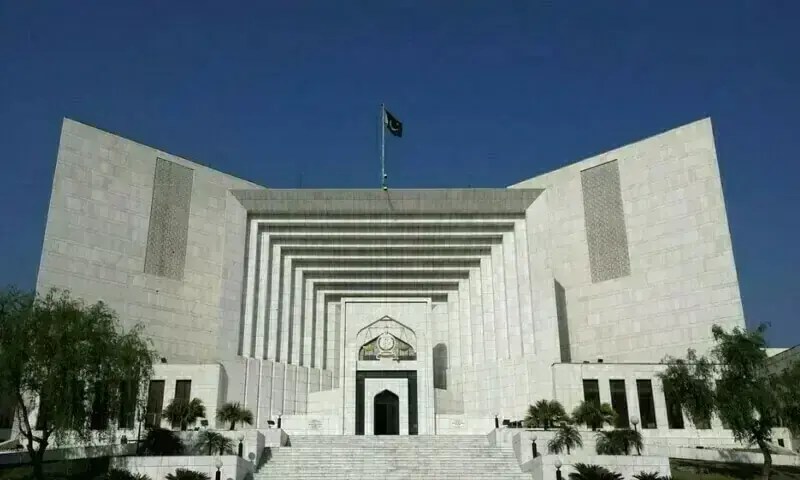
ISLAMABAD: On Monday, the Supreme Court (SC) condemned the Baldia Town factory fire as one of Pakistan’s most tragic industrial disasters, in which 260 workers perished and around 60 others suffered severe burn injuries.
In a detailed 39‑page judgment, Justice Malik Shahzad Ahmad Khan remarked that “the victims were ordinary workers who had entered the factory to earn their livelihood, but many of them never came out alive.” The ruling overturned the convictions of two Muttahida Qaumi Movement (MQM) activists, Abdul Rehman (alias Bhola) and Zubair (alias Chariya), who had been sentenced to death by an anti‑terrorism court for murder, extortion, arson and terrorism. The three‑member bench, also comprising Justices Aqeel Ahmed Abbasi and Shakeel Ahmad, set aside those sentences.
Detailed verdict in Baldia factory fire case states prosecution failed to prove charges against MQM workers
The judgment also cleared co‑accused Muhammad Abdul Rauf Siddiqui, Umar Hassan, Dr Abdul Sattar Khan and Iqbal Adeeb Khanum.
Justice Shahzad stressed that the constitutional right to life imposes a duty on the state to safeguard human life, enforce safety obligations, and conduct a prompt, scientific, impartial and effective investigation so that the true cause of the tragedy can be established and the real culprits brought to justice.
Originally, an FIR was filed against the factory owners and management for allegedly neglecting safety protocols. However, roughly two and a half years after the fire, the prosecution shifted its narrative, alleging that the petitioners and their accomplices deliberately ignited the blaze after the owners refused to pay an alleged Rs250 million extortion demand made by MQM.
The accused maintained that they were being used as scapegoats to target their political party, prompting the court to caution that utmost care must be taken before reaching any conclusion.
The Supreme Court reiterated that the prosecution bears the burden of proving guilt beyond reasonable doubt and that the judiciary must guard against convictions based on assumptions or unreliable evidence, while ensuring that genuine offenders are not freed when solid evidence exists.
Addressing the extortion and arson allegations tied to MQM, the court held that even strong probabilities cannot replace the conclusive proof required by the criminal justice system.
“We are clear in our minds that if there is no reliable evidence or conclusive proof against the petitioners to establish the alleged motive or other charges, their convictions cannot be sustained merely on the basis of presumptions, probabilities or general allegations,” the judgment stated.
The bench also made observations about the Muhajir community, acknowledging its cherished place in Pakistan and the sacrifices made during Partition in 1947. It noted that while MQM is generally seen as the political voice of Muhajirs, criminal acts by individuals cannot be used to tar an entire community or its party without tangible, convincing evidence.
Examining the prosecution’s case, the court highlighted that the Rs250 million ransom claim surfaced more than two years after the incident. The prosecution alleged that Zubair (alias Chariya) and five unidentified accomplices poured chemicals inside the factory and set it on fire, while Abdul Rehman (alias Bhola) conveyed the extortion demand and oversaw the attack.
Despite presenting around 400 witnesses, the bench found only Muhammad Arshad (PW‑374) claimed to have seen the arson, and factory owner Arshad Bhaila (PW‑397) testified about the alleged extortion demand. The court deemed these statements weak, hearsay or otherwise unreliable, noting both witnesses had originally been accused in the case before being turned into prosecution witnesses after a two‑and‑a‑half‑year delay, potentially giving them a motive to implicate the petitioners.
Further, the judgment observed that neither witness had independently reported the revised narrative to law enforcement.
The revised prosecution case was said to rest on disclosures made by Rizwan Qureshi, an accused in another matter. The court, however, pointed out that Qureshi was never prosecuted, produced as an accused, approver or witness in the Baldia factory case, leaving the prosecution’s foundation incomplete.
Consequently, the SC concluded that the prosecution failed to meet the burden of proof beyond reasonable doubt. It reaffirmed the principle that even a single circumstance casting doubt mandates acquittal, and that the present case was “replete with circumstances” fostering serious doubts about the prosecution’s version.
Published in Dawn, July 7th, 2026


