






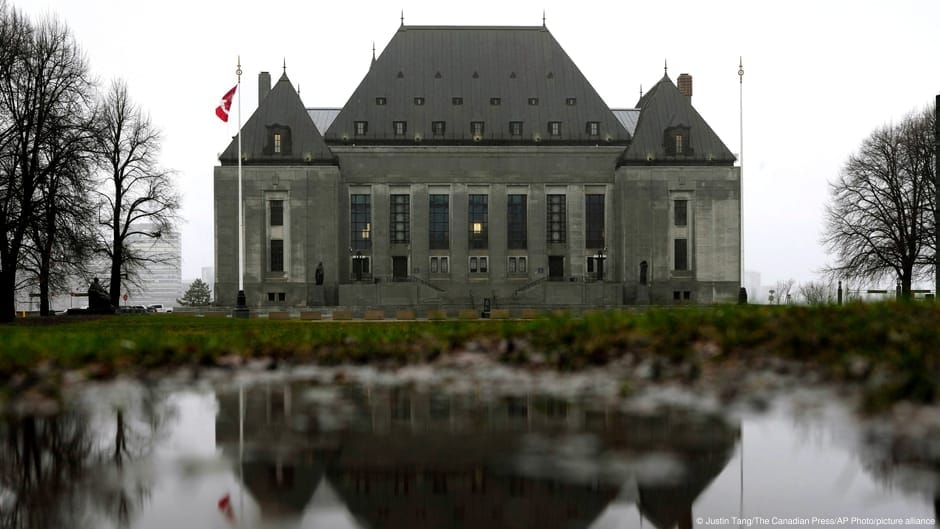
The Supreme Court of Canada on Friday affirmed Quebec’s ban on religious symbols for public servants.
However, the Court held that elected officials may wear religious symbols within the provincial legislature, the National Assembly.
The Quebec government enacted Bill 21 in 2019, stating that it was essential to safeguard the province’s secular character.
The legislation requires individuals receiving public services—such as teachers and police officers—to avoid displaying conspicuous religious symbols, including hijabs, turbans, and kippahs.
What did the Supreme Court say about the law?
Chief Justice Richard Wagner noted that the law “is rooted in Quebec’s legitimate and historical commitment to ensuring the (secularism) of the state in a free and democratic society.”
Mathieu Levesque, interim leader of the right‑wing nationalist Future Quebec Coalition (CAQ) that championed the bill, hailed it as a victory for the French‑speaking province.
“This is a victory for the Quebec nation and for the CAQ, whose actions have now been fully validated,” he said.
The CAQ governed Quebec for two consecutive parliamentary terms, from 2018 to 2026, after which it lost its parliamentary representation and the pro‑independence centre‑left Parti Québécois (PQ) assumed power.
The case represents a pivotal test of how far provinces may stretch the limits of the federal constitution by invoking the notwithstanding clause—a provision that permits provincial legislation that may contravene constitutional guarantees.
Quebec invoked the notwithstanding clause in enacting Bill 21, the secularism legislation, anticipating legal challenges concerning its compatibility with constitutional protections of religious freedom.
Critics argue secularism bill weakens rights protections
Critics contend that the bill disproportionately affects Muslim women and undermines fundamental legal protections.
“This decision grants any government unrestricted authority to enact legislation that strips fundamental freedoms and legal rights from all Canadians,” Stephen Brown, chief executive of the National Council of Canadian Muslims, told Reuters.
He added that the law compelled many Muslim women to cease teaching positions and even barred them from volunteering in schools.
Emmett Macfarlane, professor of political science at the University of Waterloo, told Reuters that the legislation constitutes state‑sanctioned Islamophobia.
Also Read
- Estonia will close border with Russia ‘to secure Europe,’ foreign minister says during Baku visit
- Yemen’s Northern Hunger Crisis: Food Is Available, but Families Cannot Afford It
- Twenty-Seven Syrian Families Return to Restored Homes in Damascus
- Saudi Arabia’s King Abdulaziz Falconry Festival Resumes with Notable Prize Fund


