






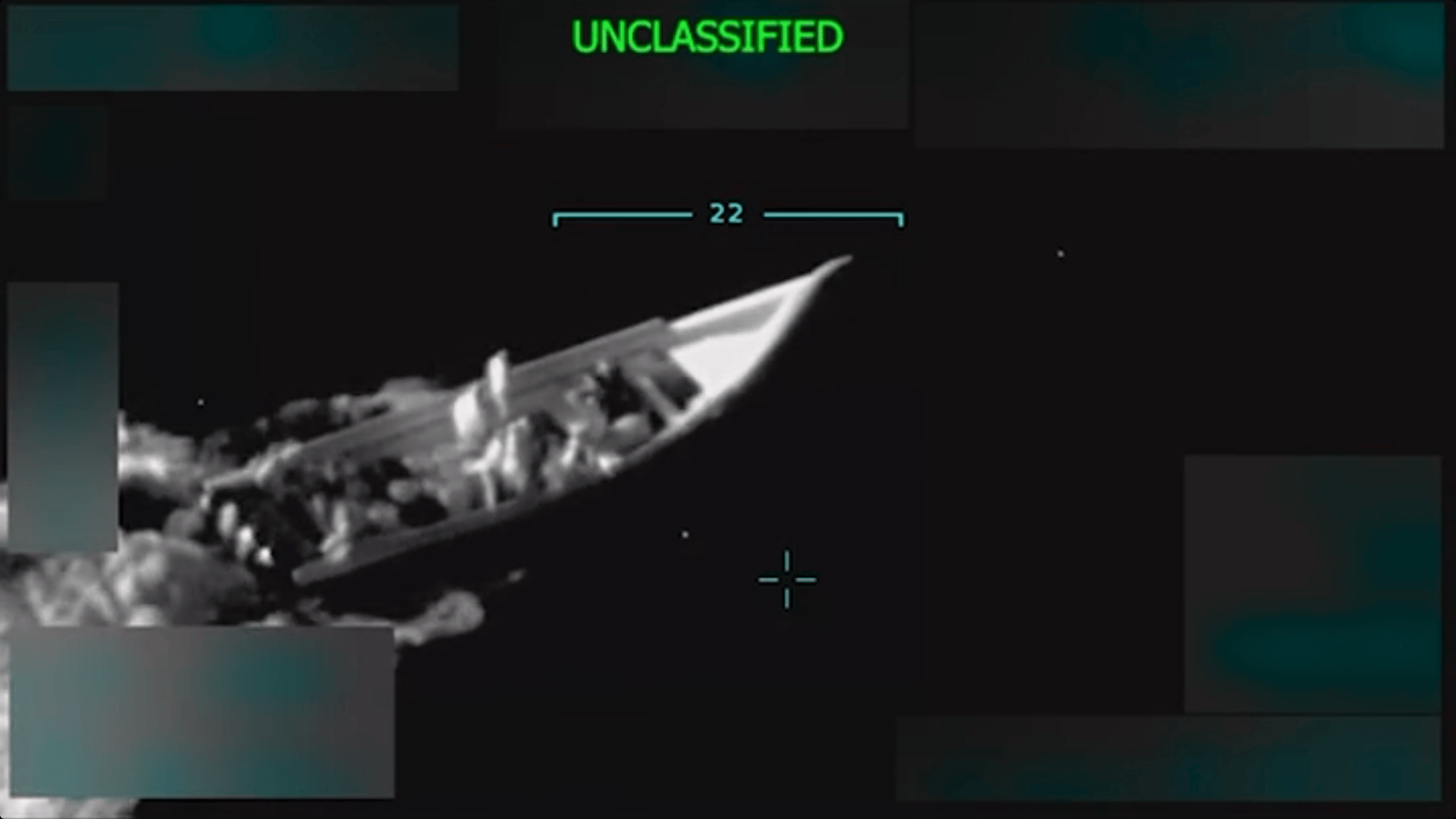
While US military attention is currently focused on airstrikes against Iran and threats to protect the Strait of Hormuz, a secondary conflict is unfolding much closer to American shores. Unlike the Middle Eastern tensions dominating global news, the ongoing military campaign in the Western Hemisphere has received comparatively little scrutiny.
Last November, Defense Secretary Pete Hegseth launched Operation Southern Spear, a military initiative aimed at neutralizing “narco-terrorists” in the Western Hemisphere. This operation followed the Pentagon’s decision to begin intercepting and bombing small vessels suspected of transporting narcotics through the Caribbean and Eastern Pacific Oceans.
To date, the United States has conducted 66 strikes. Beyond reports of approximately 221 fatalities—some of whom may not be involved in smuggling—the mission has failed to meet its primary objectives. Furthermore, the campaign is consuming significant military manpower and munitions at a time when US strategic resources are already stretched thin.
The Trump administration maintains that these strikes represent a necessary evolution in anti-drug policy, intended to disrupt the financial foundations of Latin American criminal organizations. In June, the administration claimed a 97 percent reduction in maritime drug trafficking. The White House has framed these strikes as an application of the “Donroe Doctrine”—an aggressive version of the 1823 Monroe Doctrine that asserts US authority within its own hemisphere.
However, these administrative claims lack empirical support. While certain traffickers have been killed and cargo has been destroyed, the strikes have failed in their fundamental mission: reducing the volume of narcotics reaching the US-Mexico border. In fact, by militarizing counternarcotics efforts, Washington risks undermining its own objectives and damaging its international standing.
In defending the use of lethal force at sea, Secretary of State Marco Rubio argued that Coast Guard interdictions were insufficient to stop the flow of narcotics, suggesting that only lethal force could effectively deter traffickers. Yet, after nine months of kinetic operations, drug trafficking in the Western Hemisphere remains a persistent reality.
This outcome is predictable to anyone familiar with the mechanics of the drug trade. Like any market-driven enterprise, cartels react to supply and demand. Given the immense profitability and high demand for narcotics in the United States and globally, there is a massive financial incentive for traffickers to persist. If one group is disrupted, competitors are ready to seize the market share, a dynamic particularly evident in the rising global demand for cocaine.
If US strikes were effective, they would theoretically create supply shocks, resulting in lower seizure numbers at the border and increased domestic prices. Instead, data suggests the opposite. According to US Customs and Border Protection, cocaine seizures have increased in the eight months following the start of the boat strikes compared to the preceding eight-month period. With prices remaining stable, it is clear that the market remains well-stocked. Statistically, Operation Southern Spear has failed to curb trafficking.
Beyond its lack of efficacy, the military-centric approach is costly. The Pentagon’s Special Inspector General reported that approximately $527 million was allocated to Operation Southern Spear between January and March 2026. Estimates from Brown University suggest that since the buildup began in August 2025, total costs could reach $5 billion—and that figure excludes the strategic cost of diverting forces from other global theaters.
While these costs are lower than the potential $100 billion price tag for a conflict in Iran, they represent a significant burden for the Pentagon. This comes at a precarious time for US defense budgeting, as the 2027 National Defense Authorization Act faces political gridlock and skepticism regarding large supplemental spending requests.
Washington has frequently pressured Latin American nations to join this “war on cartels,” encouraging regional partners to adopt a paradigm that classifies traffickers as terrorists. However, drug trafficking is fundamentally different from political terrorism. While Mexican cartels use terror tactics to intimidate populations and bribe officials, their objective is profit rather than the subversion of government through nihilistic political goals.
Misunderstanding this distinction leads to flawed policy. Many Latin American governments are being enticed into a “kill or arrest” strategy that may provide short-term political wins but creates long-term instability. A significant risk is that unilateral US maritime operations will alienate key allies. Countries like the United Kingdom, Colombia, and the Netherlands have already limited intelligence sharing regarding counternarcotics to avoid liability for potential wrongful deaths caused by US strikes. There is indeed evidence of such errors, with families of strike victims currently suing the US government for violations of domestic and international law.
Furthermore, the operational impact of these strikes may actually hinder law enforcement. Eliminating traffickers at sea destroys valuable intelligence regarding organizational hierarchies, command structures, and production origins. By prioritizing kinetic strikes, the US may be inadvertently stripping law enforcement of the very informants needed to dismantle these networks.
While many US presidents have championed “tough on crime” stances, Donald Trump is the first to attempt to solve the problem through direct military intervention. The evidence is conclusive: the strategy is failing. Operation Southern Spear should be terminated.
Daniel R. DePetris is a fellow at Defense Priorities.


