







The Vikings were renowned explorers, farmers, merchants, and formidable warriors who launched extensive raids across Europe. While popular imagery of the Viking Age typically highlights muscular male warriors, researchers over the past few decades have increasingly focused on the roles and experiences of women during this era (roughly A.D. 793 to 1066). Historical texts mention “shield maidens”—women who fought alongside men—and archaeological discoveries have uncovered graves of Viking Age women buried with war-grade weapons and shields.
While the question of whether Viking women could be warriors remains hotly debated, a more profound inquiry arises: what does the available evidence actually tell us about how frequently Viking women fought in battle?
According to experts, the answer depends largely on how we interpret historical texts, artifacts, and burials. In many cases, the remains of women interred with weapons face significantly higher levels of scrutiny than those of men buried with similar—or even fewer—armaments.
One of the most evocative historical accounts comes from the 12th-century Danish historian Saxo Grammaticus, who wrote in “Gesta Danorum” (“History of the Danes”) that there were once women in Denmark who dressed like men and spent almost every minute cultivating combat skills. He described them as putting “toughness before allure,” preferring “conflicts instead of kisses,” and seeking “the clash of arms rather than the arm’s embrace.”
Another medieval text, the Irish “Cogadh Gaedhelre Gallaibh” (“War of the Irish with the Foreigners”), refers to a “Red Lady” who led a Viking fleet in a raid on Belfast in the 10th century.
Neil Price, an archaeology professor at Uppsala University who has written extensively about the Vikings, expressed skepticism regarding the reliability of such accounts. He noted that the text referring to the Red Lady is of debatable accuracy, and suggested that while Viking women may have fought in battle, they likely did not do so frequently. “Female warriors were probably a very small minority,” Price explained.

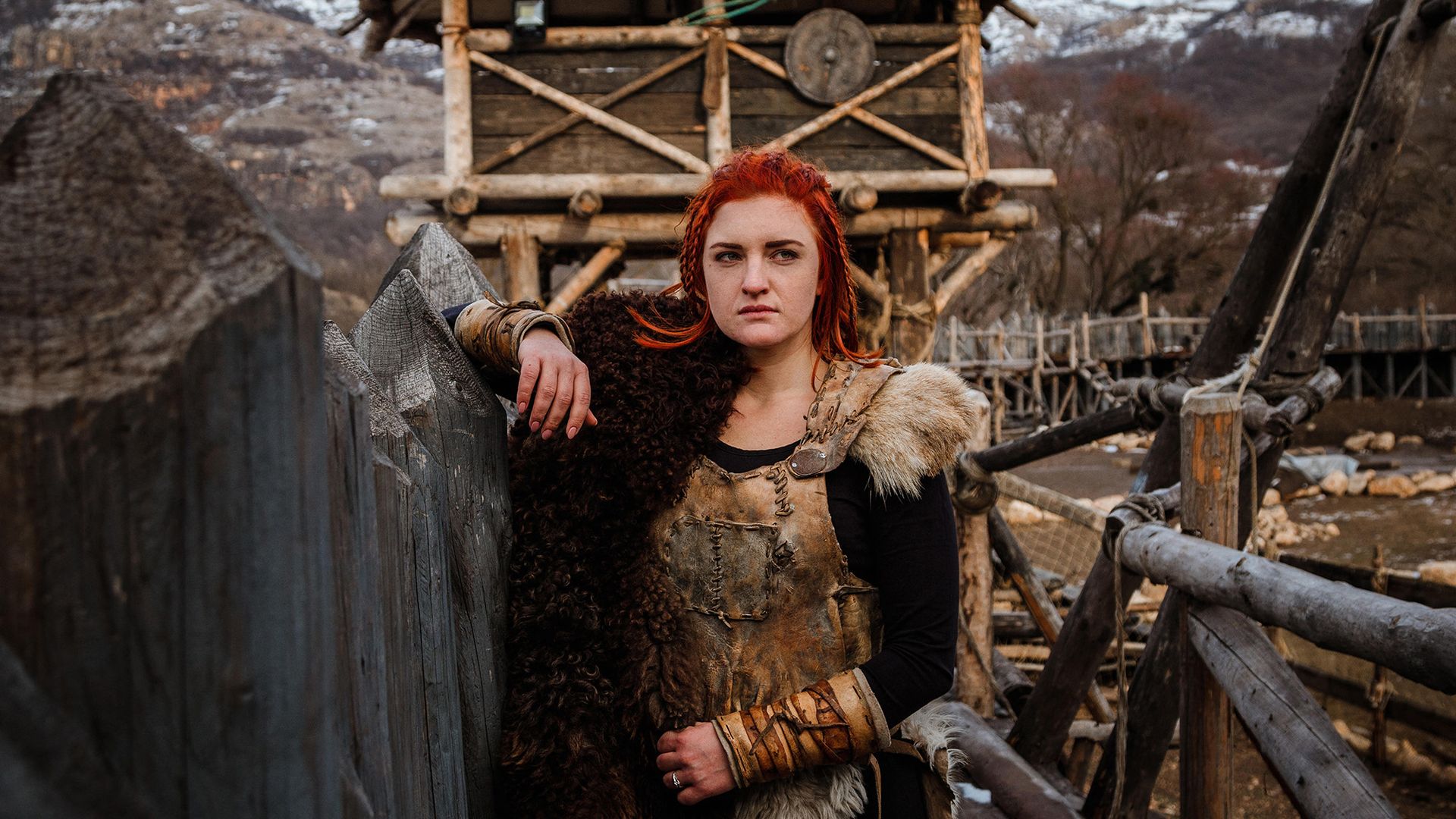
However, some scholars argue that accounts like those of Saxo Grammaticus should be approached with caution. Thomas Kristian Heebøll-Holm, a history professor at the University of Southern Denmark, pointed out that Saxo Grammaticus is generally not considered a reliable source. Heebøll-Holm noted that Saxo’s writings on female warriors are confined to the legendary past of Denmark and are more moralistic and fictitious than factual. In some instances, Saxo appeared to draw inspiration from the ancient Greek legends of the Amazons, a mythical race of female warriors.
Turning to physical evidence, archaeology presents its own set of challenges. Researchers have identified approximately 30 Viking Age female burials containing weapons, including three in Scandinavia that held swords. Additional graves contain items that could have served as weapons—such as spears, axes, and knives—though these items may have also been used for hunting or farm management. Ultimately, without direct evidence, it remains uncertain whether these women actually saw combat.
Deborah Shepherd, an independent researcher with a doctorate in archaeology who has studied the Vikings extensively, highlighted these interpretive difficulties. “The first concern is that the weapons were really used by the deceased and were not merely included as signs of special status or social rank acquired through inheritance,” Shepherd noted. She also pointed out that the preservation of graves is often poor, which limits the information available to researchers.

Despite these challenges, Shepherd suggested that there were likely “some few female warriors,” who probably belonged to the highest-ranking families and had relatively brief warrior careers. “They wouldn’t have fought in the great armies of later centuries but possibly did fight in pre-Christian skirmishes,” she added, noting that the gradual conversion to Christianity occurred between the ninth and 12th centuries.
Physical evidence of combat is rare but not entirely nonexistent. At least one Viking woman discovered in Solør, Norway, is believed to have suffered a head injury consistent with a sword strike. She was 18 or 19 years old at the time of her death, was buried with weapons, and lived around A.D. 900.
Ole Kastholm, a curator and senior researcher at the Roskilde Museum in Denmark, emphasized the general uncertainty surrounding how often Viking women fought. He noted that weapons appear as grave goods in only a handful of female graves, often consisting of just a single item like a spear or a battle axe. However, he highlighted at least one exception: a grave in Birka, Sweden, containing a woman buried with a full set of weapons and riding equipment.
“If this was a man’s grave, researchers would have no doubt that it was a warrior grave, and this explanation must necessarily also apply when the interred is a woman,” Kastholm argued.
To put the Viking Age into broader perspective, female warriors were not entirely unique to Norse society. As Neil Price noted in his book, “The Sea-King and the Sorceress: Life and Death in the Viking Age” (Basic Books, 2026), female warriors were an almost common feature of Central Asian societies for at least a millennium before the Viking Age.
For example, the Scythians, a people who flourished in Eastern Europe and Asia, buried their women with horses and weapons. In some cases, Scythian women have been found with combat wounds, such as arrowheads embedded in their bones, leading researchers to speculate that they may have inspired the ancient Greek legends of the Amazons.
Also Read
- Dawn of War 4 Returns to Kronus: Creative Director Explains the Nostalgic Strategy Behind the Setting
- Developer Mistake Renders 600 PCs Unusable, Causes $1M CD-ROM Write-Off
- Lynne-Marie Postovit: Pioneering Cancer Cell Plasticity Under Hypoxic Stress
- Is Jensen Huang’s job on the line? Yale’s Jeffrey Sonnenfeld estimates it’s “about a 50-50”


