



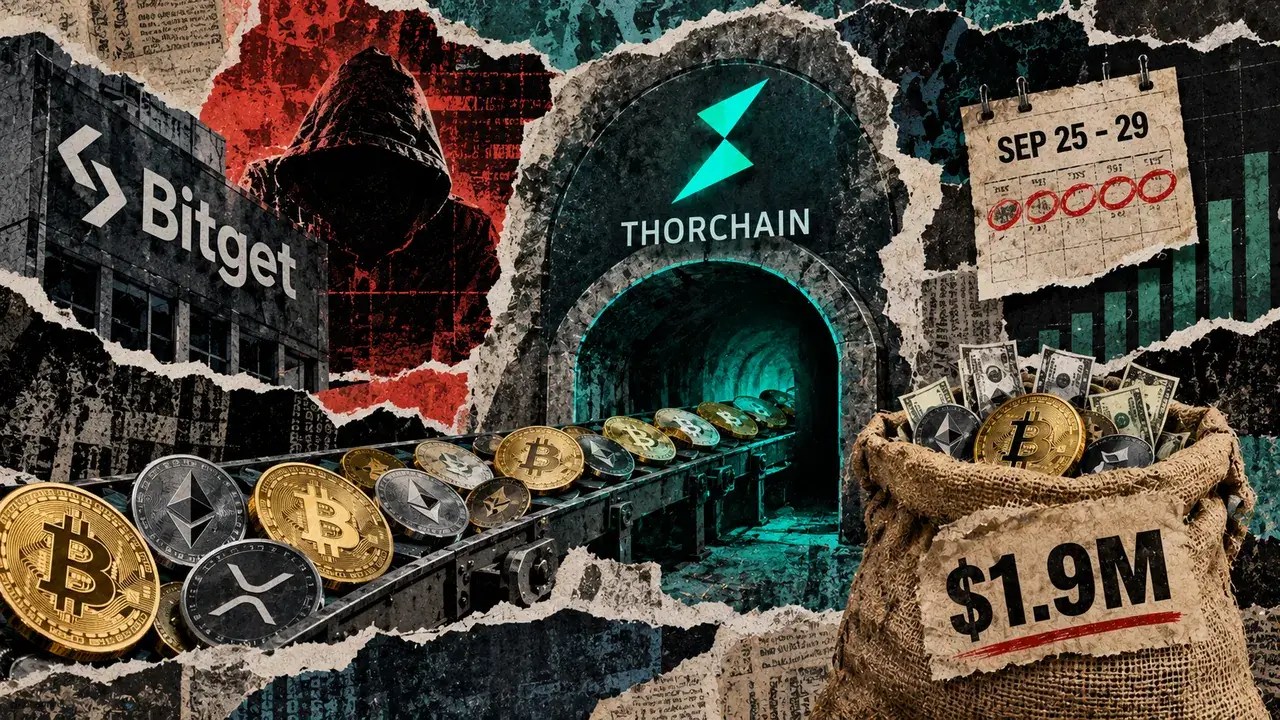
THORChain’s September income surged as Bitget‑linked flows drove the protocol’s busiest stretch in over a year.
The cross‑chain protocol generated $3.01 million in system income last month—the highest figure since March 2025—while swap volume climbed to $2.40 billion, its strongest level since June 2025.
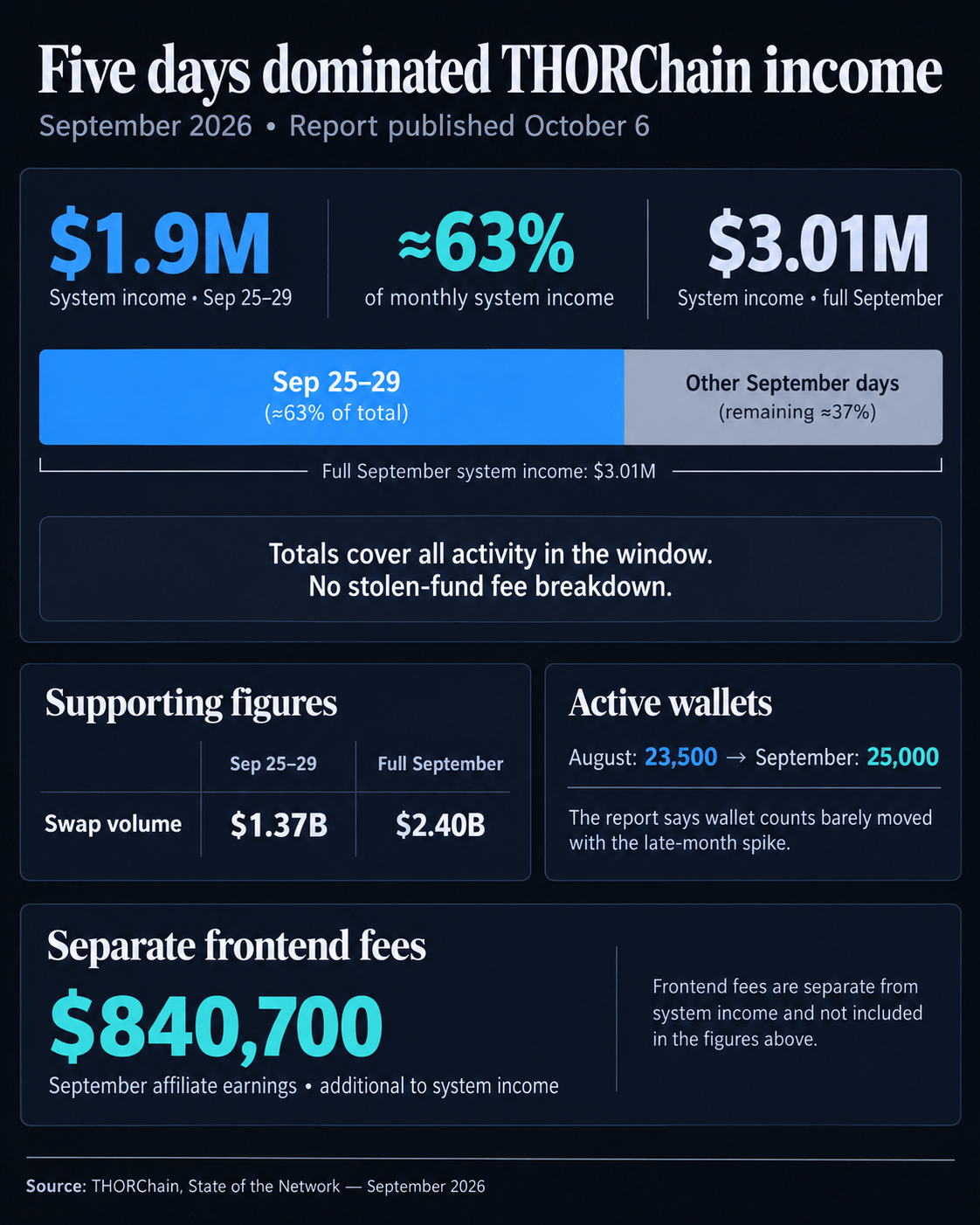
Much of the activity was compressed into a five‑day window after the Bitget hack. Between September 25 and September 29, roughly $1.37 billion—about 57 % of September’s swap volume—passed through THORChain, while the network generated approximately $1.9 million in income during that period, representing roughly 63 % of the month’s total.
THORChain said the surge coincided with funds tied to the Bitget exploit moving through the network. It explained:
“Between September 25 and 29, daily volume ran between roughly $190M and $460M as funds linked to the Bitget exploit moved through the network.”
The concentration nevertheless highlights the economic consequences of a stance THORChain defended as Bitget sought to limit the movement of stolen funds.
After the exchange was hacked, THORChain rejected calls for selective intervention, arguing that the protocol is decentralized and permissionless in the same way as Bitcoin, Ethereum and BNB Chain.
It also distinguished a network halt—an emergency mechanism designed to protect THORChain itself—from censoring individual addresses or transactions. The protocol pointed to its own May exploit, when attackers stole $10.7 million from liquidity pools but were not blacklisted from swapping assets through the network afterward.
Bitget said roughly $387.5 million was ultimately transferred to attacker‑controlled addresses during the September breach.
THORChain’s Record Activity Came Without a User Boom
THORChain’s wallet data suggests the revenue jump reflected unusually large flows rather than a comparable expansion in its user base.
Active wallets rose to 25,000 in September from 23,500 in August, while new wallets edged up to 22,400 from 21,800. THORChain said wallet activity barely responded to the late‑month volume spike, indicating that the transactions were concentrated among a relatively small number of participants.
That distinction complicates the headline improvement in protocol economics.
September income was almost five times August’s $615,000, while swap volume nearly quadrupled from $613 million. Yet most of the incremental activity occurred during the same narrow period when hack‑linked assets moved across chains.
The burst also inflated trailing yield measures. RUNE’s seven‑day annualized return peaked at 69.03 % on September 29, while TCY’s climbed to 29.74 %. THORChain expects those readings to decline as the high‑fee days roll out of the calculation window.
Frontend affiliates separately earned about $840,700 during September, with roughly $669,000 going to unidentified affiliates.
For liquidity providers and token holders, the next test is whether ordinary trading can replace the exceptional activity that lifted September’s returns.
If volume normalizes toward pre‑hack levels while wallet growth remains modest, income and trailing yields could retreat sharply. A sustained improvement would require THORChain to convert September’s visibility into recurring flow from traders and integrators rather than rely on episodic bursts generated by unusually large transactions.
Also Read
- ECB Minutes: Higher Long-Term Yields Could Do Part of Its Tightening Work
- Ex-PlayStation Executive Challenges Sony’s Plan to Kill Discs: ‘What Are You Actually Buying?’
- BoE’s Greene Says Bond Markets Cannot Do the Tightening Job Forever
- Samsung Wallet Taps Solana for USDC Transfers on 82M US Galaxy Devices