






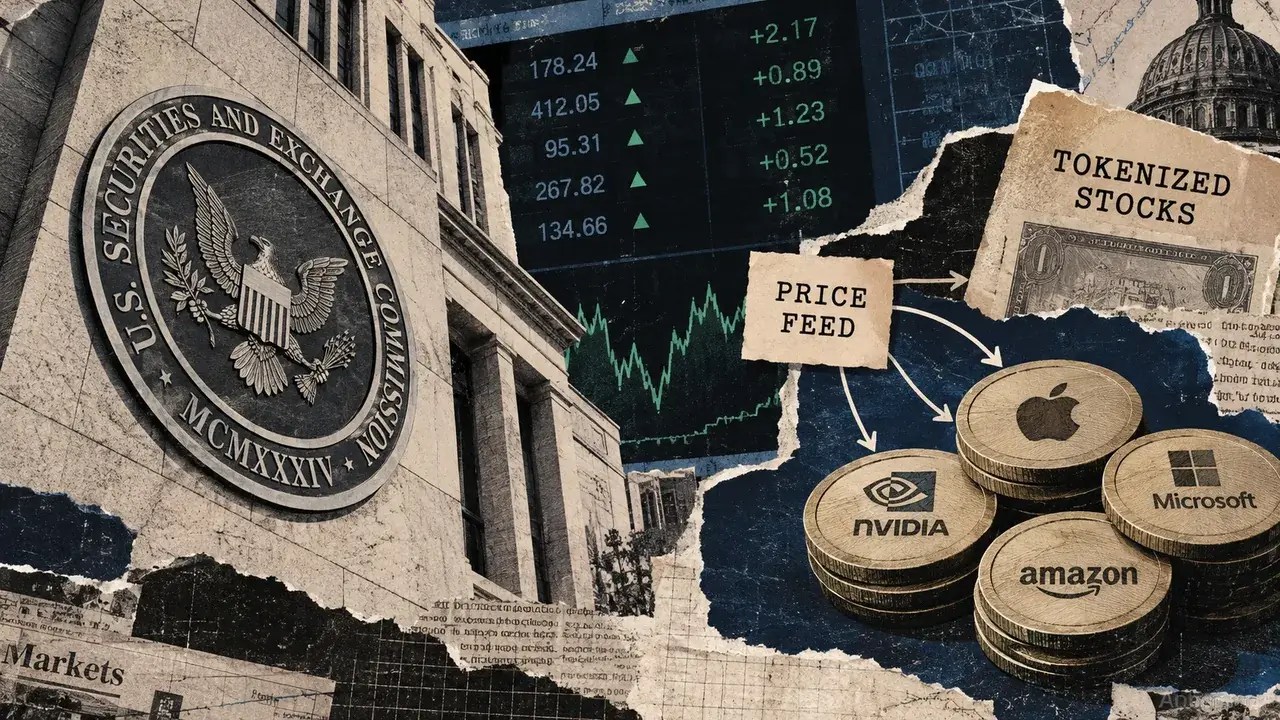
Tokenized securities that qualify for the SEC’s September exemption must provide the same shareholder rights as conventional stock, although their trading platforms may fall outside core Regulation NMS safeguards. Investors should therefore assess both the nature of the entitlement they receive and the mechanics of order pricing and execution.
Douro Labs, a market‑data provider, urged the SEC staff in an October 9 filing to establish vendor‑neutral guidelines for evaluating external price feeds and employing them in dollar‑denominated reporting. Because Douro contributes to the Pyth Network and operates Pyth Pro, it has a commercial stake in the standards under consideration.
The mandate imposes disclosure and safeguard obligations on venues, while FINRA‑member brokers continue to bear their best‑execution responsibilities for covered customer trades.
Issued on September 17, the order grants temporary, conditional exemption from the exchange definition to venues that run permissioned automated market maker pools for eligible tokenized NMS securities. These pools rely on software to enable approved participants to trade against locked‑up assets. Additionally, the order provides distinct dealer‑definition relief for certain liquidity providers that operate with their own capital.
The relief is more limited than the broad tokenized‑stock designation. It excludes third‑party instruments that give synthetic exposure—such as tokenized linked securities and security‑based swaps—as well as rights and warrants. Eligibility hinges on the specific security definition and the venue’s adherence to the order’s requirements.
For qualifying shares, the venue must confirm that investors receive the same rights and privileges attached to an equivalent class of traditional stock. These include an ownership interest in the issuer, entitlement to dividends, voting privileges, and a claim to residual assets upon liquidation. Holding these rights reflects what the investor owns, whereas execution pertains to the conditions under which the investor buys or sells the security.
A venue that satisfies the exemption’s conditions operates outside the exchange, alternative trading system, and trading‑center framework governing the relevant Regulation NMS provisions. This exclusion encompasses Rule 611’s safeguard against trades executed at prices inferior to protected quotations elsewhere. While those protections and a broker’s best‑execution duty remain distinct, the order maintains all relevant anti‑fraud and anti‑manipulation statutes and preserves participants’ separate regulatory responsibilities.
Tokenized stocks: what external price data controls
The order’s market‑data provision compels venues to disclose whether and how they employ external data or oracles—the services that feed off‑chain information into blockchain applications. Public notices must name the providers and sources, outline the data’s purpose, and detail oracle usage. Additional disclosures cover known material risks such as oracle manipulation and any reference‑price bands or other risk controls.
The order further mandates that venues halt trading in sync with any suspension of the underlying stock on its primary exchange, issue participant notifications, remediate operational events, maintain accessible records, enforce trading limits, and impose restrictions on venue credit.
The order does not dictate a sole data provider, a minimum number of contributors, a standard aggregation methodology, a confidence threshold, or a uniform approach to handling stale prices.
Douro urges the staff to develop a framework for evaluating these choices. Its proposed criteria highlight independent contributors who participate in price formation, aggregation methods resistant to manipulation, publicly disclosed contributor identities and calculation techniques, and benchmarking against external market data. The letter additionally calls for disclosures regarding confidence levels, data staleness, and procedures for when data becomes uncertain or unavailable.
Existing reporting requirements already oblige venues to publish free, machine‑readable, dollar‑denominated data for transactions in the prior 30 days, refreshed within ten minutes of each trade. Conversions must employ consistent, impartial, and reasonable methods commonly used by market participants, and both trading‑interest logs and transaction records must express prices in dollars.
An existing SEC staff FAQ employs comparable dollar‑conversion language for pair trading on exchanges and alternative trading systems. Douro’s request, however, focuses on a distinct issue: how venues should assess the quality of their price feeds.
How venue notices describe different feed roles
OKXICE’s October 4 notice shows that naming an external provider is merely the first step. It explains that AMM execution prices derive from pool asset ratios, whereas external price data serves additional purposes—showing stock values, detecting halts in the underlying market, and reporting stablecoin‑paired transactions in dollars.
The notice cites Massive.com for stock‑price and trading‑halt information, and affiliated OKX INC for stablecoin price indices. It also states that OKXICE does not layer any extra circuit breakers or reference‑price bands on top of the stoppages it already outlines.
The notice includes Circle’s dollar‑pegged USDC among its accepted payment assets. A stablecoin‑price input translates the trade into dollars for reporting purposes, while pool ratios dictate the execution price.


The notice also details how external volume data is fed into the venue’s smart contracts for trading‑limit checks, demonstrating that price and volume inputs govern separate facets of the trade.
TSV LLC’s September 23 notice offers a different perspective. It notes that operations had not yet begun at the time of the filing, outlines planned external‑data applications such as halt detection and price‑divergence monitoring, and indicates that a production market‑data provider had not been selected. The disclosed functions are therefore prospective as of that notice.


Best execution for tokenized stocks remains a broker duty
For a FINRA member executing a covered customer transaction, Rule 5310 obliges the firm to exercise reasonable diligence in locating the best market and securing a price as favorable as possible under prevailing conditions, whether the member acts as agent or principal.
The evaluation takes into account the market’s character, transaction size and type, the venues surveyed, quote accessibility, and the customer’s order terms. The rule’s execution review also weighs speed, the likelihood of filling limit orders, costs, and customer requirements. It extends beyond a simple comparison of a pool price with a single external reference.
A member may not delegate this duty to another party. Automated, non‑discretionary order routers and internalizers that rely on regular, rigorous review rather than per‑order scrutiny must perform the relevant assessments at least quarterly, broken down by security and order type, and benchmark their arrangements against competing markets. Whenever execution quality diverges materially, they must adjust routing or provide a justification for maintaining the existing approach.
When pricing information is thin, heightened diligence, formal written procedures, and documented compliance with Rule 5310 become essential.
Who handles the customer’s order matters
The customer’s instructions and the firm’s role are consequential. An unsolicited directive to send an order to a specific market narrows the best‑execution analysis beyond that instruction, although timely processing and adherence to the order’s terms remain mandatory. The duty also encompasses customer orders routed from another broker for handling and execution. Simply filling another broker’s customer order against the member’s quote does not constitute a routed‑order obligation.
Investors who deal directly with a non‑member pool should first verify whether a FINRA member is managing a covered customer transaction before invoking those broker safeguards. The venue’s exemption conditions and relevant anti‑fraud protections remain pertinent regardless of the execution path.
FINRA’s Regulatory Notice 26‑15 invited comments on modernizing guidance within the existing principles‑based framework. Its delineation between best execution and trade‑through protection clarifies why venue relief and a member’s customer duties function independently.
What tokenized-stock investors can compare
Investors can scrutinize a venue notice beyond the provider’s name. They should ask whether external data determines the execution price, underpins a displayed valuation, converts a transaction for reporting, or triggers a halt. They must also consider whether a disclosed price band genuinely constrains trading and what occurs if its reference grows stale or unavailable. When a broker handles the order, investors need to assess how the execution compares with alternative venues.
Douro’s October 9 submission supplies the SEC staff with a concrete framework for evaluation. For investors comparing tokenized securities, the practical test is whether the venue’s data, its pricing controls, and any broker’s execution review collectively support the anticipated trade.


