



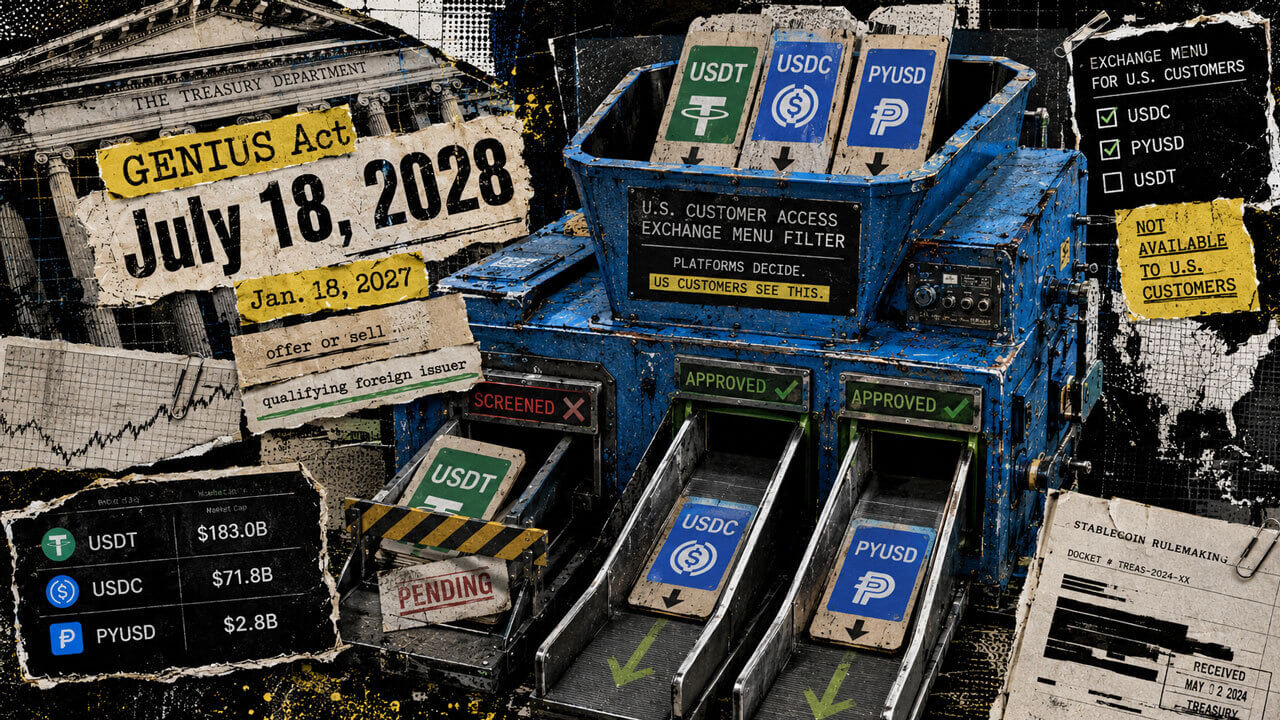
By July 18, 2028, a stablecoin may continue to circulate across blockchains while being excluded from purchase menus on U.S. exchanges. Under the Treasury Department’s proposed GENIUS Act regulations, a digital‑asset service provider would be prohibited from offering or selling a payment stablecoin to U.S. residents after that date unless the issuer qualifies under one of the law’s permitted categories.
The rule does not prohibit offshore tokens from operating abroad or moving between private wallets; it merely restricts how regulated entities distribute such tokens within the United States. For Tether’s USDT, the critical question is whether American exchanges can continue to list the asset, even though the token itself will remain active on‑chain.
This distinction transforms GENIUS from an abstract licensing framework into a tangible impact for users. Treasury expects the broader regime to be fully effective on January 18, 2027, granting issuers and platforms an additional 18 months to prepare for the stricter distribution limitations scheduled for 2028.
The exchange becomes the border
The timeline creates two implementation phases. Starting January 18, 2027, entities cannot issue a payment stablecoin in the United States without entering the GENIUS framework. Simultaneously, U.S. service providers that carry foreign‑issued tokens will face initial conditions tied to the issuer’s ability and willingness to comply with lawful orders and reciprocal arrangements. On July 18, 2028, the comprehensive rule will take effect, limiting covered providers to tokens issued by permitted or qualifying foreign issuers.
“Digital asset service provider” appears to be a narrow legal category, yet it encompasses most businesses through which consumers purchase and store crypto. Exchanges, custodians, and firms that transfer digital assets or assist in token issuance fall within this definition. If any of these entities serve U.S. customers for profit, they may need to determine whether every stablecoin on their platform possesses a valid GENIUS pathway.
Treasury interprets “offer or sell” broadly. A platform can be subject to the rule by advertising a stablecoin, agreeing to sell it, or indicating willingness to complete a trade after a user initiates contact. Even assisting a customer in bypassing geolocation controls may be considered. An exchange cannot rely on a buyer‑initiated request as a defense.
Because a centralized exchange knows the jurisdiction of each account and controls which assets are available in its application, custodians decide which tokens to hold, and hosted wallets select supported purchase and swap routes. Treasury would leverage these existing controls to require the businesses nearest to the end‑user to verify an issuer’s legal status.
For individual users, the location test is primarily geographic. A U.S. resident physically present abroad would generally be treated as outside the United States for a transaction conducted there. A non‑U.S. resident who is merely visiting the United States receives a limited exception under specified conditions. The rule targets the point of service delivery, not the permanent ownership of wallets by U.S. persons.
Self‑custody remains largely outside this framework. The proposal excludes direct peer‑to‑peer transfers and software that merely assists users in holding their own assets. An American could still possess an offshore token or receive one directly, even if a regulated exchange could no longer sell it. Friction arises when that individual attempts to use a covered business to purchase, swap, or deposit the token.
Treasury acknowledges that this approach may increase market concentration. The proposal identifies switching costs and reduced consumer choice as potential drawbacks, and it rejects a broader temporary safe harbor for smaller foreign stablecoins. Faced with a token from a fully permitted U.S. issuer and another requiring extensive legal review, technical monitoring, and continuous oversight, exchanges have a commercial incentive to list the easier asset.
When a stablecoin’s code becomes compliance evidence
Foreign issuers retain a pathway into the U.S. market under Section 18 of GENIUS. Their home jurisdiction must operate a stablecoin regime that Treasury deems comparable to the U.S. framework. The issuer must also register with the Office of the Comptroller of the Currency and demonstrate the ability to comply with lawful U.S. orders.
This requirement brings the stablecoin’s underlying code into the regulatory process. Treasury is asking whether due‑diligence should include scrutiny of a foreign issuer’s smart contracts to confirm the ability to seize, freeze, or burn tokens when legally mandated. Such capabilities enable an issuer to block funds at a specific address or remove particular tokens from circulation.
Treasury is currently seeking public comment on whether these technical checks should be codified in the final rule, as it has not yet required every platform to perform them. Nonetheless, the proposal outlines the standards an offshore issuer may need to satisfy. Reserve reports and redemption policies demonstrate whether a token is financially backed, while smart‑contract controls reveal whether the issuer can execute a court order. Access to U.S. exchanges could hinge on both financial and technical assurances.
Also Read
- Adam Back’s Bitcoin Treasury Merger Collapses; $15M Obligation Remains
- USD/JPY Weekly Forecast: Market Analysis and Key Levels
- Bitcoin, Ethena, and Solana Price Analysis: Key Levels and Market Outlook for August 21
- Illuvium Secures One-Year Operating Runway Through Cost Reductions as MMO Becomes Primary Focus