








TRON’s stablecoin settlement activity expanded during the third quarter of 2026, coinciding with a continued upward trend in the supply of its native TRX token. Between July 1 and October 16, the blockchain experienced 108 consecutive days of net TRX issuance, with 125.8 million tokens added in Q3 and an additional 22.9 million in the first half of October after accounting for token burns.
The growth in stablecoin transactions underscores TRON’s increasing role in dollar-denominated transfers. TRON DAO Research recorded $2.2126 trillion in stablecoin settlements during Q3, marking a 5.1% increase from the previous quarter. Despite this robust transaction volume, TRX supply continued to rise into October, highlighting a unique dynamic in the network’s monetary structure.


TRON’s architecture enables this dual expansion by separating resource usage from token issuance. Reusable network resources can accommodate transaction demand without necessarily triggering additional token burns, while block production and voting incentives contribute to new token creation. Data from TRONSCAN confirms that issuance consistently outpaced burns across all 108 days analyzed, with 92 observations in Q3 and 16 in early October.
CryptoSlate’s analysis of daily issuance and burn records shows that 148.6 million TRX were added to circulation over this period, excluding partial data from October 17. This net increase represented approximately 0.133% of the opening supply of roughly 94.850 billion TRX for Q3.
Separately, stablecoin balances on the platform reached $93.88 billion by the end of Q3, reflecting a 5.5% increase from Q2. While both TRX and stablecoin supplies are growing, they serve distinct functions within the ecosystem—TRX facilitates network operations and governance, whereas stablecoins underpin transactional value transfer.
Resource Mechanics and Their Impact on TRX Supply [/h2]
TRON employs a resource-based model to manage transaction processing. Bandwidth governs data storage requirements, while Energy supports smart contract execution. Transaction complexity, not asset value, determines resource consumption. Users can acquire these resources either by staking TRX directly or receiving delegated allocations from other participants.
Resource recovery occurs over a rolling 24-hour window. Once utilized, full capacity resets unless further activity interrupts the process. Importantly, staked TRX remains intact even as resources are consumed, allowing for repeated use once replenished. Delegation mechanisms also enable accounts to leverage resources contributed by others, enhancing flexibility in managing network demands.
When standard resource pools prove insufficient, fallback protocols apply depending on the type of service requested. For bandwidth charges, priority follows staked or delegated quotas before falling back to free allowances. If insufficient coverage exists at any level, TRX tokens are burned to satisfy remaining costs. Energy usage follows similar logic but includes provisions for partial offsetting against execution fees.
Token issuance stems primarily from consensus rewards allocated to block producers and network validators. Official documentation outlines fixed rates including eight TRX per produced block and 128 TRX distributed among voters daily. Governance structures retain authority to adjust these parameters moving forward.
Reward distribution further differentiates user experiences. Voters earn proportional shares after representatives deduct their brokerage cuts. Conversely, holders who do not participate in staking or voting miss out on direct token gains despite holding non-staked balances. This framework creates varied exposure levels among stakeholders based on participation choices rather than passive ownership alone.
Bridging the Gap Toward Supply Equilibrium [/h2]
Between October 1 and 16, burns compensated for about 63.5% of newly minted tokens. Daily averages showed 3.916 million TRX issued versus 2.486 million destroyed, leaving a surplus of approximately 1.430 million per day.
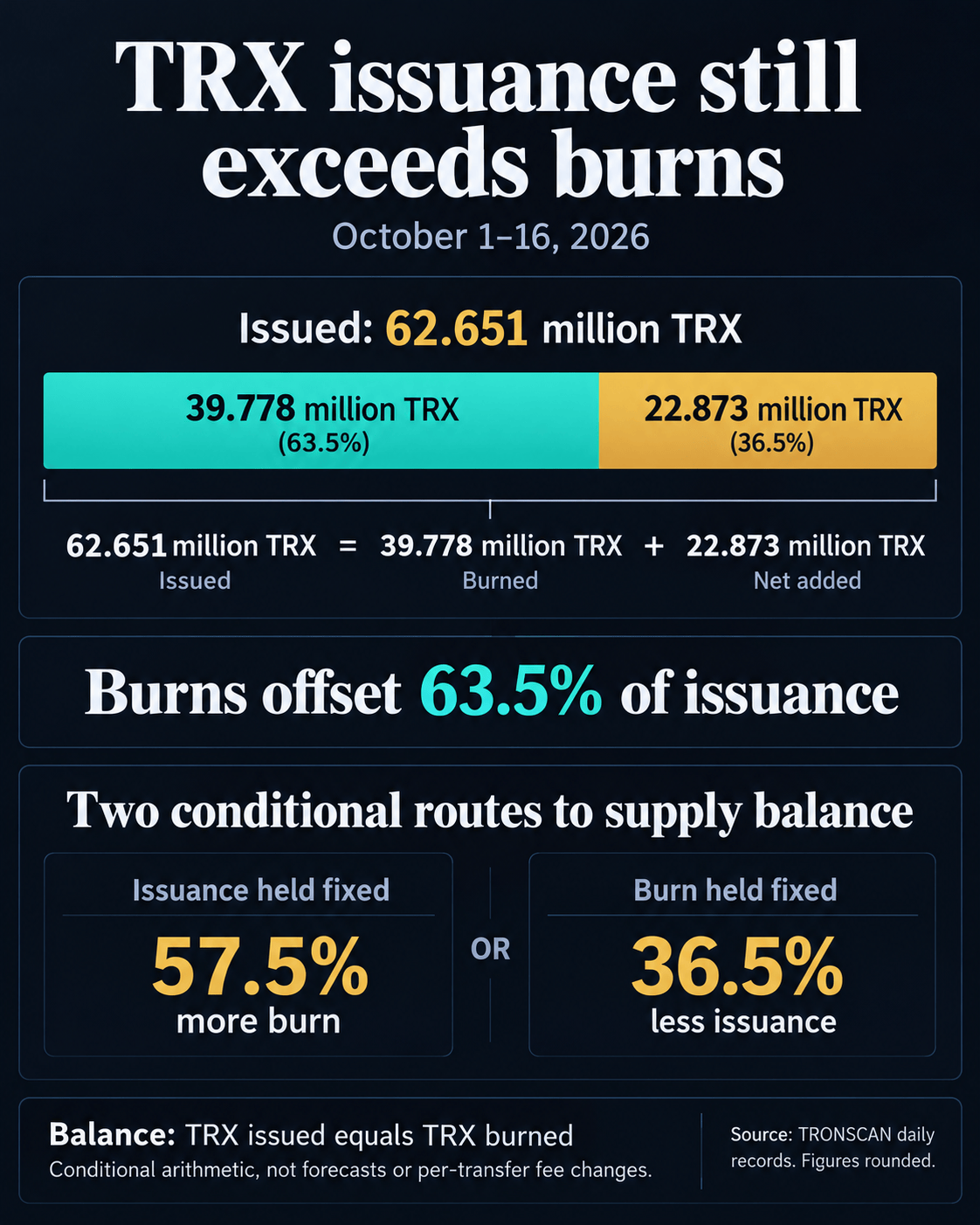

To achieve equilibrium with unchanged issuance levels, burns would need to rise from 39.78 million to 62.65 million—a 57.5% jump. Alternatively, reducing issuance by 36.5%, assuming constant burn rates, would also bridge the gap. These figures reflect distinct baseline calculations applied to the same dataset.
Reaching balanced supply wouldn’t eliminate ongoing issuance or burning cycles but would align inflows and outflows precisely. Achieving deflationary pressure requires sustained burn rates exceeding gross issuance over time.
Adjusting either axis carries implications. Increasing burn intensity amplifies costs borne by transacting parties reliant on TRX for fee settlements. Reducing issuance lowers overall reward payouts, potentially influencing validator behavior and voter incentives.
For passive holders maintaining unchanged balances, expanding net supply dilutes individual share proportions slightly. With Q3 contributing approximately 0.133% to total supply, the immediate impact remains modest. Active participants—such as stakers earning rewards or users consuming resources—experience more pronounced effects aligned with their respective roles.


