






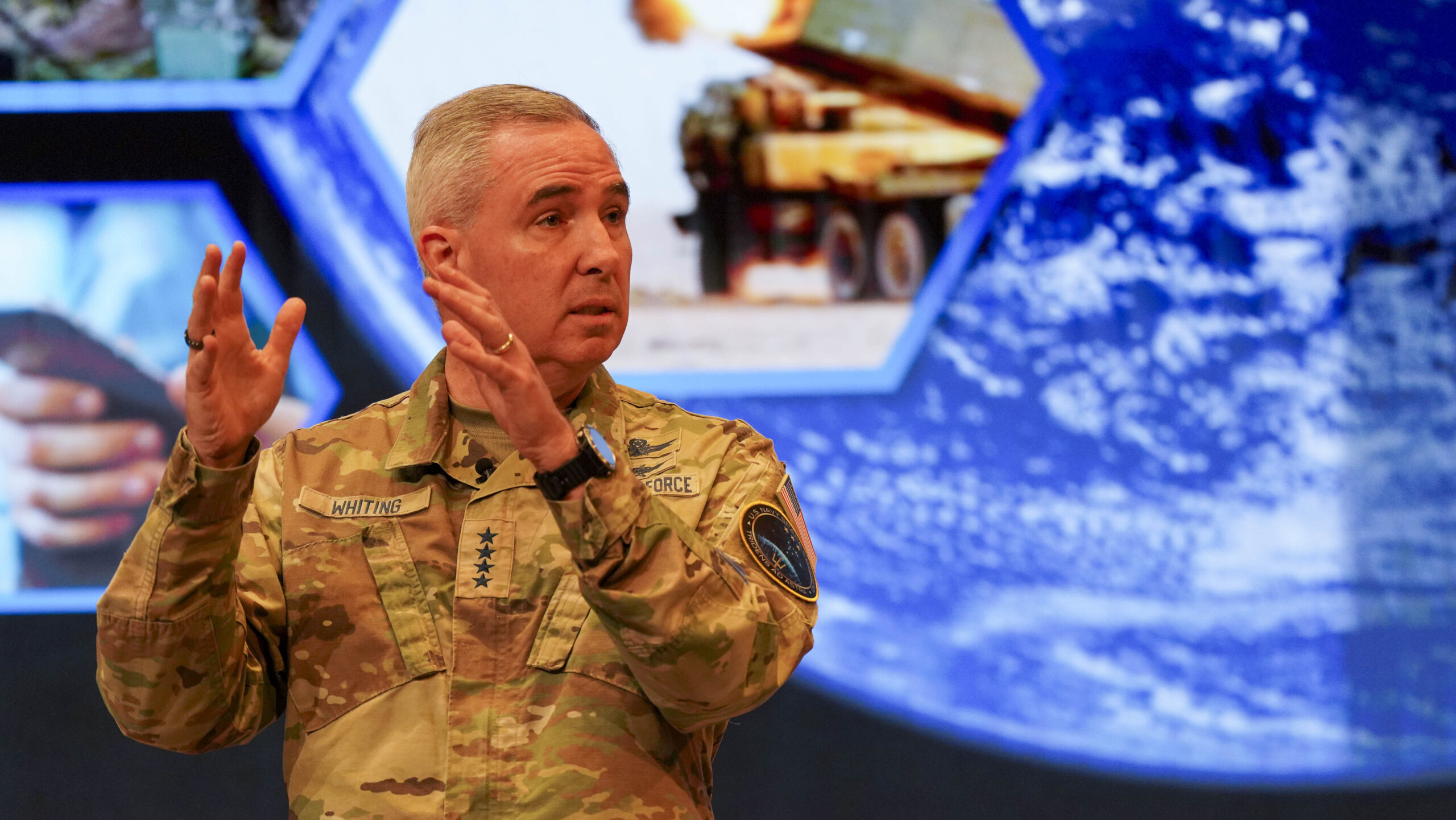
HUNTSVILLE, Ala. — Gen. Stephen Whiting, commander of U.S. Space Command (SPACECOM), stated on Tuesday that, alongside non‑kinetic systems like jammers, the joint force must also possess the ability to conduct destructive attacks against adversary space assets to prevail in future space conflicts.
Whiting made these remarks at the annual Army Space and Missile Defense Symposium, noting that SPACECOM’s top priorities for fiscal years 2029‑2033 are “integrated space fires” and the development of capabilities to counter extensive low‑Earth‑orbit satellite constellations, essential for achieving space superiority.
“As a combatant command, our objective is to win wars. Achieving victory requires credible, both kinetic and non‑kinetic fires, which are fundamental to establishing space superiority and restoring credible deterrence,” he asserted.
Whiting did not disclose specific weapon systems intended for such attacks, nor did he define the term “space fires,” a concept that also headed his 2027 priority list.
In principle, space fires could involve attacks on satellites, ground infrastructure, or communication links. Nevertheless, the Trump administration continues to uphold the U.S. moratorium on destructive anti‑satellite (ASAT) missile testing, a policy instituted by the Biden administration in 2022 and now embraced by nearly 40 nations. State Department officials highlighted this stance during the July 6‑10 session of the United Nations Open‑Ended Working Group on the Prevention of an Arms Race in Outer Space in Geneva.
Whiting’s deputy, Lt. Gen. Rick Zellman, addressed the symposium on Tuesday, revealing that the U.S. military has obtained policy approval for three categories of space fires: ground‑to‑space operations — such as communications jamming systems that have been employed for years; space‑to‑space engagements, referred to as “orbital warfare”; and, considering the Trump administration’s plan to develop space‑based interceptors for the Golden Dome missile defense system, space‑to‑ground capabilities.
He explained that these capabilities are not limited to the Space Force but also involve other services, notably the Army and Marine Corps.
“They also possess some of these capabilities to engage from the ground to space. We have effectively outsourced and decentralized these functions so that other combatant commands can manage them, aligning with their operational timing and tempo,” Zellman noted.
“However, the remaining two categories — orbital warfare and space‑to‑ground operations — will continue to fall under the jurisdiction of Space Command,” he added.
Beyond space fires and countering satellite constellations, Whiting today outlined the remaining three capabilities that constitute the top five items on SPACECOM’s FY29‑33 Integrated Priorities List.
“The third priority is a joint, integrated space command and control architecture. We must improve machine‑to‑machine connectivity to enable rapid decision‑making and battle management of global space operations on tactically relevant timescales,” he said.
Subsequently, Whiting called for dedicated space domain awareness to support both space fires and protective measures, urging the adoption of a “target‑quality tracking mindset” across all space activities, akin to practices long established in missile defense communities.
Finally, he reaffirmed his long‑standing call for new capabilities in “sustained space maneuvering,” enabling satellites to move rapidly and frequently to evade adversary attacks and to secure a positional advantage over opponents.
Also Read
- Large Bitcoin Holder Transfers $122 Million Hours Before Federal Reserve Rate Decision
- Federal Reserve Raises Interest Rates, Signals Potential Additional Hike This Year
- Federal Reserve Ends Extended Rate Pause with Unanimous Hike
- Robinhood Shares Plunge 5% as Two Staffers Face Crypto Insider Trading Charges


