







The British pound maintains strength driven primarily by sustained weakness in the US dollar along with persistent market expectations for tighter monetary policy from the Bank of England.
The Bank of England adheres to a prudent hawkish approach. Financial markets indicate considerable room for further rate increases aimed at curbing inflation, yet BoE Chief Economist Huw Pill has raised doubts regarding the magnitude of necessary tightening compared to estimates anticipated by certain market participants.
The International Monetary Fund projects UK GDP growth of approximately 1.3% for 2026, while warning that elevated energy costs and mounting borrowing expenses may restrain economic performance.
The fiscal announcements scheduled for 28 October could inject additional turbulence into the pound, particularly should governmental initiatives exacerbate apprehensions regarding state debt levels.
Technical Analysis
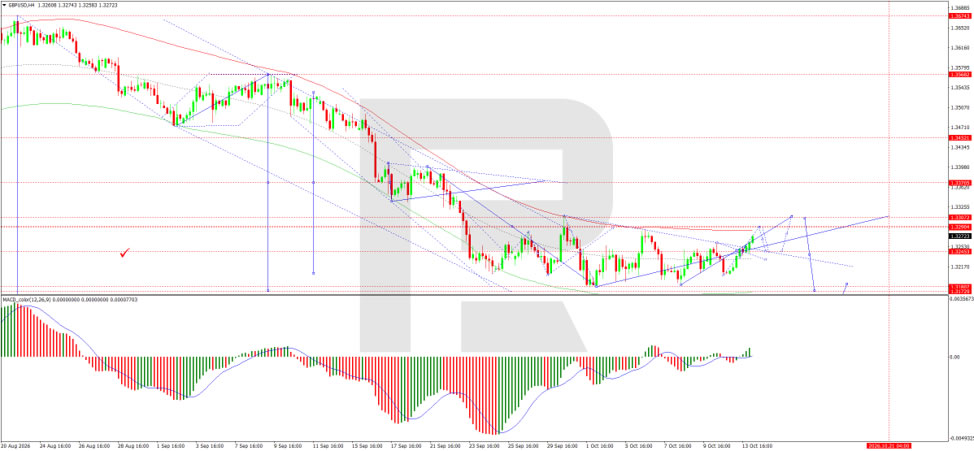

On the H4 timeframe, the GBP/USD pairing exhibits a corrective upward trajectory within the dominant downward trend. Today’s session suggests movement toward a target of 1.3290, followed by a potential dip toward support at 1.3242. A subsequent rebound toward resistance at 1.3307 appears plausible, completing the corrective structure. A rejection at this level could pave the way for another downward surge heading toward 1.3232.
Should this failure materialize, the price might descend towards 1.3181 and 1.3173 as part of the primary downtrend continuation.
The MACD indicator validates the present upward momentum, with the signal line hovering near zero while displaying an upward vector, confirming short‑term bullish conviction despite the prevailing bearish overall structure.
Technical Details on H1 Chart
Having finished a local consolidation zone centered around 1.3242, GBP/USD continues building an upward swing.
During today’s trading session, the pair anticipates reaching resistance at 1.3290 before pulling back toward 1.3242.
After the correction concludes, a secondary thrust toward 1.3307 becomes viable.
Subsequently, if a reversal formation emerges, the currency aims for a retreat toward 1.3232.
The Stochastic oscillator corroborates this outlook, with signal bands positioned in overbought territory—above eighty—which hints that the recent gain may be waning. Conversely, a downward crossover in the oscillator would reinforce the notion of an incoming corrective downturn. The essential trigger for the bearish thesis remains a close beneath the 1.3242 support line, followed by a further descent.
Conclusion
The British pound’s recent advances face substantial headwinds as the weakening US dollar and expectations of further BoE tightening offer only transient backing.
While the Bank of England pursues a cautious hawkish path, Chief Economist Huw Pill’s reservations about the required scale of rate hikes introduce significant uncertainty.
The IMF’s caution regarding escalating energy prices and borrowing obligations, combined with the looming October 28 budget release, amplifies market apprehension.
Key catalyst lies ahead: US inflation outcomes.
Potentially robust versus projections could transfer preferred advantage back toward the greenback, whereas unresolved UK fiscal concerns continue constraining the ceiling on sterling’s potential gains.
Methodologically, the pair remains embedded in a corrective pattern amid a wider bearish environment, with pivotal resistance zones set between 1.3290 and 1.3307 and vital support anchored at 1.3242.
A breach underneath this safeguard would validate the bearish narrative, eyeing targets of 1.3232, 1.3181 and 1.3173 respectively.
The overbought position of the Stochastic indeed signifies that the preceding corrective bounce may be approaching completion.


