






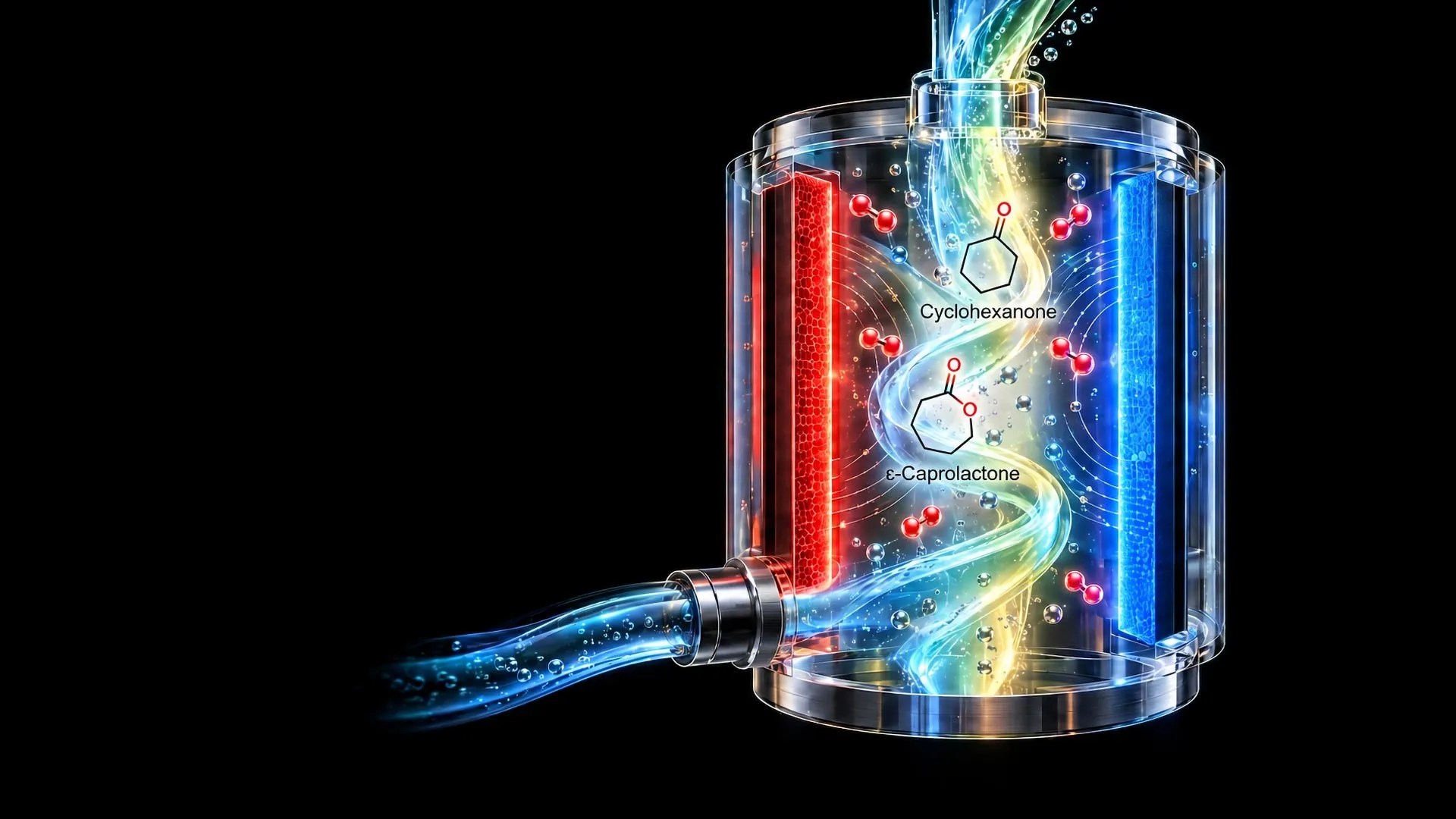
Researchers have uncovered a previously overlooked factor that can dictate the success or failure of chemical reactions. By meticulously managing microscopic fluctuations in acidity in the immediate vicinity of electrodes, scientists have dramatically enhanced the production of valuable chemical compounds, boosting the yield of the desired product from a mere 16% to an impressive 97%.
This breakthrough, spearheaded by Professor Jaeyune Ryu of the Department of Chemical and Biological Engineering at Seoul National University College of Engineering, paves the way for safer, cleaner, and more efficient chemical manufacturing. The team developed an innovative method utilizing oxygen and electricity to synthesize essential compounds found in plastics, medicines, adhesives, and everyday materials, eliminating the need for separate peroxide oxidants.
At the heart of their discovery lies “local pH,” a surprisingly neglected factor representing the acidity or alkalinity in the immediate vicinity of an electrode. By redesigning a chemical reactor to precisely control electrode spacing and liquid flow dynamics, the team successfully managed these localized conditions, dramatically enhancing overall reaction performance.
The research focused on two highly valuable families of chemicals: lactones and epoxides. Lactones serve as critical building blocks for biodegradable plastics and polyurethanes, whereas epoxides are essential for manufacturing adhesives, protective coatings, and epoxy resins used in electronics. Both compound classes also play vital roles in pharmaceutical and specialized chemical synthesis.
These findings were published in the Journal of the American Chemical Society (JACS), a premier chemistry journal of the American Chemical Society (ACS).
The Hidden Chemistry That Can Make or Break a Reaction
The research builds on a technique known as organic electrosynthesis, which uses electrical energy to drive reactions that produce carbon-based chemical compounds. This approach has attracted growing interest because it may reduce the need for some of the chemical oxidizing and reducing agents commonly used in traditional manufacturing. Such agents help reactions proceed by accepting or donating electrons, but some can be hazardous to handle and generate unwanted waste.
Until now, much of the effort to improve organic electrosynthesis has centered on familiar factors, including the electrical voltage, the materials used for electrodes, and the composition of the liquid in which reactions occur. However, the researchers suspected that something important was being overlooked: the microscopic chemical environment directly next to each electrode, where molecules exchange electrons and undergo chemical transformations. Although the surrounding solution may appear uniform, conditions within this tiny region can be dramatically different.
One particularly important factor is pH, a measure of how acidic or alkaline a substance is. During an electrochemical reaction, hydrogen ions, also known as protons, can be produced or consumed at the electrodes. If these ions are generated or removed faster than they can move through the liquid, the pH near the electrode may become very different from the pH measured in the rest of the solution. These local differences can influence several critical parts of a reaction, changing how reactive oxygen species are produced, altering the behavior of starting molecules, and even affecting whether finished products remain stable or begin to break down. In other words, a reaction can fail even when the overall solution appears to have the right chemical conditions.
An Overlooked Problem May Affect Many Chemical Reactions
To determine whether this phenomenon might extend beyond their own experiments, the researchers examined more than 600 scientific papers on organic electrosynthesis published since 2010. They found that approximately 89% of the studies involved reactions at one or more electrodes in which both electrons and protons were transferred. This matters because the movement of protons can change local acidity, suggesting that overlooked pH differences near electrodes could influence a wide range of electrochemical reactions, rather than just a few specialized examples.
The team also measured how extreme these differences could become. Even when the overall solution was essentially neutral, the researchers estimated that conditions near the cathode, the electrode where reduction occurs, could reach approximately pH 11, making the area strongly alkaline. Meanwhile, the region around the anode, where oxidation takes place, could reach approximately pH 2.5, creating a strongly acidic environment. Under such conditions, reactive oxygen species needed to drive a reaction may become less available, starting materials can change chemical form, and newly formed products may break down more rapidly. Simply adjusting the acidity of the entire solution therefore may not solve the problem; what matters is the environment directly around the electrodes, where the chemistry actually happens.
Making Valuable Chemicals With Oxygen and Electricity
To demonstrate their discovery, the scientists investigated a well-established chemical process called Baeyer-Villiger oxidation, which adds an oxygen atom to a type of organic molecule known as a ketone, converting it into an ester or lactone. Traditionally, this reaction often requires highly reactive oxidizing chemicals, including peroxyacids, which can create difficulties involving safe handling, chemical waste, and the treatment of unwanted byproducts. The Seoul National University team developed a different approach by using electricity to activate oxygen gas at an electrode, producing reactive oxygen species capable of transferring oxygen atoms into organic molecules. Isotope-tracing experiments confirmed that the incorporated oxygen originated from oxygen gas rather than water. Furthermore, the scientists discovered that the two electrodes could work together in an important way: at the cathode, oxygen reduction generates reactive oxygen species that initiate the oxygen-transfer reaction, and hydrogen peroxide formed during this process can then be converted back into reactive oxygen species at the anode, helping sustain the supply of reactive chemical species necessary for the reaction. However, the entire process depends heavily on the acidity near the electrodes; if local pH becomes too extreme, the chemistry can become much less effective.
A Simple Reactor Redesign Boosts Selectivity From 16% to 97%
Once the researchers understood the importance of local pH, they investigated how to control it. Using computer simulations and electrochemical measurements, they developed a reactor design that places the electrodes closer together while allowing the electrolyte to flow between them, preventing extreme acidity differences from developing. Because the area near the anode tends to become acidic while the area near the cathode becomes alkaline, bringing these regions closer together and circulating the liquid helps counterbalance their effects. The results were striking: under conditions where local pH differences were not effectively controlled, approximately 16% of the relevant products formed were the desired target compound, but with the improved reactor design, that selectivity rose to approximately 97%. This increase in selectivity means the reaction became much better at producing the intended substance rather than unwanted products.
The researchers also discovered that changing the flow of the electrolyte had a powerful effect on production, with the amount of product generated per unit time increasing by approximately 14 times from the lowest to the highest flow rate tested. Moving the electrodes closer together also made a difference; when the distance between them was reduced from 20 mm to 4 mm, the production rate increased by approximately 2.2 times. Perhaps most revealing was what happened when the liquid was not allowed to flow: even though the applied voltage and the solution’s composition remained unchanged, the researchers obtained almost none of the desired product, showing just how important the immediate chemical environment can be. The success of an electrochemical reaction depends on more than the ingredients, voltage, and electrode materials; the physical design of the reactor and the microscopic conditions it creates can be equally critical.
Applications for Biodegradable Plastics, Medicines, and Electronics
The researchers then explored whether their approach could be used to manufacture different kinds of useful chemicals. Using their optimized conditions, they successfully synthesized lactones from 18 different ketone compounds, including ε-caprolactone, which they produced with an 82% yield. This compound is a starting material for polycaprolactone, a biodegradable polymer used in medical applications such as surgical sutures and drug-delivery systems. The researchers also applied their local pH control strategy to the production of epoxides, successfully obtaining products from six different alkene starting materials. Epoxides are important ingredients in adhesives, surface coatings, and epoxy resins used in electronics, as well as valuable intermediates in the production of pharmaceuticals and fine chemicals. Together, these experiments showed that controlling the microscopic environment around electrodes could have applications beyond a single reaction, suggesting a potentially versatile way to improve the production of many commercially important chemical ingredients.
Toward Cleaner and More Sustainable Chemical Manufacturing
One of the most promising aspects of the technique is that it uses oxygen and electricity while reducing the need for externally added peroxide oxidants. The reactions also take place at room temperature and normal atmospheric pressure, avoiding the need for separate equipment to heat or pressurize the system. These characteristics could make certain chemical processes simpler and potentially safer. Because electricity provides the energy needed to drive the reactions, the approach could eventually be combined with renewable energy sources to support more sustainable chemical manufacturing. The researchers believe that pharmaceutical ingredients and other high-value specialty chemicals could be particularly promising applications, as electrochemical methods may offer advantages by limiting the need to handle hazardous oxidizing agents and potentially allowing production in relatively compact equipment. However, the technology is not yet ready for widespread industrial use, and further optimization and testing at larger production scales will be needed to determine whether the laboratory results can be reproduced economically and reliably in commercial manufacturing.
A New Way to Think About Chemical Reactions
Beyond its immediate applications, the discovery offers a different perspective on how electrochemical reactions should be designed. Traditionally, researchers have concentrated on choosing the right starting materials, catalysts, electrode surfaces, voltages, and solution compositions. The Seoul National University team’s findings indicate that controlling the tiny environment where molecules actually react may be just as important, shifting attention toward “designing the environment in which molecules actually react.” Professor Jaeyune Ryu, who supervised the research, stated, “This study transforms ‘local pH’ near the electrode from a hidden variable into a controllable design principle. To improve the efficiency of organic electrosynthesis, we need to design not only the reaction substrates and catalysts, but also the environment in which the molecules actually react.” Rather than treating local acidity as an unavoidable side effect, future chemical reactors could be deliberately engineered to maintain conditions that favor the desired reactions, potentially revealing opportunities to improve other electrochemical processes, particularly those involving the movement of both electrons and protons.
The study’s co-first authors were Seonghyeon Min and Junghoon Lee, both M.S. students in Seoul National University’s Department of Chemical and Biological Engineering. Hanju Kim, an integrated M.S./Ph.D. student, participated as a co-author, with Professor Ryu overseeing the research. Min and Lee plan to continue investigating how local reaction environments influence organic electrosynthesis, with the goal of extending the approach to a broader range of chemical reactions and manufacturing processes. The research was supported by Seoul National University, the National Research Foundation of Korea, and the Institute for Basic Science (IBS).
Also Read
- Microsoft President Says AI Regulation Falls Short of Everyday Consumer Safeguards
- Raspberry Pi Desktop Update Aligns with Debian 13 After Four-Year Gap
- “History Could Have Been Very Different”: New Research Narrows Estimate of Indigenous Population in the Americas at Columbus’s Arrival
- NYT Connections Sports Edition: Hints and Answers for October 12 Puzzle #749


