




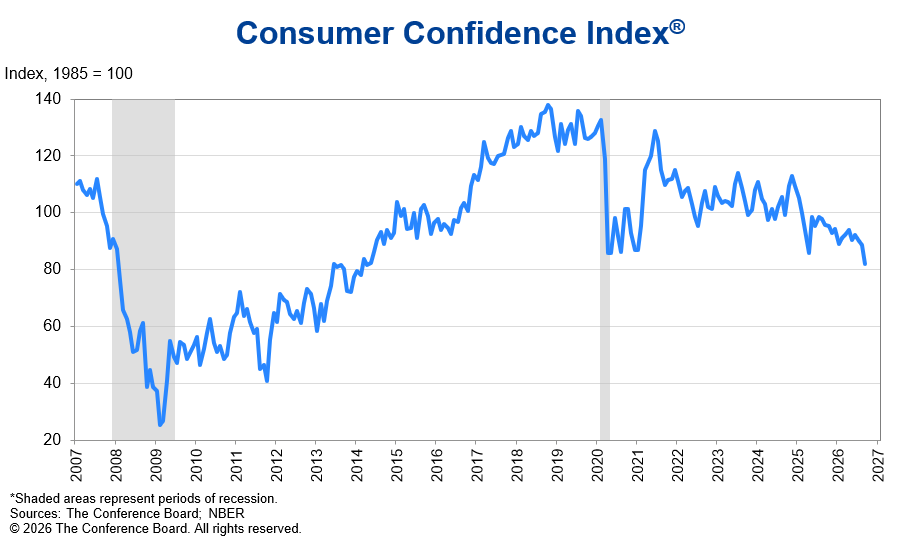
US consumer confidence declined significantly in September, with The Conference Board’s Consumer Confidence Index dropping from 88.6 to 81.9. The decline was widespread. The Present Situation Index fell from 117.2 to 109.3, while the Expectations Index slid from 69.5 to 63.6, marking its third consecutive monthly decrease. Current business condition assessments turned negative overall for the first time since September 2024, and consumers grew more pessimistic about business conditions and household income prospects over the next six months. The survey captured responses collected between September 1–23.
The labor market showed notable weakness. The proportion of consumers reporting jobs were plentiful declined from 24.5% to 23.6%, while those finding jobs hard to get rose from 20.3% to 21.9%, compressing the labor-market differential from 4.2% to 1.7%. Expectations also worsened: the share anticipating more jobs decreased from 14.8% to 14.0%, while those expecting fewer jobs increased from 26.1% to 28.4%. Income expectations softened as well, with consumers anticipating higher income falling from 19.0% to 17.9% and those expecting declines rising from 13.5% to 15.4%.
However, the weaker confidence and labor data coincided with elevated inflation concerns rather than easing price pressure. Average 12-month inflation expectations climbed from 5.8% to 6.1%, while median expectations rose from 4.8% to 5.1%. The share expecting higher interest rates over the next year also surged to 68.4%. Consumers increasingly pointed to prices, the high cost of goods and services, and oil and gasoline costs as worries, leaving the survey with a troubling mix of softer growth and labor sentiment alongside firmer inflation expectations.
Data Summary
| Indicator | Previous | Current |
|---|---|---|
| Consumer Confidence Index | 88.6 | 81.9 |
| Present Situation Index | 117.2 | 109.3 |
| Expectations Index | 69.5 | 63.6 |
| Jobs “plentiful” | 24.5% | 23.6% |
| Jobs “hard to get” | 20.3% | 21.9% |
| Labor-market differential | 4.2% | 1.7% |
| Average 12-month inflation expectations | 5.8% | 6.1% |
| Median 12-month inflation expectations | 4.8% | 5.1% |
The September survey was conducted for The Conference Board, with the preliminary-results cutoff on September 23.
Key Takeaways
- Consumer confidence deteriorated sharply, with the headline index falling from 88.6 to 81.9 as both current conditions and expectations weakened.
- The Expectations Index fell for a third consecutive month, while the Present Situation Index also posted a sizable decline.
- Labor-market perceptions weakened materially. The gap between consumers saying jobs were plentiful and those saying jobs were hard to get narrowed from 4.2% to just 1.7%.
- Forward-looking employment views softened too, with fewer consumers expecting more jobs and more expecting employment opportunities to decline.
- The weaker growth and labor signals were accompanied by higher inflation expectations, with average 12-month expectations rising from 5.8% to 6.1% and median expectations from 4.8% to 5.1%.
- That combination makes the release less cleanly dovish than the confidence headline suggests: households are becoming more pessimistic about activity and jobs while simultaneously worrying more about inflation.
- For the broader US outlook, the release adds another soft labor-market signal ahead of payrolls, but rising inflation expectations keep the growth-versus-inflation tension unresolved.
Also Read
- XRP Uniquely Positioned to Capitalize on SWIFT’s ISO 20022 Migration
- U.S. CFTC Moves to Redefine Event Contracts, Challenging State Gambling Allegations
- Aave (AAVE) Price Forecast: Token Slips Below $161 as Market Evaluates Rally Sustainability
- Bitcoin’s Options Market Signals Emerging Bullish Trend