




In 2010, researchers from Purdue University and the University of New South Wales launched a study to determine the maximum temperature threshold for human survival. Their calculations revealed this limit to be 95 degrees Fahrenheit (35 degrees Celsius) at 100% humidity—a “wet bulb” temperature marking the absolute survivability limit for the human body.
Beyond this temperature, a cascade of irreversible physiological reactions is triggered, leading to organ shock, blood clotting, and ultimately, death.
With global temperatures rising and heatwaves becoming more frequent, numerous regions worldwide are approaching this critical limit. Climate models project that the first 35 C wet bulb temperatures could be reached by mid-century.
However, temperatures do not need to reach these extremes to become unlivable for large segments of the population. This threshold is significantly lower for the elderly, women, and individuals with specific medical conditions. Additionally, engaging in physical activity elevates the risk of heat stress.
Recent research indicates that in certain areas of Asia, South America, and Australia, the hottest days have already become “unlivable,” meaning even a healthy adult resting in the shade with a light breeze could be at risk of heat-related illness.
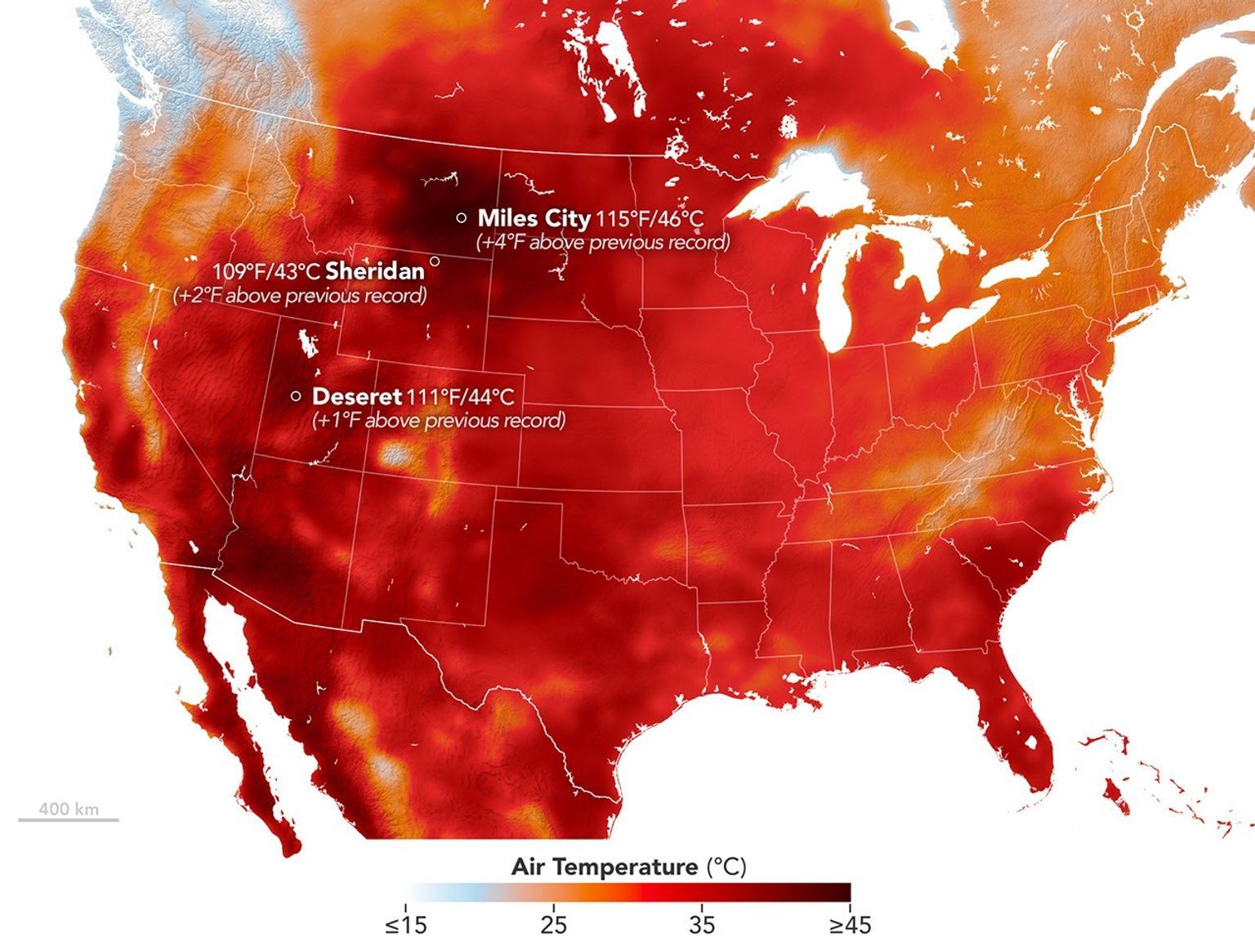
A heat dome hit the western U.S. on July 12, 2026, air temperature data from the GEOS (Goddard Earth Observing System) revealed. Numerous weather stations in Utah, Montana and Wyoming recorded their highest temperatures since record-keeping began. Such heat waves will become more common as the climate warms.
(Image credit: NASA Earth Observatory/Michala Garrison)
The same study noted that in North America, extreme heat days in parts of the Southwest and Southeast present a similar threat. Furthermore, more intense heat is on the horizon: under projected warming scenarios, the U.S. could see tens of thousands of additional heat-related deaths by the year 2100.
By the middle of the century, extreme heat could claim the lives of nearly 20,000 people annually in the United States. Additionally, the U.S. and Mexico could experience an extra 9,000 suicides each year.
While heat can cause immediate fatalities through heat stroke, it also exacerbates preexisting cardiovascular conditions, transforming manageable chronic heart issues into fatal ones. Marina Romanello, a senior research fellow at University College London’s Institute for Global Health who monitors climate impacts on health, notes that heatwaves frequently coincide with droughts or other extreme weather events, potentially leading to food and water shortages or price spikes. In this regard, climate change acts as a stress multiplier.
Moreover, elevated temperatures can degrade health in more subtle ways, leading to restless nights and impaired cognitive function.
“No single metric truly captures the comprehensive threat to health and well-being when these multiple stressors are amplified and compound one another,” she explained to Live Science.
Heat wave deaths
Heat stroke represents the most immediate cause of heat-related death, occurring when core body temperature exceeds 104 F (40 C) and fails to cool down. Over the past few decades, dangerous heatwaves and associated fatalities have already increased. Research indicates that in 2023, heat was listed as the primary cause or a major underlying factor on 2,325 U.S. death certificates, a significant rise from 1,069 in 1999. When adjusted for population age, this reflects a 63% increase in heat-related mortality.
However, scientists believe the actual death toll from heat is much higher. Heat is frequently omitted from official death records as a contributing factor, even when it may have aggravated an underlying health condition.
Individuals with cardiovascular issues are particularly vulnerable to heat, with the risk of heart attacks more than doubling on extreme heat days. The likelihood of stroke also nearly doubles during the hottest periods. Preliminary evidence suggests that heat’s effect on the immune system may contribute to these cardiovascular incidents. Projections indicate that extreme heat-related deaths from all causes will more than double by mid-century in the U.S., potentially reaching up to 20,000 fatalities if temperatures rise by 8.1 degrees F (4.5 degrees C).

A woman in Manhattan wipes away sweat during a July 2026 heat wave.
(Image credit: Angela Weiss/Getty Images)
Furthermore, the incidence of hyponatremia, or low blood sodium levels—which can lead to seizures and coma—is expected to rise as climate change progresses.
The populations most at risk include older adults, children, adolescents, and outdoor workers. As people age, their heart pumps less efficiently, making it harder for older individuals to circulate blood to the skin for cooling. Due to differences in fat composition and a lower ratio of skin surface area, children generate more heat than adults and sweat less, increasing their susceptibility to heat stroke. Outdoor workers frequently exert themselves during hot days and may find it difficult to consume enough fluids to counterbalance the extreme heat.
Individuals with specific medical conditions also face a high level of risk. Diabetes can impair sweating and the dilation of blood vessels that facilitate cooling in hot weather, increasing susceptibility to heat stroke. Certain medications, such as diuretics commonly used for heart disease, beta-blockers for cardiac conditions, and selective serotonin reuptake inhibitors (SSRIs) for mood disorders, also elevate the risk of heat-related illnesses because their side effects hinder the body’s natural cooling mechanisms.
Mental illness itself serves as a risk factor. Elevated temperatures have been correlated with an increase in suicides, with a 0.7% rise in U.S. suicides for every 1.8 F (1 degree C) increase in monthly average temperature. If temperatures were to rise by more than 5 degrees C (9 degrees F), this could result in 9,000 to 40,000 additional suicides in the U.S. and Mexico by 2050, researchers noted—an increase comparable to the suicide rate spike expected during a severe economic recession. Fortunately, such a drastic temperature rise is now deemed unlikely due to the global transition away from coal as an energy source.
The precise mechanism through which hotter days contribute to higher suicide rates remains unclear, though one theory suggests that the discomfort of feeling hot may exacerbate the impulsivity that drives such behavior.
Kim Meidenbauer, a neuroscientist at Washington State University who researches the impact of heat on emotion and behavior, has found that impulsivity also increases among individuals who struggle to keep their homes comfortably cool.
The impact may be most severe for those with preexisting mental health conditions, ranging from schizophrenia to anxiety. Research has shown that mental-health-related emergency department visits increase alongside rising temperatures.
Perhaps the most widespread way heat undermines health in the U.S. is through sleep disruption. Elevated temperatures reduce both the quality and quantity of sleep. A large-scale sleep-tracking study revealed that for every 1-degree Celsius increase in nighttime temperature, there is a loss of three good nights of sleep per month for every 100 individuals.
Meidenbauer suggests that these sleep disruptions could be the primary reason heat has a detrimental effect on mood and mental health, even for individuals without preexisting conditions.
“We observe a decline in emotional state,” she told Live Science. “We see a rise in impulsivity.” Sleep-deprived individuals find it more difficult to maintain emotional stability, which may account for both the increase in emergency room visits and the elevated risk of suicide.
“Regulating emotions is significantly more challenging when sleep quality is poor,” Meidenbauer explained to Live Science.
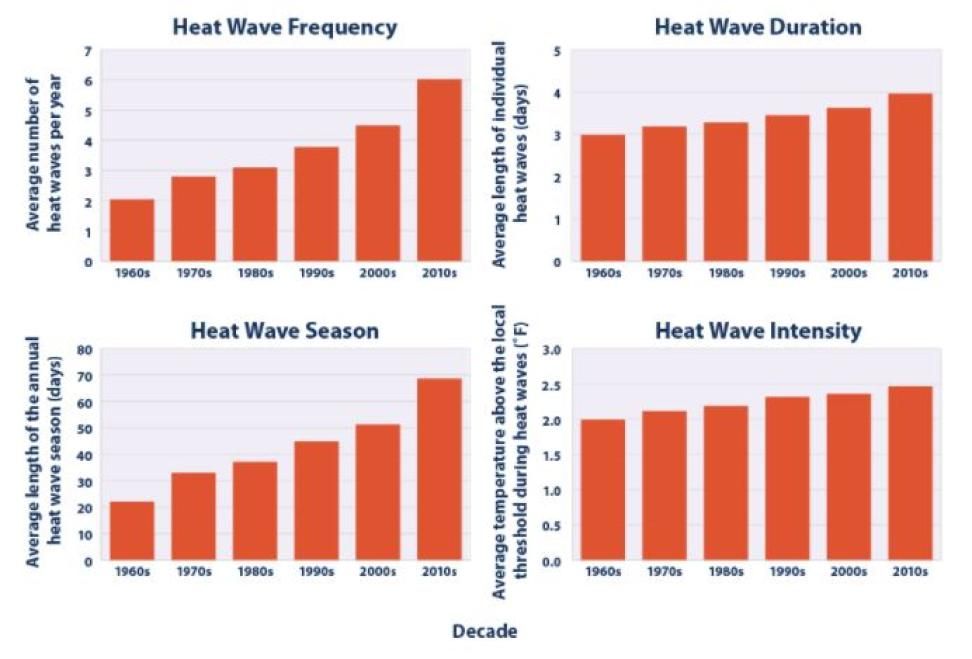
Heat waves have been increasing in frequency, intensity and length since the 1960s, and the seasons in which they occur have lengthened as well.
(Image credit: Socioeconomic Data and Applications Center (SEDAC))
Daily health in a hotter world
Heat also impacts cognitive function in other ways. A study conducted in China, which administered math and verbal reasoning tests to 50,000 individuals, discovered that people struggle to think clearly once temperatures reach 89.6 F (32 C).
The number of days in the U.S. with a heat index exceeding 100 F (37.8 C) is anticipated to double within the next decade, while days with a heat index over 105 F (40 C) are expected to triple. The heat index combines air temperature and relative humidity to reflect how hot it actually feels. As humidity rises, it becomes increasingly difficult for the body to cool down through sweating.
Although nearly 90% of U.S. households have air conditioning, Americans are not entirely immune to heatwaves. The 2024 study in China demonstrated that even brief exposure to extreme heat—as little as an hour over a couple of days—can result in slight declines in math and verbal test scores, suggesting a degree of cognitive sluggishness during hot weather.

The effects of heat can be exacerbated by outdoor exercise.
(Image credit: FG Trade via Getty Images)
Rising temperatures may drive individuals indoors, potentially deteriorating both physical and mental health. Engaging in outdoor exercise may offer mental health benefits that surpass those of indoor workouts. While data is somewhat constrained by research methodologies that may lack rigor, the loss of outdoor exercise opportunities could lead to a decline in physical fitness, even if people transition to indoor routines. For instance, a 2020 study found that cancer survivors who were randomly assigned to indoor and outdoor exercise exerted more effort when active outside. Similarly, a 2019 study revealed that teenage boys with obesity who participated in outdoor playful exercise lost more weight and experienced greater increases in a molecule that regulates appetite and wakefulness compared to those using a treadmill indoors. Furthermore, people reported greater satisfaction with outdoor exercise, which could influence their long-term commitment to fitness.
Excessively hot days could also restrict children’s sports, which are frequently played outdoors. In Japan, summer youth sports across much of the country may need to be limited for one to four months annually, even under lower-warming scenarios; similar challenges could emerge in much of the U.S., which shares a similar latitude with Japan.
Overall, research indicates a U-shaped relationship between obesity and temperature, with higher body mass index (BMI) observed in both the coldest and hottest regions. A study conducted in Australia found that regular exposure to temperatures above 86 degrees F (30 degrees C) was linked to increases in BMI and obesity.
Adapting to extreme heat
Humans can adapt to warmer temperatures over weeks or months through physiological adjustments, such as more efficient sweat glands and increased water retention. The cognitive study conducted in China found that individuals living in generally warmer climates were more resilient to declining test scores during elevated temperatures, potentially indicating that these physiological changes yield practical benefits.
However, extreme heat and short-term temperature spikes often outpace the human body’s capacity to adapt, as evidenced by the rise in heat-related deaths recorded between 1999 and 2023. Similarly, children are already bearing the brunt, particularly in the South where temperatures are highest. A study of two major hospitals in Texas revealed a 170% surge in pediatric emergency department visits for heat-related illness between 2012 and 2023.
Marshall Burke, a professor of global environmental policy at Stanford University, noted that determining what effectively mitigates the impacts of extreme heat remains an open question. While cities frequently establish cooling centers during heatwaves—which may save lives—the extent of their effectiveness has not been thoroughly studied, he told Live Science.
In an effort to address this, Burke and his colleagues developed the Environmental Hazard Adaptation Atlas, a website that aggregates data on temperature, heat-related illnesses and fatalities, and potential beneficial adaptations.
“We need solid case studies of effective interventions,” he stated. “We require reliable, systematic evidence.”
Also Read
- Protecting Against AI-Impersonation Scams: Understanding Audio Deepfakes
- The Lifeline of the Voyagers: How NASA Engineers Sustain Humanity’s Furthest Probes
- Ransomware crook poses as recovery firm to steal payments from fellow extortionists
- The best and worst AI for your privacy, ranked – and how each handles your data