









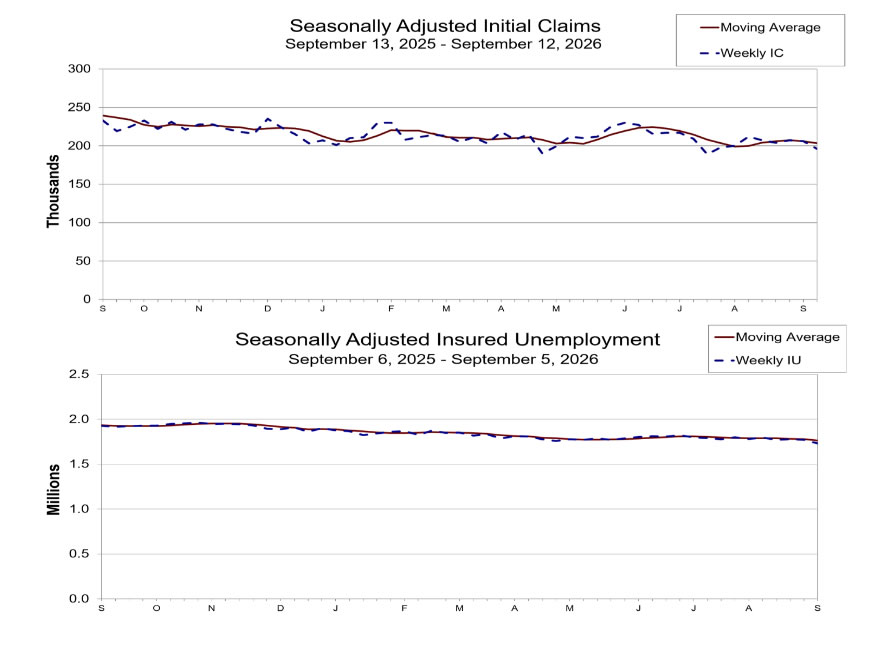
Initial US unemployment claims fell from 206,000 to 196,000 for the week ending September 12, coming well below the 209,000 forecast. The four-week moving average declined from 206,000 to 203,250, showing that the improvement extended beyond a single weekly reading. Unadjusted claims fell 13.9%, outpacing the 9.3% decrease expected from normal seasonal patterns.
Continuing claims also declined sharply, moving from a downwardly revised 1.769 million to 1.730 million for the week ending September 5. The previous estimate was originally reported at 1.774 million. The four-week average for continuing claims eased from 1.778 million to 1.761 million, while the insured unemployment rate declined from 1.2% to 1.1%. Compared with a year earlier, initial claims were down from 233,000 and continuing claims from 1.925 million.
The report indicates limited new layoffs and a shrinking pool of workers receiving unemployment benefits. Weekly figures can fluctuate, but the synchronized improvement in initial claims, continuing claims and their moving averages points to continued labor-market resilience. Released one day after the Federal Reserve raised interest rates, the data provide little employment-based justification for pausing further tightening while inflation remains elevated.

Data summary
Headline data
| Indicator | Actual | Expected | Previous |
|---|---|---|---|
| Initial jobless claims | 196k | 209k | 206k |
Supporting claims data
| Indicator | Current | Previous | Change |
|---|---|---|---|
| Initial claims, four-week average | 203.25k | 206.00k | -2.75k |
| Continuing claims | 1.730m | 1.769m | -39k |
| Continuing claims, four-week average | 1.761m | 1.778m | -16.5k |
| Insured unemployment rate | 1.1% | 1.2% | -0.1pp |
| Unadjusted initial claims | 152.29k | 176.92k | -24.63k |
The previous continuing-claims estimate was revised from 1.774 million to 1.769 million.
Key takeaways
- Initial claims declined from 206,000 to 196,000, beating the 209,000 forecast by 13,000.
- The four-week average fell to 203,250, reinforcing that the improvement was not confined to one volatile weekly figure.
- Continuing claims dropped by 39,000 to 1.730 million, while the insured unemployment rate edged down from 1.2% to 1.1%.
- Unadjusted claims fell 13.9%, ahead of the 9.3% seasonal decline.
- Initial claims were 233,000 and continuing claims 1.925 million in the comparable week a year earlier, showing substantially lower benefit usage.
- The decline in both new and continuing claims signals a resilient labor market and gives the Federal Reserve little employment-related reason to stop tightening after one rate increase.
- While individual weekly readings can be unpredictable, the consistent movement across headline claims, four-week averages and insured unemployment strengthens the overall signal.
Also Read
- Crédit Mutuel Arkéa Resumes Operations After $133 Million Fraud Attack, but Crypto Loss Remains Unconfirmed
- BoJ Minutes Point to Rising Inflation-Overshoot Worries, but Rate Hike Path Remains Contested
- Gold Price Attempts Comeback but Faces Steep Resistance Ahead
- American Bitcoin Corp. Delivers $126M Net Income Powered by $197 Million in Bitcoin Holdings Gains


