







USD/JPY surged to 163.81 on Friday, reaching a fresh 40-year high as the yen’s decline accelerated despite repeated official warnings of potential currency intervention. The advance comes amid broad-based U.S. dollar strength that has overwhelmed attempts by Japanese authorities to support their currency.
Markets largely dismissed comments from Japan’s Finance Minister signaling readiness to take decisive action. Similarly, reports suggesting the Bank of Japan may accelerate its pace of rate hikes beyond current market expectations failed to provide meaningful support for the yen.
Additional downward pressure stems from concerns surrounding Prime Minister Sanae Takaichi’s fiscal agenda and the escalating conflict between the U.S. and Iran. Given Japan’s heavy reliance on energy imports, the economy and trade balance remain acutely sensitive to rising oil prices.
Domestic headline inflation climbed to a six-month high in June, reinforcing expectations for further monetary tightening. Nevertheless, the yen has weakened 0.8% since the start of the week and is poised for its worst weekly performance since May.
Technical Analysis
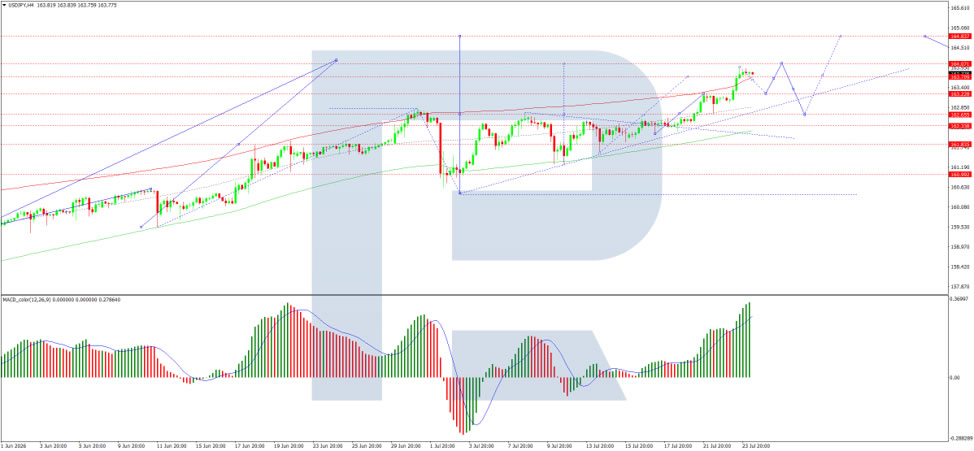

On the H4 chart, USD/JPY is consolidating around the 163.70 level, with the range currently bounded between 163.97 and 163.70. An advance toward 164.27 is expected today, with scope for the move to extend to 164.84. The MACD indicator supports this outlook, with its signal line above zero and trending firmly higher.
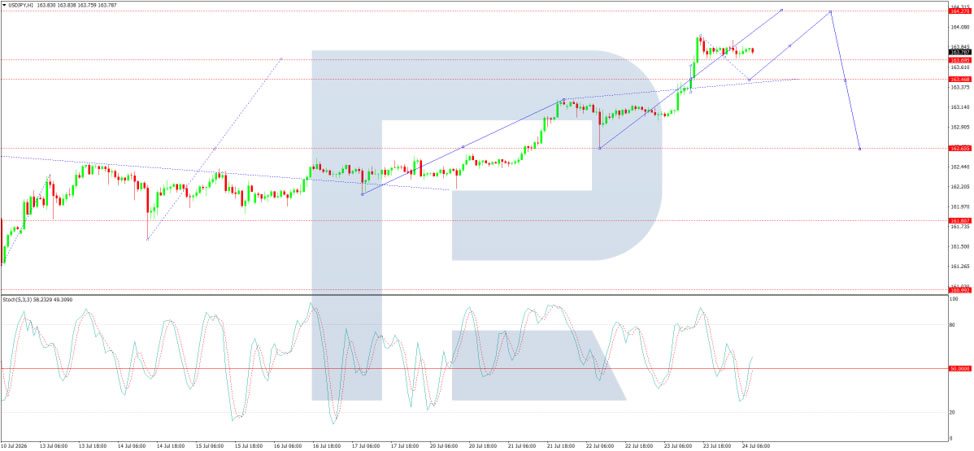
On the H1 timeframe, the pair has completed a pullback to the 163.50 area, with a possible extension toward 163.30. From there, a renewed advance toward at least 164.30 is anticipated. A break above that level would open the path for a continuation toward 164.84. The Stochastic oscillator aligns with this scenario, its signal line below 50 and turning down toward 20, signaling short-term downside pressure before a potential reversal.
Conclusion
USD/JPY has rallied to a fresh 40-year high as the yen remains under sustained pressure from a resilient dollar and persistent fundamental headwinds. Despite official intervention warnings and signals that the Bank of Japan may tolerate a faster pace of rate increases, market participants have remained largely unmoved. The currency continues to contend with fiscal policy uncertainty, escalating Middle East tensions, and Japan’s structural dependence on energy imports. Even as domestic inflation accelerates to a six-month high, the yen is on track for its weakest weekly showing since May. Technically, further upside toward the 164.27–164.84 zone appears probable, with intervention risk remaining a key wildcard.
Also Read
- EU Enacts Broad Sanctions Targeting $120 Billion Russian Crypto Network
- Euro Holds Near 12-Week Peak Versus Yen as Strong Eurozone PMI Counters BoJ Uncertainty
- Winklevoss Twins Donate $10 Million in Bitcoin to Trump‑Aligned Super PAC
- India’s Forex Reserves Reach $676.24B Amid Strategic Reserves Management


