




The Trade
On August 9, 1988, the NHL witnessed a seismic shift when the Edmonton Oilers dealt Wayne Gretzky—alongside defenseman Marty McSorley and forward Mike Krushelnyski—to the Los Angeles Kings in exchange for centre Jimmy Carson, left wing Martin Gélineau, three first‑round draft picks (1989, 1991, 1993) and $15 million in cash.
The 1988-89 season
Gretzky hit the ground running in Los Angeles, finishing his inaugural season with 54 goals—fourth‑best in the league—and a league‑leading 114 assists, a total of 168 points that earned him the Hart Memorial Trophy. His brilliance also lifted Bernie Nicholls, whose offensive surge included career‑high numbers of 70 goals and 150 points.
Teamed with veterans Luc Robitaille and Dave Taylor, Gretzky helped the Kings emerge as a playoff contender. In the first round, the fourth‑seeded Los Angeles squad upset Gretzky’s former Oilers in a seven‑game series. The run ended in the second round, however, as the Calgary Flames swept the Kings on their way to capturing the Stanley Cup. During the playoffs, Gretzky formed a line with Nicholls and Chris Kontos, contributing 22 points in 11 games; Kontos added nine goals while Nicholls tallied 16 points.
1989-90 Season
In his second year with the Kings, Gretzky posted a staggering 142 points—40 goals and a league‑leading 102 assists—over just 73 games, earning the Art Ross Trophy as the league’s top scorer. He also broke Gordie Howe’s long‑standing point record on October 15, 1989, an achievement highlighted in The New York Times.
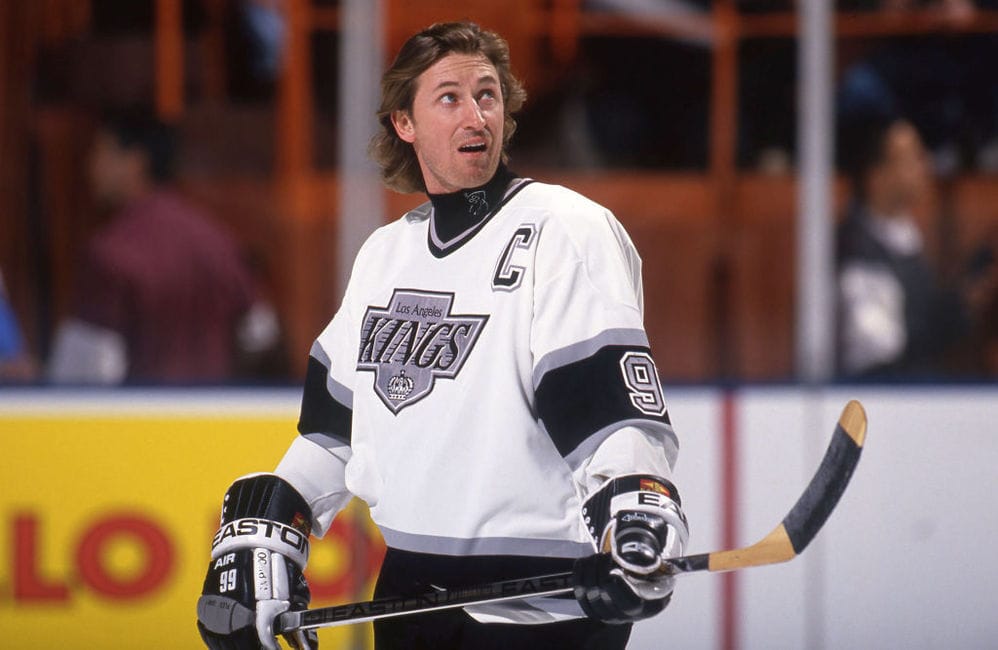
Following the trade of Bernie Nicholls—who had recorded 75 points in 47 games—Gretzky settled into a new line alongside Tomas Sandström and Tony Granato, the latter acquired as part of the Nicholls deal.
Los Angeles advanced past Calgary in the first round, ending a three‑year string of early exits. The Kings’ postseason run concluded in the second round, however, as the Oilers swept them en route to capturing the franchise’s sole Stanley Cup. Gretzky contributed 10 points across seven playoff contests, while his linemates Granato and Sandström each posted nine points in ten games.
1990-91 Season
Gretzky recorded 41 goals and 122 assists for 163 points, a performance that earned him both the Art Ross Trophy (league leader in points) and the Lady Byng Trophy for sportsmanship, having accumulated just 16 penalty minutes. He remained on the same line with Tony Granato and Tomas Sandström, whose physicality complemented the scoring attack; Sandström posted a career‑high 89 points while Granato contributed 64. Los Angeles dispatched Vancouver in six games in the opening round but fell again to Edmonton in the second round. Gretzky posted 15 points in 12 playoff games.
1991-92 Season
Gretzky’s 1991‑92 campaign marked the first time in his career that he tallied fewer than 137 points, though he still posted 121 points—led by a league‑high 90 assists—and captured another Lady Byng Trophy, having incurred only 34 penalty minutes. His line comprised Sandström, Granato and newly acquired Jari Kurri, a forward signed by the Kings during the off‑season (Los Angeles Times, May 31, 1991).
At the trade deadline, the Kings added Paul Coffey—another of Gretzky’s former Oilers teammates and an all‑time great defenseman—through a three‑team transaction (Los Angeles Times, February 20, 1992).
Los Angeles finished second in the Campbell Conference and faced the third‑seeded Oilers in the first round. The series featured a memorable performance from Bernie Nicholls, who contributed 13 points for Edmonton as they dispatched their former teammate. Gretzky, Coffey and Robitaille each led the Kings with seven points in the six‑game loss.
1992-93 Season
The 1992‑93 season stands out as the Kings’ most successful campaign with Gretzky, highlighted by a deep playoff run despite a third‑place finish in the Campbell Conference. Though limited by injury, Gretzky still posted 65 points in 45 games, playing on a line with Luc Robitaille and Jari Kurri. Kurri contributed 87 points, while Robitaille enjoyed career‑high numbers of 63 goals, 62 assists and 125 points.
Los Angeles opened the playoffs against Calgary, with their high‑octane offense firing on all cylinders; the Kings scored nine goals in both Game 5 and Game 6. After a collision with Joel Otto, the Kings shifted to a physically oriented line featuring Warren Rychel and Tomas Sanderson. According to the Chicago Tribune (May 23, 1993), Gretzky, Rychel and Sanderson were the Kings’ top three point producers in the series.
The Kings next toppled the Vancouver Canucks in six games, with Gretzky leading the charge and posting 13 points across the series while rotating through various linemates.
Los Angeles faced the Toronto Maple Leafs in a seven‑game Western Conference final. After splitting the first four contests, Toronto took a 3‑2 series lead with an overtime victory in Game 5. In Game 6, a missed high‑stick on Doug Gilmour by Gretzky went unnoticed, but the Kings rallied when Gretzky scored the overtime winner to force a deciding Game 7. In that final game, Gretzky recorded a natural hat trick plus an assist, propelling the Kings to a 5‑4 triumph and a berth in the Stanley Cup Final.

The postseason culminated in the Stanley Cup Final, where the Kings were swept by the Montreal Canadiens in six games. Patrick Roy’s remarkable .929 save percentage earned him the Conn Smythe Trophy, a rare achievement for a goaltender in the 1990s. Despite the defeat, Gretzky’s play shined, as he led the playoffs in goals (15) and points (40) and tied for the most assists (25) with Doug Gilmour.
The Dark Days, 1993-96
Gretzky’s final three seasons in Los Angeles were marked by consistent playoff misses. In the 1993‑94 campaign, the Kings posted a disappointing 27‑45‑12 record, yet Gretzky captured the final Art Ross Trophy of his career with 130 points—led by a league‑high 92 assists—and secured the Lady Byng Trophy after accumulating only 20 penalty minutes. He also broke Gordie Howe’s goal record on March 23, 1994, scoring his 802nd goal while mainly playing on a line with Kurri and Robitaille.
During the 1994‑95 lockout‑shortened season, Gretzky recorded 48 points in 48 games, helping the Kings to a 16‑23‑9 record. Los Angeles missed the playoffs by a single point, and Gretzky’s line‑up remained fluid, often featuring winger Rick Tocchet (now the Canucks’ head coach) alongside Jari Kurri.
In his final season with the franchise (1995‑96), Gretzky posted 81 points in 62 games, primarily partnering with Dmitri Khristich and rookie Vitali Yachmenev. On February 27, 1996, he was traded to the St. Louis Blues in exchange for a first‑round selection, Roman Vopat, Craig Johnson, Patrice Tardif and a fifth‑round pick in 1996.
Gretzky’s Time in LA Was Very Important
Gretzky’s tenure in Los Angeles, while ultimately limited by the Kings’ inability to capture a Stanley Cup, left an indelible mark on the franchise and the broader hockey landscape. His arrival sparked a surge in ticket sales and helped usher in an era that would see two additional California NHL clubs—the Mighty Ducks of Anaheim and the San Jose Sharks—enter the league. Over seven seasons, he amassed multiple individual honors, including three Art Ross Trophies and several Lady Byng awards, and guided the Kings to their first Stanley Cup Final appearance in 1993. Though his overall success in LA paled in comparison to his Edmonton years, Gretzky’s impact on California’s hockey culture and his personal achievements cemented his legacy as one of the sport’s most transformative figures.