






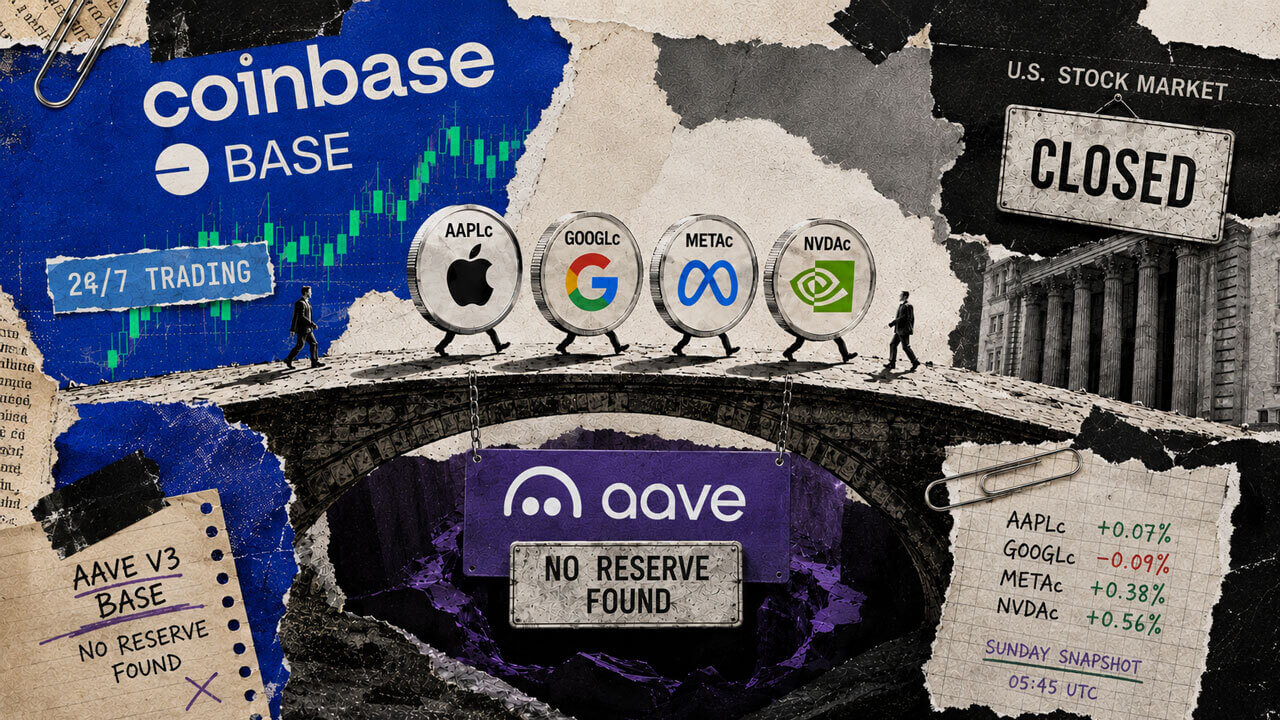
Coinbase’s new B20 stock tokens on Base bring Apple, Alphabet, Meta and Nvidia exposure onto a blockchain that continues trading even when traditional markets are closed.
The tokens—AAPLc, GOOGLc, METAc and NVDAc—represent beneficial claims on the underlying shares held in Coinbase’s tokenization framework, targeting eligible non‑U.S. investors and differing from standard U.S.-listed equity.
Coinbase highlights continuous secondary tradability, whereas Base markets the tokens as DeFi building blocks, citing a borrowing example where tokenized Nvidia exposure could serve as collateral on Aave—a scenario that raises risk concerns when the token trades while the underlying equity market is shut.
A Sunday audit of the official Aave V3 Base address book revealed no reserves for any of the four tokens. Consequently, the weekend showed that secondary‑market prices could be observed, but there was no verifiable live B20 lending market to assess.
Between 05:45 and 05:47 UTC on August 30, the four largest Aerodrome USDC pools stayed within about 0.6 % of the Chainlink reference values last updated on Friday. Those reference points offer a snapshot of weekend token pricing relative to the most recent equity‑linked data, but they do not reflect a continuously updated view of the underlying shares.
Coinbase stock tokens held close to Friday reference values
Coinbase stock tokens decouple ongoing trading from the operational mechanisms that back them. According to Coinbase, primary minting and redemption are performed by KYC‑verified institutional partners and authorized participants. Once issued, Base permits the tokens to move freely between wallets and be traded via always‑on automated market makers, allowing exposure to be bought or sold even when the U.S. equity market is closed.
A snapshot of the top Aerodrome pools at 05:45 UTC revealed roughly $6.07 million of displayed liquidity and $7.08 million of 24‑hour trading volume. While DEX Screener reports pool liquidity and volume for its live feed, displayed liquidity serves only as an approximate depth gauge and does not guarantee that a trade of any given size will execute at the quoted price.
At 05:47 UTC, the four official Chainlink feed proxies showed Friday update timestamps—17:01:55 UTC for AAPL, 15:59:21 UTC for GOOGL, 19:10:19 UTC for META and 18:50:11 UTC for NVDA. Comparing these stored values with DEX Screener’s rounded dollar prices yields the following Sunday snapshot:
TokenDEX priceHeld Chainlink valueDEX gapDisplayed liquidity24h volumeAAPLc$320.52$320.30500+0.067%$1.50 million$1.84 millionGOOGLc$346.42$346.73345-0.090%$1.41 million$1.70 millionMETAc$579.76$577.54070+0.384%$1.13 million$1.38 millionNVDAc$218.98$217.76905+0.556%$2.03 million$2.16 million
All four deviations remained under 0.6 % at the cutoff, indicating that the observed prices reflect a stale reference rather than a firm peg, an issuer‑solvency test, or a guaranteed arbitrage opportunity. Prices, trading volume and pool balances may shift after the timestamp, and the comparison does not reveal the execution price attainable for a sizable order.
Nevertheless, the narrow gaps are informative. Weekend traders gravitated toward prices near the held equity references, even without fresh primary‑market pricing, which contained the initial measured dislocation. The significance for collateral hinges on how a lending protocol handles situations where its reference feed ceases to update.


A callable oracle can still carry a held price
According to Base’s B20 integration guide, the launch assets rely on Chainlink’s 24/5 total‑return feeds, which compute each value from the underlying equity price multiplied by a factor, rather than from the token’s DEX price. On weekends and holidays the feed freezes at the last value and stops updating its timestamp—a behavior confirmed by the Friday timestamps observed on Sunday.
The weekend behavior mirrors the feed’s schedule and should not be confused with an oracle outage. Chainlink’s equity‑stream documentation notes extended market coverage and provides market‑status data, while Base advises integrators to check the updatedAt field, apply staleness limits, and refrain from settling or liquidating positions based on stale values. Although data delivery supplies the necessary inputs, the ultimate decision on whether collateral can be deposited, borrowed against or liquidated rests with the application’s smart‑contract logic.
This distinction matters when the DEX market fluctuates while the reference feed is frozen. A sudden increase in token price would not automatically propagate to a feed derived from the held equity value, and a sharp drop would need explicit handling to prevent a lending protocol from relying on outdated data for liquidation decisions.
Because Sunday prices stayed sufficiently close to the references, this hypothetical pressure did not manifest in the measured pools, although the schedule discrepancy persisted for approximately 35 to 38 hours at the time of the snapshot.
Coinbase’s public documentation restricts primary creation and redemption to KYC‑cleared institutional partners and authorized participants. The NVDA prospectus additionally grants a “Vested Holder” a redemption right, contingent on following prescribed instructions, passing compliance checks, and meeting operational requirements.
The prospectus does not impose an outright weekend prohibition on placing orders. It defines a business day as excluding Saturdays, Sundays and holidays, and stipulates that cash or stablecoin settlement requires the issuer to sell the underlying shares after validating a request. The terms also permit rejection, delay, suspension or modification under certain conditions, meaning that the underlying sale and settlement process cannot be relied upon to deliver instant weekend arbitrage, even though the token continues to trade.
For Coinbase stock tokens, the essential 48‑hour gap lies in the fact that the on‑chain secondary market stays open, the equity‑linked feed adheres to a 24/5 schedule, and the execution and settlement of the underlying shares continue to depend on business‑day operations. A narrow Sunday spread lessens the observed dislocation at a given moment, but the differing operational clocks persist.
Aave collateral controls remain prospective
The official Aave V3 Base address book showed no reserve, aToken, variable‑debt token or Aave oracle entry for AAPLc, GOOGLc, METAc or NVDAc at the time of the Sunday review. While this finding applies only to the official V3 deployment list and does not exclude every unrelated or unindexed contract elsewhere on Base, it constitutes the authoritative source for assessing whether the promoted Aave use case presently has active V3 reserve parameters.
The forward‑looking outlook indicates that work remains. An Aave governance proposal dated August 3 stated that the initial assets, oracle configuration, risk framework and deployment contracts for V4 on Base would be finalized and released at a later date. The proposal sets the direction, yet leaves the B20 asset list and its associated risk controls undetermined.
Consequently, no reliable live figures were on hand for a B20 loan‑to‑value ratio, liquidation threshold, supply cap, borrow cap or outstanding borrowing. Likewise, there was no verified Aave B20 liquidation history to gauge closed‑market behavior. Base’s mention of Aave reflects an integration objective; a functioning lending market would need deployed reserves and transparent parameters.
The eventual parameters will decide whether the timing mismatch can be turned into usable collateral infrastructure. A lending deployment would require explicit oracle‑freshness checks and a clear policy for deposits, borrowing and liquidations during periods when the reference feed is inactive. Conservative LTVs and liquidation thresholds could act as buffers, while supply and borrowing caps would limit exposure. None of these safeguards can be attributed to the four tokens until the corresponding contracts and settings are live in a verified market.
Nonetheless, the first weekend offers a useful baseline: four active Aerodrome pools recorded roughly $7.08 million in 24‑hour volume and remained within about 0.6 % of the Friday reference values at the timestamp. This demonstrates orderly secondary‑market pricing during a single closed‑market window. The caveats are equally clear—the reference feeds were still broadcasting Friday data, the prospectus retained business‑day dependencies for underlying share sales and settlement, and the promoted Aave collateral layer had no verified live reserve.
Coinbase has highlighted the market‑hours mismatch on‑chain. The definitive stress test will not commence until a lending platform publishes its B20 reserve configuration and users begin to borrow against the tokens. Until that point, the weekend’s data reflects only the DEX and oracle layers, with collateral safety contingent on future deployed controls.
Also Read
- Former White House Speech Operator Accused of Insider Trading on Prediction Markets, Faces $107,539 Disgorgement and Ban
- Bitcoin Hardware Wallet Interface Moves to Maintenance Mode as Successor Remains Unproven
- The Hidden Risk in Shadow Banking: How Insurance Companies Face Unforeseen Liquidity Threats
- Homebuyers Can Use Bitcoin for Down Payments Without Margin Calls, but Default Triggers Remain


