



The XRP Ledger (XRPL) has surpassed 5 billion validated transactions, although new data indicates that a growing share of network activity is being generated by a narrow group of accounts.
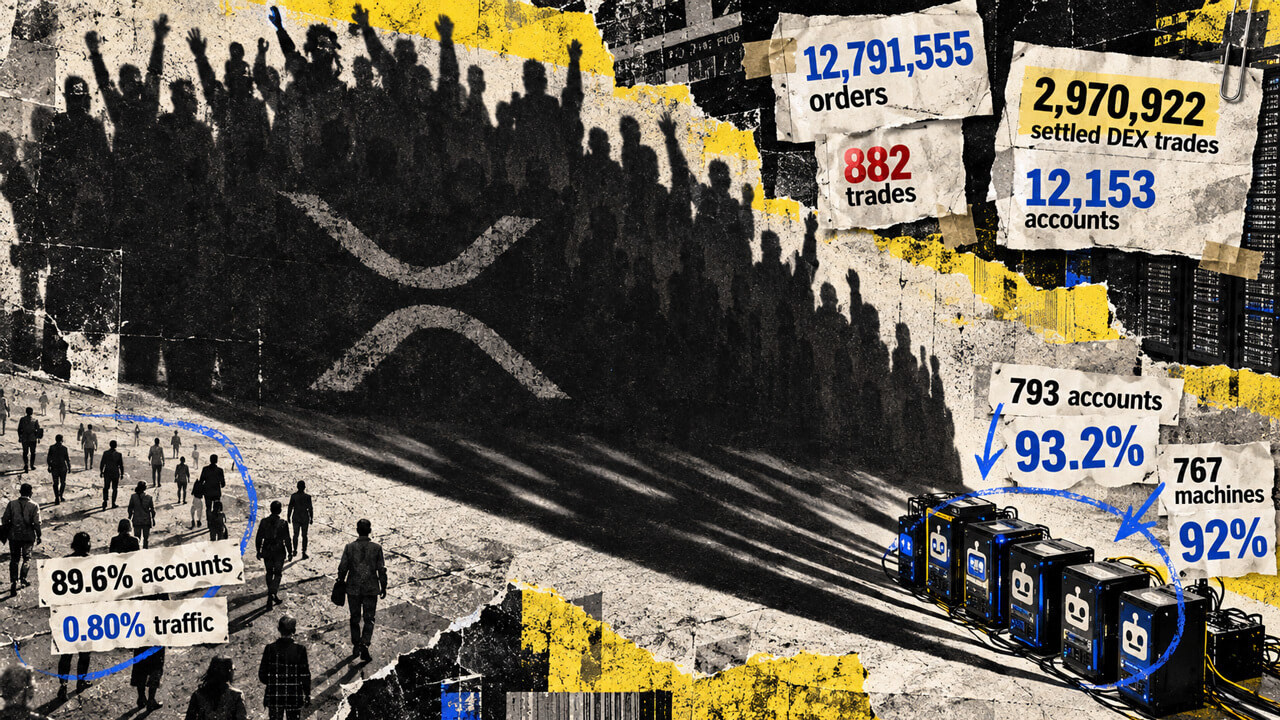
Bitquery found that 793 sender addresses accounted for 75.98 million of XRPL’s 81.56 million transactions in August, representing 93.2% of monthly throughput. It classified 767 of those addresses as machine-operated; together, they generated 92% of all transactions. Another 26 exchange hot wallets accounted for 1.1%.

The concentration is also visible in trading behavior. Evernorth Research reported that order-book volume increased 79% year over year in the second quarter, even as the number of accounts initiating those trades declined by roughly 40%.
Together, the datasets suggest that XRPL is processing more transactions through fewer participants. Evernorth cautioned, however, that some of the shift may reflect professional traders and institutions capturing a larger share of market flow rather than a simple decline in organic network use.
That distinction is important when assessing XRPL’s 5.06 billion validated-transaction milestone. The network is demonstrating substantial throughput, but the economic significance of that activity depends on whether machine-generated orders become payments, completed trades, or liquidity movements requiring meaningful XRP balances.
One address generated nearly 13 million transactions
At the account level, the gap between submitted activity and executed trading is especially clear.
Bitquery identified one address that produced nearly 13 million transactions in August, including 12.79 million orders on the decentralized exchange. Just 882 of those orders resulted in trades. The address alone represented roughly one-sixth of the ledger’s total activity during the month.
Across XRPL’s built-in decentralized exchange, Bitquery recorded 2.97 million settled trades initiated by 12,153 accounts in August. That figure was small relative to the more than 81 million transactions processed by the network during the same period.
Automation accounted for much of the broader total. Bots submitting decentralized-exchange orders generated 39.25 million transactions, or 48.1% of August traffic. Accounts sending dust also contributed 18.79 million transactions, while NFT-related automation, check spam, and other machine activity generated several million more.
Most addresses operated at the opposite end of the spectrum. Nearly half of the accounts active in August sent only one transaction, and four-fifths sent five or fewer. A lower-frequency filter that excluded dust-level transfers identified 89.6% of transacting accounts but captured just 0.8% of total network activity.
| August Metric | Bitquery Result | Interpretation |
|---|---|---|
| Top sender cohort | 793 accounts; 93.2% of transactions | Network activity was highly concentrated |
| Machine-classified accounts | 767 accounts; 92% of transactions | Automated categories dominated throughput |
| Lower-frequency, non-dust filter | 89.6% of accounts; 0.80% of traffic | Most accounts contributed little transaction volume |
| Settled built-in DEX trades | 2,970,922 trades from 12,153 accounts | Execution was far smaller than submitted activity |
These figures count addresses rather than unique people. One exchange wallet may serve thousands of customers, while a trading firm may control several addresses, limiting how directly account concentration translates into user concentration.
Fewer traders are handling larger XRP positions
Evernorth’s quarterly data shows that the shrinking cohort of trading accounts has coincided with larger transaction sizes and deeper balances.
During the second quarter, average order-book volume reached 3.57 million XRP per day, up 79% from a year earlier. The average number of accounts initiating trades fell from 1,864 per day to 1,111. As a result, average volume per initiating account rose to 3,217 XRP from 1,072.
On XRPL’s broader decentralized exchange, trading averaged 4.42 million XRP per day, approximately 20% higher year over year. Evernorth estimated that about 2,435 accounts traded each day, with fewer participants moving more value than in the previous year.
The trend gives the concentration data a more nuanced interpretation. Evernorth said it is consistent with professional flow gaining share as XRPL adds institution-oriented infrastructure, including permissioned domains and dedicated trading venues.
Capital held on the network also expanded. Average value on XRPL reached $4.26 billion during the quarter, the highest point in Evernorth’s six-quarter dataset. Average RLUSD balances rose 642% year over year to $539 million, while the value moving through the stablecoin increased 925%.
Broader participation weakened in parallel. The average number of accounts transacting each day fell to 16,587, while new account creation averaged 2,783; both measures were down roughly 25% from a year earlier.
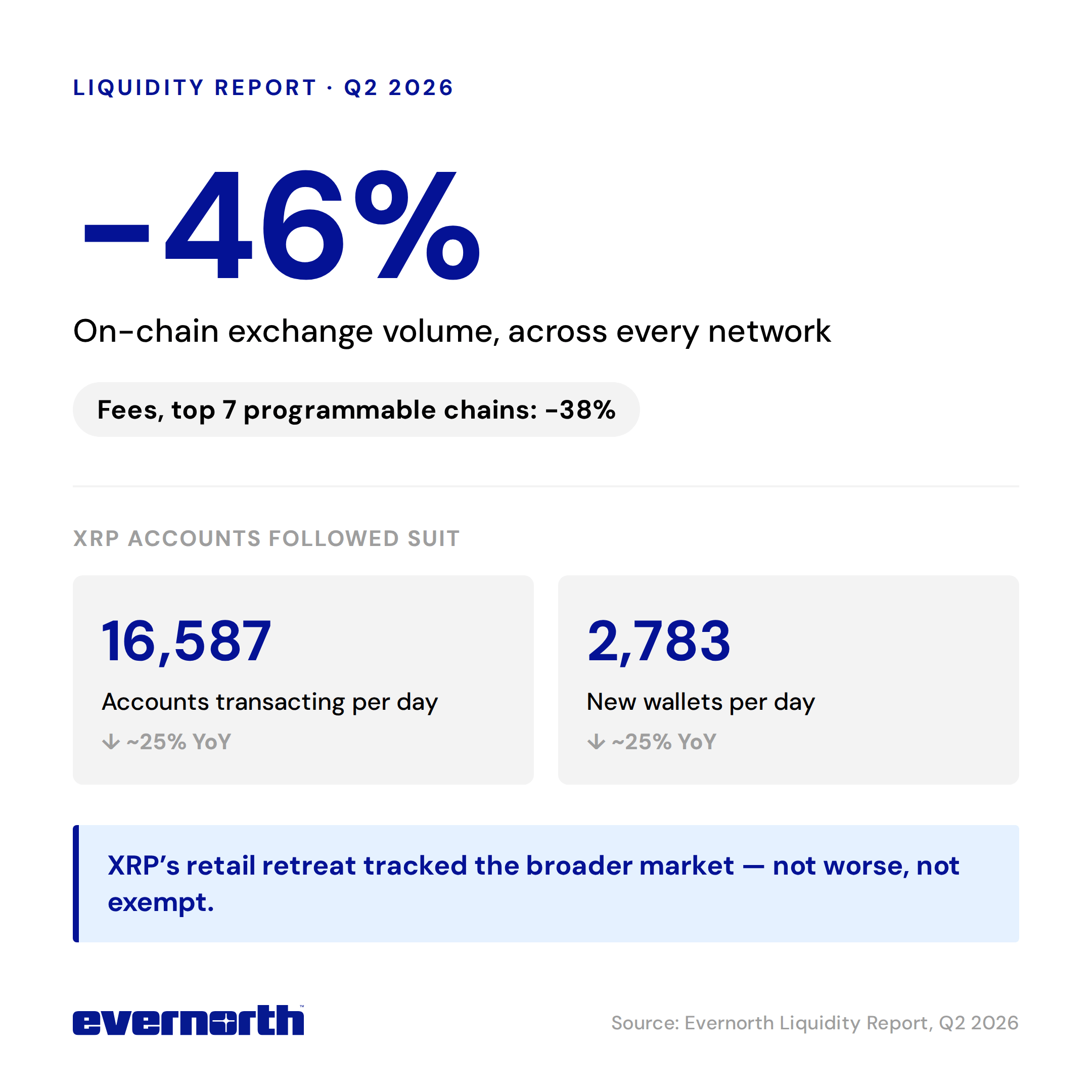
Evernorth said account counts are particularly sensitive to retail participation, which retreated across crypto markets during the quarter.
XRP liquidity matters more than raw transaction totals
For XRP, the key commercial question is increasingly where this growing pool of capital is actually being traded.
Evernorth’s figures include swaps involving XRP but exclude transactions between two non-XRP assets. Those excluded trades accounted for 18% of transactions and approximately 9% of value in the second quarter, highlighting how XRPL activity can grow without directly involving XRP.
That leaves exchanges, market makers, and token issuers with a more demanding test of adoption than headline transaction totals. Larger RLUSD balances and more professional trading can strengthen market liquidity, but the direct benefit to XRP depends on how frequently it is used as inventory, collateral, or a routing asset.
The coming quarters will show whether this concentration becomes a lasting feature of a more institutional market or remains primarily a reflection of automated traffic.
For firms allocating capital to XRPL, the most useful indicators will be sustained growth in settled trades, repeat participating accounts, and liquidity that continues to route through XRP.
Also Read
- Quantum Computing Decoded: The Existential Threat to Bitcoin
- Robinhood CEO Insists Tokenized Stocks Are Fully Backed by Underlying Assets
- Brent Surges to $106 Per Barrel as Hostilities in the Middle East Escalate Further
- Coinbase CEO Reaffirms $400,000 Bitcoin Target for 2030 as Downturn Bottoms Out